

Are tokenized real estate retirement portfolios the next big thing?
TL;DR — Tokenized Real Estate Retirement Portfolios
- Tokenized real estate allows fractional ownership of income-producing property using blockchain technology.
- For retirement portfolios, it offers diversification, lower entry costs, and access to global real estate markets.
- You generate income through rental distributions, not speculation.
- Liquidity is often limited and should not be assumed.
- Regulatory clarity, platform quality, and asset selection matter more than token mechanics.
- Tokenized real estate works best as a supplement, not a replacement, for traditional retirement assets.
Some links in this article may be affiliate links. If you choose to invest through them, we may earn a small commission at no extra cost to you.
Always do your own research before making any investment decisions.
Introduction: Retirement Investing Is Changing
Retirees no longer build their portfolios around a simple mix of stocks, bonds, and local property. With factors such as longer life expectancies, rising property prices, and global economic uncertainty, investors are looking for income-producing assets that offer diversification, flexibility, and global reach.
Tokenized real estate is emerging as one of the most discussed alternatives in this space. By combining traditional property with blockchain-based fractional ownership, it promises lower entry barriers, programmable income distribution, and access to global real estate markets that were previously out of reach for most long-term investors.
But what does tokenized real estate really mean for a retirement portfolio? And how does it compare to traditional property ownership, REITs, or private real estate funds?
This article explores the mechanics, benefits, risks, and real-world platforms shaping tokenized real estate today — with a clear focus on long-term retirement suitability, not short-term speculation.
What Is Tokenized Real Estate?
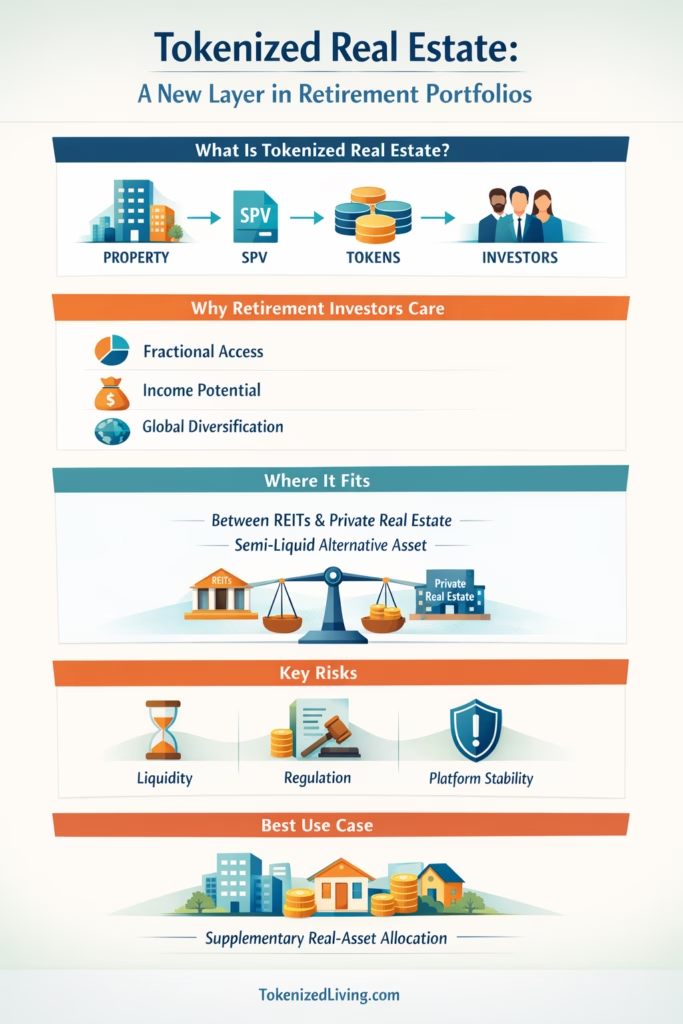
Tokenized real estate refers to real-world property assets that are legally structured and digitally represented by blockchain-based tokens. Each token represents a fractional economic interest in an underlying property or real estate entity.
In most cases:
- A property (or group of properties) is held inside a special purpose vehicle (SPV) or legal entity
- Digital tokens represent fractional ownership or income rights in that entity
- Rental income and other distributions are paid to token holders
- They record ownership transfers on a blockchain rather than traditional registries
Tokenization does not eliminate real estate fundamentals. Properties still generate income through rent, appreciate or depreciate, and require professional management. What changes is how ownership is structured, recorded, and transferred.
For retirement investors, this distinction is critical: tokenization is a delivery mechanism, not a replacement for property economics.
Why Investors Are Paying Attention Tokenized Real Estate Retirement Portfolios
Traditional real estate has long been a cornerstone of retirement planning. However, it comes with clear drawbacks:
- High capital requirements
- Illiquidity
- Geographic concentration
- Active management responsibilities
Tokenized real estate addresses several of these issues without removing exposure to property itself.
1. Fractional Ownership and Capital Efficiency
First, tokenization allows real estate to be divided into smaller investment units. Instead of committing large sums to a single property, investors can allocate smaller amounts across multiple assets.
For retirement portfolios, this enables:
- Broader diversification
- Reduced concentration risk
- Easier portfolio rebalancing over time
This is particularly relevant as investors approach retirement and want to fine-tune exposure without selling entire properties.
2. Income Generation Without Direct Management
Moreover, most tokenized real estate offerings focus on income-producing properties, such as residential rentals or commercial buildings.
Income is typically:
- Collected by a professional property manager
- Distributed automatically to token holders
- Paid on a regular schedule (weekly, monthly, or quarterly)
For retirement planning, predictable income streams are often more important than speculative appreciation. Tokenization allows investors to access rental income without becoming landlords.
3. Improved Liquidity — With Important Caveats
Additionally, one of the most discussed advantages of tokenized real estate is liquidity. In theory, digital tokens can be transferred more easily than entire properties.
In practice:
- Liquidity depends on the existence of secondary markets
- Many platforms operate internal marketplaces rather than open exchanges
- Holding periods and transfer restrictions are common
For retirement portfolios, this means tokenized real estate is more flexible than direct property ownership, but still less liquid than public REITs. It should be treated as a semi-liquid asset, not a cash equivalent.
4. Global Diversification
Tokenization allows investors to access real estate markets across multiple countries without navigating foreign property ownership laws directly.
From a retirement perspective, this offers:
- Geographic diversification
- Reduced dependence on local property cycles
- Exposure to different currencies and economic conditions
However, global access also introduces currency risk and cross-border tax considerations, which must be evaluated carefully.
How Tokenized Real Estate Fits Into a Retirement Portfolio
Tokenized real estate works best as part of a diversified real-asset allocation, rather than a replacement for core holdings.
Typical roles include:
- Income-focused sleeve alongside bonds or dividend stocks
- Alternative real-asset exposure alongside REITs
- Diversification away from local property markets
Because the sector is still evolving, most retirement-oriented strategies limit exposure to a modest percentage of total portfolio value.
Leading Tokenized Real Estate Platforms (2026 Snapshot)
Below, you can see an overview of the platforms most commonly discussed in long-term, income-focused tokenized real estate strategies.
RealT
- Focus: US residential rental properties
- Structure: Property-level LLCs with tokenized ownership
- Income: Regular rental distributions
- Key strength: Transparency and cash-flow orientation
- Retirement relevance: Strong income focus, limited liquidity, US-centric exposure

Lofty
- Focus: US rental properties
- Structure: Fractional tokens with daily income accounting
- Income: Frequent rental distributions
- Key strength: User experience and reinvestment tools
- Retirement relevance: Income-driven, but still subject to US regulatory and currency exposure
Blocksquare
- Focus: European real estate infrastructure and partnerships
- Structure: Regulated tokenization framework used by licensed operators
- Income: Depends on underlying asset strategy
- Key strength: Regulatory alignment and institutional orientation
- Retirement relevance: Long-term stability, lower liquidity expectations
Reental
- Focus: European residential real estate
- Structure: SPV-based tokenized ownership
- Income: Rental yield distributions
- Key strength: EU diversification and yield focus
- Retirement relevance: Complementary diversification outside US markets
BinaryX
- Focus: Blockchain-based asset tokenization and fractional ownership infrastructure
- Structure: Tokenized asset framework enabling fractional exposure to real-world and digital assets
- Income model: Asset-dependent; varies by underlying structure and partner implementation
- Key strength: Flexible tokenization model designed to support fractional ownership use cases
- Retirement relevance: Early-stage exposure to tokenized asset infrastructure rather than pure income real estate
Summary:
BinaryX operates at the infrastructure layer of tokenization, enabling fractional ownership models that can be applied to real-world assets, including property. While not positioned as a traditional income-focused real estate platform, it represents a broader tokenization approach that may appeal to investors seeking early exposure to evolving real-asset tokenization ecosystems. As with all emerging platforms, suitability for retirement portfolios depends on asset structure, liquidity terms, and regulatory clarity.
Key Risks Retirement Investors Must Understand
Tokenized real estate offers genuine innovation, but it is not without its risks.
Platform and Operational Risk
Investors rely on:
- Platform solvency
- Smart contract security
- Custody and compliance infrastructure
A strong legal structure matters more than blockchain branding.
Liquidity Risk
Many tokenized real estate investments:
- Have limited secondary markets
- Enforce minimum holding periods
- Depend on internal trading systems
As a consequence, retirement portfolios should assume longer holding horizons.
Regulatory and Tax Risk
Tokenized real estate sits at the intersection of:
- Securities law
- Property law
- Digital asset regulation
Tax treatment varies by jurisdiction and may evolve. Therefore, retirement strategies must prioritize clarity over yield.
Market Risk Remains
Tokenization does not eliminate:
- Vacancy risk
- Property market downturns
- Interest-rate sensitivity
It simply changes how exposure is accessed.
Tokenized Real Estate vs Traditional Alternatives
| Asset Type | Liquidity | Income Potential | Complexity | Retirement Fit |
|---|---|---|---|---|
| Physical Property | Low | High | High | Medium |
| REITs | High | Medium | Low | High |
| Private Real Estate Funds | Very Low | Medium–High | Medium | Medium |
| Tokenized Real Estate | Low–Medium | Medium–High | Medium | Medium–High |
Tokenized real estate sits between private funds and REITs, offering greater flexibility than traditional property, whilst requiring more due diligence than public markets.
Is Tokenized Real Estate Ready for Retirement Portfolios?
Tokenised real estate is no longer a speculative experiment, but it has not yet become a mainstream retirement default.
Its strongest use cases today include:
- Supplementing income-oriented portfolios
- Enhancing real-asset diversification
- Reducing capital barriers to global property markets
Consequently, for retirement investors, you need measured adoption: focusing on quality assets, conservative assumptions, and realistic liquidity expectations.
Final Thoughts
Tokenized real estate represents a significant shift in the structure of property ownership and income distribution. For a tokenized real estate retirement portfolio, its value lies in access, efficiency, and diversification, not in replacing proven long-term strategies.
Finally, as regulations mature and secondary markets improve, tokenized real estate may become a standard component of retirement planning. For now, it remains an evolving but promising addition — best used thoughtfully, alongside traditional assets, rather than instead of them.
Tokenized Real Estate vs REITs vs Direct Property (Retirement Comparison)
Tokenized Real Estate
REITs
Direct Property
Notes: This is an educational comparison. Liquidity, FX, and one-off transaction costs vary widely by country and platform.
Frequently Asked Questions
Is tokenized real estate suitable for retirement investing?
Tokenized real estate can complement retirement portfolios by providing income and diversification. However, it should not replace core assets such as equities, bonds, or pensions.
How is tokenized real estate different from REITs?
The public can trade highly liquid REITs. Tokenized real estate usually represents fractional ownership in specific properties and is less liquid but may offer higher transparency at the asset level.
Does tokenized real estate generate passive income?
Most platforms distribute rental income generated by the underlying property. Distribution frequency varies by platform and asset structure.
Is tokenized real estate liquid?
Liquidity depends on secondary markets and platform rules. Many investments require long holding periods, making them semi-liquid rather than easily tradable.
What risks should retirement investors consider?
Key risks include platform risk, regulatory uncertainty, limited liquidity, currency exposure, and traditional real estate market risks.
Is tokenized real estate regulated?
Regulation varies by jurisdiction. Some platforms operate under securities frameworks, while others rely on property-specific legal structures.
Can tokenized real estate replace owning property?
No. It offers exposure to real estate without direct ownership responsibilities but does not remove market or income risks.
We use AI tools to enhance research and drafting, always under human supervision.
Pingback: Tokenized real estate for younger generations: A Path to Property Ownership - Tokenized living
Pingback: Why Tokenize Your Assets in 2026? For Investors and Companies - Tokenized living
Pingback: Detroit vs Realt Lawsuit: What’s Happening? (2026 Deep Dive) - Tokenized living
Pingback: The Complete Guide to Tokenized Real Estate - Tokenized living