

TL;DR
Fractional ownership means several people share ownership or financial rights in one asset.
Instead of buying the whole asset, each investor buys a fraction.
That asset might be real estate, art, luxury goods, private companies, farmland, music rights, or even shares of expensive stocks.
The idea sounds simple.
But the structure matters.
You need to know what you own, how income gets paid, who manages the asset, how fees work, and whether you can sell your share later.
Fractional ownership can open access to expensive assets.
It can also create legal, liquidity, and management risks that beginners often miss.
What Is Fractional Ownership?
Fractional ownership is a model where more than one person owns or holds rights to part of an asset.
Instead of one buyer paying for the whole asset, several investors each buy a smaller share.
A simple example is a $500,000 property.
One person may not want to buy the whole property.
So the property is split into smaller ownership interests.
One investor might own 1%.
Another might own 5%.
A larger investor might own 20%.
Each person gets exposure based on their share.
That share may give them access to income, future sale proceeds, voting rights, usage rights, or another financial benefit.
It depends on the structure.
That last sentence matters.
Fractional ownership is not one single model.
It is a broad idea.
The details change depending on the asset, platform, legal documents, and investor agreement.
Fractional Ownership in Simple Terms
Think of fractional ownership like sharing a pizza.
One person does not buy the whole pizza.
Several people buy slices.
Each person gets a portion based on what they paid for.
That is the basic idea.
But investing is not pizza.
With real assets, you also need rules.
Who owns the asset legally?
Who manages it?
Who pays expenses?
Who receives income?
Who decides when to sell?
What happens if one investor wants to exit?
These questions turn a simple idea into a serious investment structure.
That is why beginners should never stop at the phrase “own a share.”
They need to understand what that share actually means.
Fractional Ownership vs Tokenization
Fractional ownership and tokenization are connected, but they are not the same thing.
Fractional ownership describes the split.
Tokenization describes the digital format.
You can have fractional ownership without blockchain.
For example, a group of investors can buy shares in a company that owns a property. That can happen with normal legal documents and no tokens at all.
You can also have tokenization without true ownership.
A token might represent access rights, income rights, debt exposure, or a contractual claim.
So the difference is simple:
Fractional ownership means the asset or rights are divided.
Tokenization means those rights are represented digitally on a blockchain.
When both ideas come together, investors may buy digital tokens linked to part of a real-world asset.
That is why fractional ownership matters so much in tokenized real estate and RWAs.
How Fractional Ownership Works
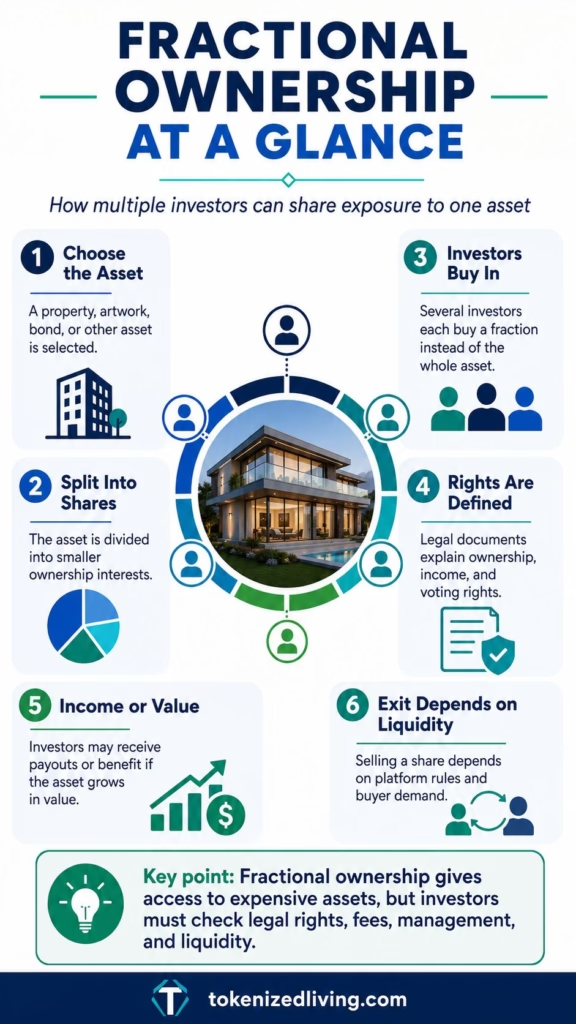
Fractional ownership usually follows a basic process.
First, an asset is selected.
That asset could be a property, artwork, private business, loan, bond, or luxury item.
Next, a legal structure is created.
This structure defines who owns the asset and what each investor receives.
Then the asset is divided into smaller interests.
Investors buy those interests through a platform, company, fund, or offering.
After that, the asset still needs management.
If the asset produces income, investors may receive a share after costs and fees.
If the asset sells later, investors may receive a share of the proceeds.
That is the clean version.
The messy version depends on the fine print.
Some investors get equity.
Others get debt exposure.
Some get revenue rights.
Others get usage rights.
Some get no control at all.
That is why the documents matter more than the headline.
A Simple Real Estate Example
Imagine a property worth $400,000.
A platform places the property into a company.
Then it divides the economic rights into 40,000 shares or tokens.
Each unit costs $10.
An investor buys 100 units for $1,000.
That investor now has exposure to 0.25% of the structure.
If the property generates net cash flow, the investor may receive payments based on that share.
If the property sells in the future, the investor may receive part of the sale proceeds.
But that depends on the agreement.
The investor may not own the deed directly.
They may own shares in a company that owns the property.
Or they may hold tokens linked to income rights.
Or they may hold debt linked to the asset.
Those are different positions.
Beginners must not treat them as the same.
What Can Use Fractional Ownership?
Fractional ownership can apply to many asset types.
| Asset Type | What Investors May Buy | Main Risk to Check |
|---|---|---|
| Real estate | Shares, tokens, or interests linked to property | Legal ownership and liquidity |
| Art | A share of a high-value artwork | Valuation and sale timing |
| Luxury goods | Exposure to watches, cars, wine, or collectibles | Storage, insurance, and demand |
| Stocks | Fractional shares of public companies | Broker rules and voting rights |
| Private credit | A slice of a loan or credit pool | Borrower default risk |
| Music rights | A share of royalty income | Rights structure and revenue source |
| Farmland | Exposure to land or agricultural income | Weather, management, and commodity risk |
| Bonds | A portion of debt exposure | Issuer credit risk |
Real estate gets the most attention because property is easy to understand.
But fractional ownership is much wider than property.
It is becoming common across alternative assets, digital platforms, and tokenized finance.
That does not mean every opportunity is good.
It means access has improved.
Quality still varies.
Why Investors Like Fractional Ownership
The main attraction is access.
Many assets are too expensive for one small investor.
Property, art, private funds, and high-value collectibles often require large amounts of capital.
Fractional ownership lowers the minimum ticket size.
That allows investors to spread money across different assets instead of putting everything into one purchase.
For example, someone might prefer smaller exposure to five properties rather than full exposure to one.
That can reduce concentration risk.
It can also help beginners learn without committing huge capital.
However, lower ticket size can also create lazy behavior.
People sometimes skip research because the investment feels small.
That is a terrible habit.
A weak investment is still weak at $50.
Diversification: Useful, But Not Magic
Fractional ownership can help investors diversify.
Instead of buying one asset, investors may spread money across several assets, sectors, or locations.
That can be useful.
A real estate investor might hold exposure to apartments, commercial property, and short-term rental assets.
An alternative asset investor might mix property, bonds, gold, art, and private credit.
But diversification does not remove risk.
If all the assets sit on weak platforms, the investor still has platform risk.
If all the assets are illiquid, the investor still has exit risk.
If all the assets depend on optimistic valuations, the investor still has pricing risk.
Diversification works only when the underlying assets and structures make sense.
Buying ten bad deals is not diversification.
It is just spreading mistakes around.
Income and Payouts
Some fractional ownership models pay income.
Real estate may produce net property cash flow.
Bonds may pay interest.
Private credit may generate loan repayments.
Music rights may generate royalties.
Farmland may generate income from leases or crop production.
But income is never automatic.
Investors need to know where the money comes from.
They also need to know what gets deducted before payouts.
For real estate, gross rent is not investor income.
Expenses may include property management, repairs, insurance, taxes, vacancy reserves, legal costs, platform fees, and maintenance.
Only after those costs are handled can investors receive distributions.
So do not ask only, “What is the yield?”
Ask:
What costs come out before I get paid?
That is the question serious investors ask.
Who Manages the Asset?
Fractional ownership does not remove management.
Someone still needs to manage the asset.
For real estate, that may mean tenants, repairs, rent collection, inspections, and insurance.
For art, it may mean storage, insurance, authentication, and eventual sale.
For luxury goods, it may mean custody, condition reports, and resale strategy.
For private credit, it may mean borrower monitoring and collections.
This is one of the most overlooked risks.
Investors may own only a small fraction, but poor management can hurt the whole asset.
That is why the manager matters.
A good asset in bad hands can become a bad investment.
Beginners should check who manages the asset, how they get paid, and what track record they have.
Legal Ownership: The Part Beginners Miss
The phrase “fractional ownership” sounds clear.
Often, it is not.
You may not directly own the asset.
Instead, you may own shares in a company, tokens linked to a legal entity, fund units, debt notes, or contractual rights.
That does not automatically make the product bad.
But it does mean you need to understand the structure.
Ask these questions before investing:
- Who legally owns the asset?
- What exactly do investors own?
- Are investors equity holders, lenders, members, or contract holders?
- What rights exist if the platform fails?
- Can investors vote on major decisions?
- What happens if the asset sells?
- Which country’s laws apply?
If a platform cannot answer these questions clearly, do not give it your money.
Confusion is not a feature.
It is a risk.
Liquidity: Can You Sell Your Share?
Liquidity is one of the biggest problems in fractional ownership.
Some platforms suggest that buying a small share makes an asset easier to sell.
Sometimes that is true.
Often, it is not.
A fractional share still needs a buyer.
If no buyer exists, you may be stuck.
This is especially important with real estate, art, collectibles, private credit, and tokenized RWAs.
A platform may offer a secondary marketplace.
That marketplace may still have low activity.
So check real trading data.
Look at volume, buyer demand, pricing spreads, transfer rules, and withdrawal limits.
Do not confuse a marketplace button with real liquidity.
That mistake costs people money.
Fractional Ownership and Tokenized Real Estate
Tokenized real estate often uses fractional ownership.
A property or portfolio is placed into a legal structure.
Then investors buy tokens linked to that structure.
Those tokens may represent equity, income rights, debt, or another financial interest.
The benefit is smaller access to property exposure.
The risk is misunderstanding what the token represents.
A tokenized property investment may look simple on the front end.
Behind the scenes, there may be legal entities, management agreements, smart contracts, fees, tax rules, and transfer restrictions.
This does not make it bad.
It makes it serious.
A beginner should not buy just because the platform looks easy.
Easy access does not equal low risk.

Fractional Ownership and RWAs
RWAs stands for real-world assets.
These are assets from outside crypto that are represented or managed through blockchain-based systems.
Examples include real estate, bonds, private credit, gold, commodities, and fund interests.
Fractional ownership fits naturally into the RWA market.
That is because many RWAs are expensive, illiquid, or difficult to access.
Tokenization can divide those assets into smaller units.
Blockchain can help track ownership records and transfers.
But again, the token is only part of the story.
The asset, legal structure, custody, reporting, and marketplace all matter.
In RWA investing, fractional ownership is useful only when the real-world structure is solid.
Otherwise, it becomes a polished wrapper around a weak deal.
Benefits of Fractional Ownership
Fractional ownership can offer real benefits.
It can make expensive assets more accessible.
It can help investors diversify across several assets.
It can reduce the need to manage an entire asset alone.
It can give investors exposure to markets that were once hard to reach.
It can also support newer investment models, especially when combined with tokenization.
For investors who understand the risks, that is useful.
But beginners should not treat fractional ownership as a shortcut to wealth.
It is a structure.
Not a guarantee.
Risks of Fractional Ownership
Fractional ownership also carries real risks.
The asset may fall in value.
Income may be lower than expected.
Fees may reduce returns.
The manager may perform badly.
The platform may fail.
The legal structure may limit investor rights.
The secondary market may be weak.
Selling may take longer than expected.
Valuations may be optimistic.
Some investors may also misunderstand taxes.
That list is not there to scare people.
It is there because most weak investment decisions start with ignoring boring details.
The boring details are where the truth sits.
Fractional Ownership vs Timeshares
Fractional ownership is sometimes confused with timeshares.
They are not the same thing.
A timeshare usually gives usage rights for a property during a certain period.
For example, someone might use a holiday property for one week each year.
Fractional ownership may involve actual ownership or financial rights in an asset.
That asset may produce income or appreciate in value.
However, the distinction depends on the contract.
Some products use friendly wording to make usage rights sound like investment ownership.
Be careful with that.
Check whether you are buying usage, income rights, equity, debt, or something else.
Words matter less than documents.
Fractional Shares vs Fractional Ownership
Fractional shares are a familiar example.
Many brokers allow investors to buy part of a public company share.
For example, someone might buy $50 worth of a stock instead of one full share.
That is a simple form of fractional investing.
However, fractional ownership of alternative assets can be more complex.
A fractional stock position usually sits inside a regulated brokerage system.
A fractional property, artwork, or private asset may involve different structures, restrictions, and risks.
So do not assume all fractional investing works the same way.
Buying part of an Apple share is very different from buying part of a rental property structure.
The phrase may be similar.
The risk profile is not.
What Beginners Should Check First
Before investing in any fractional ownership product, check these points.
1. What exactly am I buying?
Do not accept vague answers.
Find out whether you are buying equity, debt, income rights, usage rights, fund units, tokens, or shares in a company.
2. Who owns the asset legally?
This is critical.
If you do not know who owns the asset, you do not understand the investment.
3. How is the asset valued?
Check whether the valuation comes from an independent appraisal, market data, internal estimates, or optimistic projections.
4. Who manages the asset?
The manager can make or break the investment.
Look for experience, transparency, reporting quality, and incentives.
5. How do investors get paid?
Check the income source, payment schedule, deductions, reserves, and platform fees.
6. Can I sell my share?
Check whether there is a secondary market, redemption option, lock-up period, or transfer restriction.
7. What happens if the platform fails?
This is the stress-test question.
If the platform disappears, do investors still have enforceable rights?
If the answer is unclear, walk away.
A Quick Beginner Checklist
| Question | Why It Matters |
| What do I own? | Defines your legal and financial rights |
| Who owns the asset? | Shows whether the structure is real |
| Who manages it? | Poor management can destroy returns |
| How are payouts calculated? | Gross income is not investor income |
| What fees apply? | Fees can eat projected returns |
| Can I sell? | Illiquid assets can trap investors |
| What happens if things go wrong? | Weak structures fail under stress |
Common Myths About Fractional Ownership
Myth 1: Fractional ownership always means direct ownership
No.
It may mean shares, tokens, membership interests, debt, income rights, or contractual claims.
Myth 2: Smaller investments are always safer
No.
The amount invested may be smaller, but the structure can still be risky.
Myth 3: Fractional assets are easy to sell
Not always.
Many fractional assets have limited buyers and weak secondary markets.
Myth 4: Passive income is guaranteed
No.
Income depends on the asset, costs, management, demand, and market conditions.
Myth 5: Tokenization fixes everything
No.
Tokenization can improve records and transfers.
It does not fix bad assets, weak legal rights, or poor management.
Final Thoughts
So, what is fractional ownership?
It is a way for several investors to share exposure to one asset.
That can make expensive markets easier to access.
It can also help investors spread capital across different assets.
But the basic idea is not enough.
You need to know what you own.
You need to know who controls the asset.
You need to know how income works.
You need to know whether you can sell.
You need to know what happens if the platform fails.
Fractional ownership can be useful.
It can also be badly explained.
That is the danger.
The best investors do not stop at “own a share.”
They ask what that share really means.
That is the difference between access and understanding.
FAQs
What is fractional ownership in simple terms?
Fractional ownership means several people share ownership or financial rights in one asset. Each investor owns or holds a smaller part instead of buying the whole asset.
Is fractional ownership the same as tokenization?
No. Fractional ownership means the asset or rights are divided. Tokenization means those rights are represented digitally on a blockchain.
Can you make money from fractional ownership?
Yes, but it depends on the asset and structure. Investors may earn income, sale proceeds, interest, royalties, or capital gains. None of these are guaranteed.
Do fractional owners control the asset?
Not always. Some structures give voting rights. Others give little or no control. The legal documents define investor rights.
Is fractional ownership risky?
Yes. Risks include poor management, weak liquidity, platform failure, legal uncertainty, falling asset values, and lower-than-expected income.
Can fractional ownership apply to real estate?
Yes. Real estate is one of the most common examples. Investors may buy shares, tokens, or interests linked to a property structure.
Is fractional ownership good for beginners?
It can be useful, but only if beginners understand the structure. Smaller investment amounts should not replace proper research.
What should I check before investing?
Check what you own, who owns the asset, who manages it, how payouts work, what fees apply, whether you can sell, and what happens if the platform fails.