
Governments, airlines and major corporations now include tokenized carbon credits in their climate strategies. As these markets expand, many organizations want faster and clearer ways to issue, track, transfer and retire credits.
Tokenized carbon credits attempt to provide that infrastructure.
The basic idea sounds simple. A platform links a verified carbon credit to a digital token on a blockchain. Buyers can then hold, transfer or retire the token through a digital system.
However, blockchain only records information.
It cannot prove that a forest remains protected, that households use clean cookstoves or that a project genuinely removed carbon dioxide from the atmosphere.
That distinction matters.
Tokenization may improve the infrastructure surrounding carbon credits. It cannot improve the environmental quality of a weak project.
TL;DR
- One carbon credit generally represents one metric tonne of carbon dioxide equivalent.
- Tokenization links a carbon credit to a digital token on a blockchain.
- A recognized registry should continue to track the original credit.
- Companies may buy, transfer and retire tokenized credits.
- Governments need digital systems to monitor international carbon transfers.
- Blockchain may improve settlement, traceability and access to project data.
- Poor project quality, double counting and greenwashing remain serious risks.
- The project, methodology and registry determine the credibility of the token.
What Is a Carbon Credit?
A carbon credit represents a verified reduction or removal of greenhouse-gas emissions.
One credit normally equals one metric tonne of carbon dioxide equivalent, written as one tCO2e. The word “equivalent” allows project developers to measure several greenhouse gases through a common unit.
Carbon credits may come from projects involving:
- Reforestation
- Forest conservation
- Clean cooking
- Methane capture
- Renewable energy
- Soil carbon
- Biochar
- Direct air capture
- Industrial emissions reduction
Project developers cannot simply claim that their activity reduced emissions.
They must follow an approved methodology, collect evidence and pass an independent review. After the project meets the required standard, a carbon registry issues credits with unique serial numbers.
Companies, governments and other organizations can then purchase those credits.
When a buyer uses the environmental benefit, the buyer retires the credit. Retirement removes the credit from circulation and prevents another organization from making the same claim.
Carbon Credits, Allowances and RECs Are Not the Same
People often group several environmental instruments. Each one serves a different purpose.
| Instrument | What it represents | Common use |
|---|---|---|
| Carbon credit | A verified emission reduction or removal, usually equal to one tCO2e | Voluntary climate finance or an approved compliance obligation |
| Carbon allowance | Permission to emit a specified amount under a regulated cap-and-trade system | Compliance with an emissions trading scheme |
| Renewable Energy Certificate | The environmental attributes connected to one megawatt-hour of renewable electricity | Supporting renewable electricity claims |
A carbon allowance does not prove that anyone removed carbon from the atmosphere. Instead, it gives the holder permission to emit within a regulated market.
A Renewable Energy Certificate, or REC, relates to electricity generation rather than a verified tonne of carbon reduction.
Tokenization does not remove these differences.
Buyers still need to understand exactly what each digital token represents.
Why Carbon Markets Matter in 2026
Carbon-pricing systems now cover close to 30% of global greenhouse-gas emissions across 87 implemented policies, according to the World Bank’s 2026 carbon-pricing report.
These systems generated more than $107 billion for public budgets during 2025. Carbon-credit issuance also increased by 8% between 2024 and 2025.
However, market growth has not lifted every category equally.
Average credit prices declined slightly during 2025, while buyers continued to pay premiums for certain higher-quality categories. Credits eligible for international aviation use and well-rated forest projects attracted stronger pricing than many generic voluntary credits.
This difference matters because carbon credits do not function as identical commodities.
Two credits may each represent one tonne on paper, yet carry completely different risks, methodologies and environmental value.
Market Insight
Carbon-market growth does not guarantee that every credit will gain value. Buyers increasingly compare credits by project quality, methodology, permitted use, vintage and verification standard.
The Paris Agreement has also entered a more practical stage.
In February 2026, the United Nations approved the first issuance under the Paris Agreement Crediting Mechanism, also known as the Article 6.4 mechanism.
A clean-cooking project generated the credits. Before approving them, the mechanism applied updated and more conservative calculations.
Those new calculations produced roughly 40% fewer credits than the previous system would have allowed.
That result exposes an uncomfortable truth.
More conservative accounting may reduce the number of credits available for sale. However, stricter calculations can increase confidence that each credit represents a genuine climate benefit.
How Traditional Carbon Credits Work
Readers need to understand the original asset before examining tokenization.
1. A Developer Designs the Project
A project developer creates an activity that aims to reduce or remove greenhouse-gas emissions.
The project may replace polluting cooking equipment, capture methane from landfill sites or restore damaged forests.
2. The Developer Selects a Methodology
The project must follow a methodology that explains how to calculate its climate impact.
The framework may cover:
- The baseline scenario
- Monitoring requirements
- Eligible technology
- Leakage risk
- Additionality
- The crediting period
- Reversal risk
The methodology provides the rules that determine how many credits the project may generate.
3. An Independent Body Validates the Design
A qualified organization examines the project before crediting begins.
The validator checks whether the project follows the selected standard and whether the calculations appear reasonable.
4. The Project Team Monitors Performance
After operations begin, the project team collects data.
The monitoring process may use:
- Satellite images
- Electricity meters
- Fuel-use records
- Forest surveys
- Remote sensors
- Household inspections
- Drone imagery
The type of project determines which evidence the team needs.
5. A Third Party Verifies the Results
An independent verifier reviews the monitoring information.
The verifier checks whether the project produced the claimed reductions or removals and whether the developer calculated them correctly.
6. A Registry Issues Credits
Once the project passes verification, a carbon registry issues uniquely identified credits.
Each credit links to information such as:
- Project name
- Project location
- Methodology
- Vintage
- Quantity
- Registry serial number
7. Buyers Transfer the Credits
Project developers may sell credits to companies, traders, marketplaces or other intermediaries.
The registry tracks each change in ownership.
8. The Final Buyer Retires the Credits
A company or organization retires the credit when it uses the environmental benefit.
The registry then removes the unit from active circulation.
A retired credit should never return to the market.
What Is Carbon Credit Tokenization?
Carbon credit tokenization links a carbon credit, or a specific right connected to one, to a digital token.
A blockchain records the token and its transactions.
The token may contain or link to information about:
- The underlying project
- Registry serial numbers
- Credit vintage
- Methodology
- Certification standard
- Current owner
- Transaction history
- Retirement status
Tokenization does not remove the need for a registry.
A credible system must maintain a reliable connection between the blockchain token and the recognized off-chain credit.
Many early carbon-token projects struggled at this point.
The technology worked, but the connection between the token and the original registry record often lacked clarity.
How Tokenized Carbon Credits Work
A simplified tokenization process follows this path:
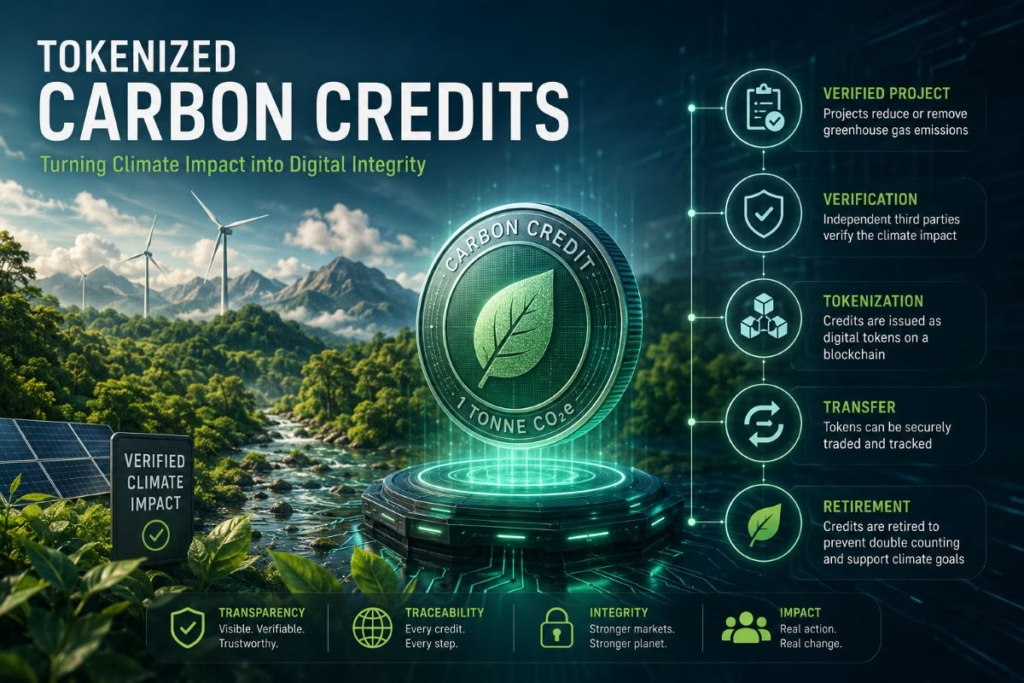
Climate project → Verification → Registry issuance → Credit locked or represented → Token created → Token transferred → Token surrendered → Registry credit retired
Each step plays a different role.
Step 1: The Platform Confirms the Underlying Credit
Before creating a token, the platform should confirm that a genuine carbon credit exists.
The project details and serial numbers should match the records in the issuing registry.
This check establishes the link between the physical-world project and the digital asset.
Step 2: A Custodian Locks the Credit
The platform may transfer the original credit into a dedicated registry account.
The custodian should stop anyone from selling or transferring the registry credit while the token circulates elsewhere.
Without this control, the original credit and the token could both enter the market.
Step 3: A Smart Contract Creates the Token
A smart contract mints a digital token that represents the locked credit.
The clearest structure maintains one token for each underlying credit.
Some platforms combine similar credits into pools. Pooling may simplify trading, but it can also hide differences between projects, methodologies and vintages.
Step 4: Buyers Transfer the Token
Users can move the token between approved wallets or accounts.
A marketplace may also allow buyers and sellers to trade the asset.
The blockchain creates a transaction history. However, that history only adds value when the system also connects wallets to identified owners and accurate registry records.
Step 5: The Holder Retires the Credit
A buyer that wants to claim the environmental benefit must retire the credit.
The system may require the buyer to surrender or burn the token. The platform must then update the original registry record.
A retirement certificate should identify the beneficiary and the purpose of the retirement.
Burning the token without retiring the underlying registry credit does not complete the process.
A genuine retirement must create a permanent record in the recognized registry. Burning a token alone does not prove that the environmental benefit has left the market.
Two Main Tokenization Models
Digital carbon systems generally follow one of two models.
A Registry Credit Represented by a Token
Under this model, a conventional carbon registry issues the credit first.
A custodian then locks or holds that credit in a designated account. Afterward, a platform creates a corresponding blockchain token.
This approach keeps the existing carbon standard and verification process while adding a digital transaction layer.
The model’s main weakness lies in the bridge between the registry and the blockchain.
Buyers need clear evidence that no one can trade the original credit separately.
A Digitally Native Carbon Credit
A digitally native system introduces technology earlier in the credit lifecycle.
The system may connect monitoring data, verification records, issuance details and retirement information through one digital infrastructure.
In March 2026, Gold Standard announced fully digitized cookstove credits from a project in Bangladesh.
Connected devices recorded equipment usage and transmitted the data for independent audit. Gold Standard issued the credits through its registry, while a public ledger displayed a non-tradeable digital representation.
This model does more than wrap an existing credit in a token.
It uses digital monitoring, reporting and verification to improve the evidence supporting the credit.
What Can Tokenization Improve?
Tokenization can improve several parts of the carbon-credit market when a credible registry and project support it.
Faster Transactions
Traditional transfers may require several intermediaries and manual checks.
Blockchain systems can reduce some of those steps. Smart contracts can also connect payment with asset delivery.
Faster settlement may help companies manage large carbon-credit inventories more efficiently.
Better Traceability
A blockchain creates a chronological record of token movements.
Buyers may find it easier to examine the ownership history and current status of a token.
Traceability becomes especially useful when companies need to explain purchases to auditors, regulators or shareholders.
Easier Retirement
Smart contracts can connect token surrender with retirement instructions.
Automation may reduce administrative delays and make the process easier for smaller buyers.
The platform must still update the original registry record.
Improved Access to Project Data
A token can link to information about the project.
A buyer may view the methodology, location, vintage, verifier and registry details through one interface.
Better access to data can support due diligence, although it does not guarantee that buyers will perform it.
Smaller Transaction Sizes
Tokenization may divide credits into smaller units.
This feature could expand access for individuals and smaller companies.
However, fractional ownership raises another question: who has the right to make the final climate claim?
The platform must answer that before offering fractional units.
Programmable Purchasing
Companies may use smart contracts to establish purchasing rules.
For example, a company could instruct its system to accept only:
- Recent-vintage credits
- Removal-based projects
- Approved registries
- Selected countries
- Specific methodologies
Programmable rules may help companies maintain a consistent carbon-credit policy.
Connections Between Registries
Carbon registries have historically operated as separate databases.
Shared digital infrastructure could help market participants compare records, identify conflicts and detect credits that appear in multiple systems.
The Climate Action Data Trust aims to connect and harmonize carbon-registry metadata.
Its blockchain-based data layer seeks to improve transparency and help users identify potential double counting.
What Tokenization Cannot Fix
Carbon-token promoters often exaggerate what blockchain can achieve.
The technology cannot solve several fundamental problems.
A Weak Project Remains Weak
A blockchain records the information that people enter into it.
When a project overstates its impact, tokenization may simply make the questionable credits easier to distribute.
Accurate records do not guarantee accurate climate claims.
Verification Still Happens in the Physical World
Forests, farms, factories and cookstove projects operate outside the blockchain.
Auditors, sensors and monitoring systems must still determine whether the project produced the claimed result.
Blockchain can store the evidence. It cannot independently confirm what happened.
Additionality Requires Human Judgment
A credible carbon project should normally support an activity that would not have happened without carbon finance.
A blockchain cannot decide whether a project genuinely needed that funding.
Project developers, validators and auditors must assess additionality.
Permanence Risk Continues
A forest may store carbon for several years and then lose it through fire, disease or land-use change.
Token ownership does not remove this risk.
Crediting programs need buffer pools, insurance or other mechanisms to address possible reversals.
Social Safeguards Still Matter
Carbon projects can affect land rights, local communities and Indigenous peoples.
Blockchain records do not guarantee fair consultation, benefit sharing or access to grievance procedures.
A project can maintain excellent digital records while treating communities badly.
Tokenization Does Not Guarantee Liquidity
Creating a token does not create demand.
Thousands of digital assets have reached marketplaces without developing active trading.
A token may technically remain tradeable while offering buyers little chance of finding another buyer.
Why Governments Are Interested
Governments need stronger systems for recording climate projects and tracking transfers between countries.
Article 6 of the Paris Agreement allows countries to cooperate on emission reductions.
That cooperation requires detailed accounting.
Without reliable records, two countries could attempt to count the same reduction towards their climate targets.
Digital infrastructure can help governments:
- Record project approvals
- Track international transfers
- Apply corresponding adjustments
- Monitor unit ownership
- Connect national registries
- Support international reporting
- Attract private climate finance
- Detect inconsistent records
The United Nations began developing Article 6 registry infrastructure in 2026.
These systems will help record international transfers and activity under the Paris Agreement Crediting Mechanism.
Governments do not need to use blockchain for every registry.
However, they do need interoperable, auditable and secure data systems.
Thailand’s Tokenized Carbon Credit Framework
Thailand provides one of the clearest examples of a government connecting environmental assets with regulated digital-asset businesses.
In September 2025, Thailand’s Securities and Exchange Commission updated its rules.
The framework allows approved digital-asset exchanges, brokers and dealers to offer services involving:
- Tokenized carbon credits
- Tokenized Renewable Energy Certificates
- Tokenized carbon allowances
Operators must obtain permission before adding these services.
They must also screen the tokens and provide sufficient information to customers.
Thailand treats these products as consumption-based utility tokens rather than financial products under its digital-asset framework.
That classification does not remove the risk.
Buyers still need to examine the underlying product, registry connection, permitted use and retirement process.
Market Insight: Thailand
Thailand does not treat tokenized carbon credits as ordinary cryptocurrencies. Its framework focuses on recognized environmental assets, operator screening and buyer disclosure.
The model could support Thailand’s agriculture, forestry, renewable-energy and industrial sectors.
Project developers may gain new routes to buyers, while companies may access environmental products through regulated digital platforms.
The framework will only succeed if the infrastructure connects properly with recognized registries.
Another isolated marketplace would add complexity rather than solve it.
Why Corporations Use Carbon Credits
Companies purchase carbon credits for several reasons.
Some organizations face formal obligations under regulated systems. Others use credits voluntarily to finance climate action outside their operations.
Common corporate uses include:
- Addressing permitted residual emissions
- Supporting environmental projects
- Closing part of a Scope 3 action gap
- Meeting sector-specific requirements
- Financing carbon removals
- Managing environmental-asset inventories
- Preparing for future regulation
- Supporting supplier decarbonization
Responsible corporate guidance does not treat carbon credits as a substitute for operational reductions.
Companies should first measure their emissions, set credible targets and reduce emissions across their own activities and supply chains.
High-quality credits may then support additional climate action.
A company that buys cheap credits while continuing to ignore avoidable emissions does not follow a credible net-zero strategy.
Aviation Shows How Compliance Demand May Grow
International aviation provides a practical example of carbon credits entering a regulated framework.
The Carbon Offsetting and Reduction Scheme for International Aviation, known as CORSIA, allows airlines to use units from approved crediting programs.
For the 2024–2026 compliance period, ICAO approved eight eligible programs.
These include:
- American Carbon Registry
- Gold Standard
- Verified Carbon Standard
- Thailand’s Premium T-VER program
Airlines cannot buy any token that carries a green label and use it for compliance.
The underlying credit must meet the relevant eligibility rules.
A tokenized version must also preserve that eligibility and produce a valid retirement record.
Compliance-driven demand may eventually become more important than speculative trading.

Institutional Carbon Tokenization Is Developing
Early blockchain carbon markets often relied on cryptocurrency platforms and decentralized finance.
The newer phase looks more institutional.
J.P. Morgan Kinexys
In 2025, J.P. Morgan’s Kinexys Digital Assets announced trials with S&P Global Commodity Insights, EcoRegistry and International Carbon Registry.
The project explored blockchain infrastructure for tokenizing carbon-registry assets.
J.P. Morgan’s involvement does not guarantee success.
However, it shows that large financial institutions now view registry connectivity and digital settlement as serious infrastructure challenges.
Climate Action Data Trust
The Climate Action Data Trust does not operate as a typical token marketplace.
Instead, it connects and harmonizes metadata from different carbon registries.
The system aims to increase transparency and help users identify possible double counting across separate databases.
This infrastructure may create more value than another speculative carbon token.
Gold Standard Digital Monitoring
Gold Standard’s 2026 cookstove issuance demonstrated how connected devices can support digital monitoring.
The equipment recorded usage data rather than relying entirely on occasional manual surveys.
Independent auditors still reviewed the information.
This combination shows where the market may move next: blockchain connected to sensors, audits and recognized registries.
The Main Risks of Tokenized Carbon Credits
Buyers face carbon-market risk and digital-asset risk at the same time.
Double Issuance
A platform could create more than one token against the same underlying credit.
Strong registry controls and regular reconciliation should prevent this.
Double Use
The registry credit and its tokenized representation could both remain active.
Custody arrangements must prevent anyone from transferring the original unit independently.
Double Claiming
Two organizations may attempt to claim the same climate benefit.
Retirement records should identify the party that receives the final claim.
Tokens Created From Retired Credits
Retirement normally means that a buyer has already used the environmental benefit.
Verra prohibited tokens based on retired credits because the practice could make a previously consumed benefit appear tradeable again.
Hidden Differences Inside Pools
A pooled token may combine credits from several projects, years and methodologies.
Pooling may make trading easier, but buyers can lose access to details that affect quality.
Smart-Contract Failures
Coding errors can disrupt token creation, transfers and retirement.
Independent audits can reduce this risk, but they cannot remove it completely.
Custody and Wallet Risk
Users may lose private keys or expose them to theft.
Corporate buyers also need internal controls that determine:
- Who can authorize transactions
- How the company stores keys
- How it recovers assets
- How it separates responsibilities
Regulatory Uncertainty
Countries may classify the same token differently.
A regulator may treat it as a utility token, commodity, financial instrument or contractual claim.
The structure and jurisdiction determine the legal position.
Greenwashing
A company may promote its use of blockchain while avoiding questions about the underlying credit.
Technical transparency does not equal environmental integrity.
How to Evaluate Tokenized Carbon Credits
Never evaluate a carbon token through its price or blockchain alone.
Start with the underlying asset.
Underlying Credit
Ask:
- Which registry issued the credit?
- What is the serial number?
- Which project generated it?
- Where does the project operate?
- Which methodology does it use?
- Who verified the results?
- What is the credit vintage?
- Does it represent avoidance, reduction or removal?
Token Structure
Check:
- Does each token represent one credit?
- Has a custodian immobilized the original unit?
- Who controls the registry account?
- Can the platform mint additional tokens?
- Has an independent firm audited the smart contract?
- Can buyers view the project details?
- Does the token belong to a mixed pool?
Retirement Process
Confirm:
- Can the holder retire the underlying credit?
- Does token surrender trigger a registry update?
- Which party appears on the retirement record?
- Can the platform produce a retirement certificate?
- Who receives the right to make the environmental claim?
Market and Legal Risk
Consider:
- Does a regulated provider offer the token?
- Does the buyer own the credit or only hold a contractual claim?
- Can the buyer use the asset for its intended purpose?
- What happens if the platform closes?
- Can the buyer recover the underlying credit?
- Do any jurisdictions restrict transfers?
Environmental Integrity
Examine:
- Does the credit meet recognized quality criteria?
- Did the project need carbon finance?
- How does the project address permanence?
- Could emissions have shifted elsewhere?
- Did the project consult local communities?
- Does the project provide safeguards and grievance procedures?
The Integrity Council for the Voluntary Carbon Market developed ten Core Carbon Principles to help buyers identify high-integrity credits.
The principles cover:
- Governance
- Tracking
- Transparency
- Independent verification
- Additionality
- Permanence
- Robust quantification
- Double-counting controls
- Social safeguards
- Contribution towards net zero
A blockchain token cannot replace these requirements.
Are Tokenized Carbon Credits Investments?
Some tokenized carbon credits may rise or fall in price.
That price movement does not automatically make them suitable investments.
Several factors can affect their value:
- Project quality
- Credit vintage
- Regulatory eligibility
- Buyer demand
- Registry acceptance
- Corporate climate policies
- Available supply
- Liquidity
- Platform reliability
Carbon markets remain highly fragmented.
Prices vary because credits represent different project types, methodologies and claims.
A cheap credit may carry serious quality problems.
Investors should also question whether they can sell the token later.
A marketplace listing does not prove that meaningful liquidity exists.
Legal and Investment Risk
Tokenized carbon credits may receive different legal classifications depending on their structure and jurisdiction.
Buyers should not assume that regulators treat it like a security, protect it like a bank deposit or redeem it like a conventional commodity contract.
This article provides general educational information. It does not provide legal, financial or investment advice.
Watch This Trend: Digital MRV
Digital monitoring, reporting and verification may become more important than token trading.
Traditional carbon projects often rely on manual surveys and occasional site visits.
These methods can cost a lot, take months and produce incomplete information.
Digital MRV may use:
- Internet-connected meters
- Satellite monitoring
- Remote sensors
- Artificial intelligence
- Mobile applications
- Drone imagery
- Automated data feeds
- Tamper-resistant records
Better monitoring can shorten verification cycles and provide buyers with more current information.
However, technology still requires independent testing.
A broken sensor or biased model can produce unreliable data at scale.
Human oversight will remain necessary.
The Future of Tokenized Carbon Markets
Anonymous carbon tokens without registry oversight are unlikely to dominate the future market.
A more credible model has started to emerge.
That model will combine:
- Recognized carbon standards
- Government authorization
- Interoperable registries
- Digital monitoring
- Independent verification
- Controlled token issuance
- Regulated marketplaces
- Transparent retirement
- Clear ownership rights
- Reliable corporate reporting
Governments will play a larger role as Article 6 markets develop.
Corporations will also demand stronger evidence because weak environmental claims can create legal and reputational damage.
Financial institutions may improve settlement and custody.
Specialist technology companies may connect registries with project data.
No single blockchain will control the entire market.
Interoperability will matter more than loyalty to one chain.
Final Thoughts
Tokenized carbon credits sit at the intersection of climate policy, corporate finance and digital assets.
That combination creates genuine potential.
Better infrastructure could help buyers track ownership, connect registries, automate retirement and direct capital towards environmental projects.
However, slow transactions do not represent the market’s greatest problem.
The most serious challenges involve credit quality, additionality, permanence, double counting and misleading corporate claims.
Tokenization cannot solve these issues on its own.
The strongest systems will use blockchain as one layer within a broader structure of environmental standards, verification, regulation and public accountability.
A well-designed token may improve the way a carbon credit moves through the market.
Only a credible project can determine whether that credit deserves to exist.
Frequently Asked Questions
What are tokenized carbon credits?
A tokenized carbon credit uses a blockchain token to represent a carbon credit or a defined right connected to one.
A credible token should maintain a clear link to a verified credit in a recognized registry.
Does one token always equal one carbon credit?
No.
Some platforms use one-to-one backing. Others divide credits into smaller units or combine several credits in a pool.
Buyers should examine the token structure before purchasing.
Can blockchain verify that a project removed carbon?
No.
Blockchain can record data and transactions, but it cannot independently prove what happened at a physical project.
Monitoring systems, methodologies and third-party auditors must verify the result.
What happens when someone retires a tokenized carbon credit?
The holder normally surrenders or burns the token.
The platform should then retire the underlying credit in the original registry and create a record that identifies the beneficiary.
Burning the token alone may not complete the retirement.
Can a platform tokenize a retired carbon credit?
A platform should not create a tradeable token from an already-retired credit.
Retirement means that someone has already used the environmental benefit.
Verra prohibits tokens based on retired credits.
Do governments regulate tokenized carbon credits?
Regulation varies by country.
Thailand allows approved digital-asset businesses to offer certain tokenized environmental products under specific conditions.
Other jurisdictions may apply different classifications and rules.
Are tokenized carbon credits good investments?
They remain speculative and carry environmental, legal, technical and liquidity risks.
A rising token price does not prove that the underlying credit has high environmental quality.
What is the difference between a tokenized carbon credit and a carbon allowance?
A tokenized carbon credit represents a verified reduction or removal.
A carbon allowance gives the holder permission to emit within a regulated cap-and-trade system.
Can companies buy credits instead of reducing emissions?
Responsible climate guidance says companies should reduce their own emissions first.
High-quality credits may support additional climate action, but they should not replace internal decarbonization.
Which blockchain works best for tokenized carbon credits?
No single blockchain provides the best solution for every project.
Registry integration, ownership rights, data quality, security and retirement controls matter more than the blockchain name.