
Updated: August 20, 2026
Deutsche Bank is developing infrastructure for tokenized funds, digital-asset servicing and blockchain-based settlement. However, that does not mean the German banking group has moved its financial services onto a public blockchain.
Its best-known initiative, Project DAMA 2, remains an institutional pilot. The project proposes a platform that could help asset managers issue and service tokenized funds across different blockchain networks while retaining compliance controls and transaction privacy.
That is a more credible story than simply claiming Deutsche Bank has “embraced the future of finance.” Nevertheless, a blueprint is not a finished commercial product. The important questions concern what Deutsche Bank has built, what remains experimental and whether institutions will use it at scale.
TL;DR
- Deutsche Bank joined the Monetary Authority of Singapore’s Project Guardian in 2024.
- Project DAMA 2 focuses on issuing, distributing and servicing tokenized funds and other digital assets.
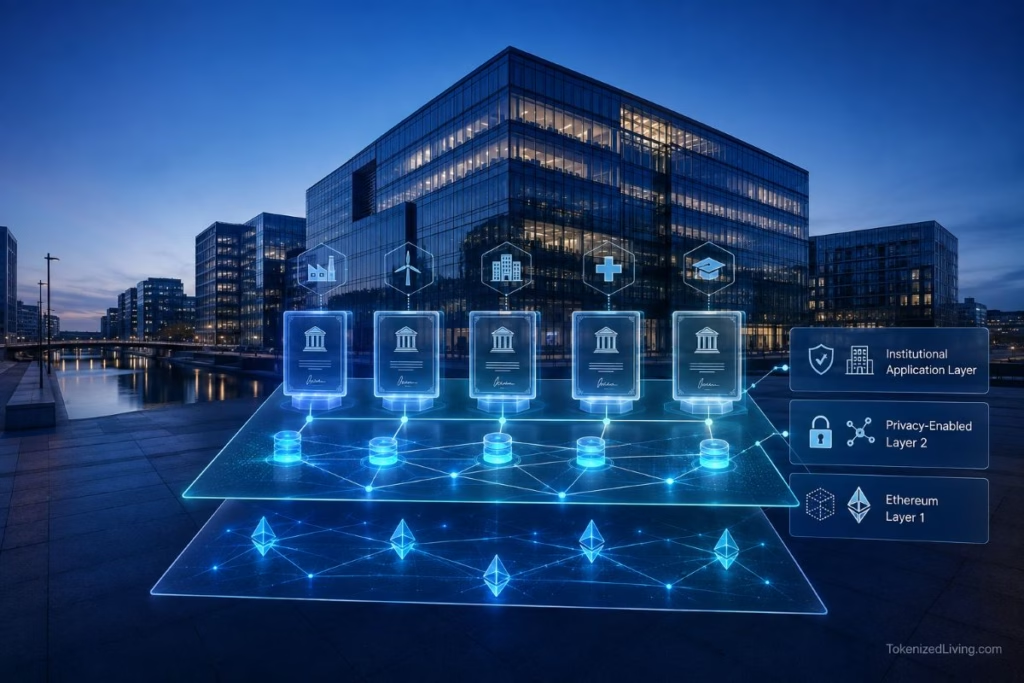
- Its proposed architecture combines Ethereum, a privacy-enabled Layer 2 and an application layer for institutional users.
- Axelar technology would help connect assets and services across different blockchain networks.
- Deutsche Bank has also explored tokenized deposits, stablecoins, blockchain settlement and digital-asset custody through separate projects.
- DAMA 2 was presented as a pilot with a targeted non-commercial mainnet—not a fully operational commercial platform.
- Tokenization could improve fund administration and settlement, but it does not automatically create liquidity, investor demand or legal certainty.
What Is Deutsche Bank Actually Tokenizing?
Project DAMA does not involve turning Deutsche Bank shares, branches or its entire balance sheet into tokens.
DAMA stands for Digital Asset Management Access. The project focuses primarily on the infrastructure used to create, distribute and service tokenized investment funds.
A tokenized fund uses blockchain-based tokens to represent interests in a fund. The token may record an investor’s units and support transfers, subscriptions, redemptions or other administrative processes.
However, the token does not replace the fund’s portfolio, legal documents or regulated entities. Investors still depend on the fund manager, administrator, custodian and applicable securities laws.
Readers unfamiliar with this distinction can start with our guide explaining what tokenization is.
From DAMA 1 to Project Guardian
Deutsche Bank completed its first DAMA proof of concept with Memento Blockchain in 2023.
DAMA 1 examined how asset managers could launch and administer digital funds using blockchain infrastructure. It also considered the difficulties that investors face when accessing funds issued across different networks.
In May 2024, Deutsche Bank joined Project Guardian, an initiative led by the Monetary Authority of Singapore.
The bank joined the project’s asset and wealth management workstream. Its stated objective was to test an open and interoperable platform for servicing tokenized and digital funds.
That wording matters. Deutsche Bank joined to test the technology and help develop standards. It did not announce a finished product or the immediate migration of client assets onto a blockchain.
Project Guardian brings financial institutions, regulators and technology providers together to examine tokenization in regulated markets. Its work covers funds, fixed income, foreign exchange and other financial products.
DAMA 2 became Deutsche Bank’s contribution to this wider initiative.
The DAMA Timeline
| Date | Development | What it means |
|---|---|---|
| 2023 | DAMA 1 proof of concept completed | Initial testing of digital fund issuance and servicing |
| May 2024 | Deutsche Bank joined Project Guardian | DAMA 2 entered a wider regulated-industry initiative |
| June 2024 | Interoperability paper published | Deutsche Bank examined connections between blockchains and conventional systems |
| May 2025 | AI collaboration announced | The bank explored using explainable AI in fund-servicing workflows |
| June 2025 | DAMA 2 litepaper published | The partners presented the proposed platform architecture |
| Second half of 2025 | Non-commercial mainnet targeted | This was a project target, not confirmation of a commercial launch |
| 2026 | Deutsche Bank continued discussing digital assets, collateral and custody | The wider strategy continued, although adoption remained gradual |
How Would DAMA 2 Work?
In June 2025, Deutsche Bank, Memento Blockchain and Interop Labs published a DAMA 2 litepaper.
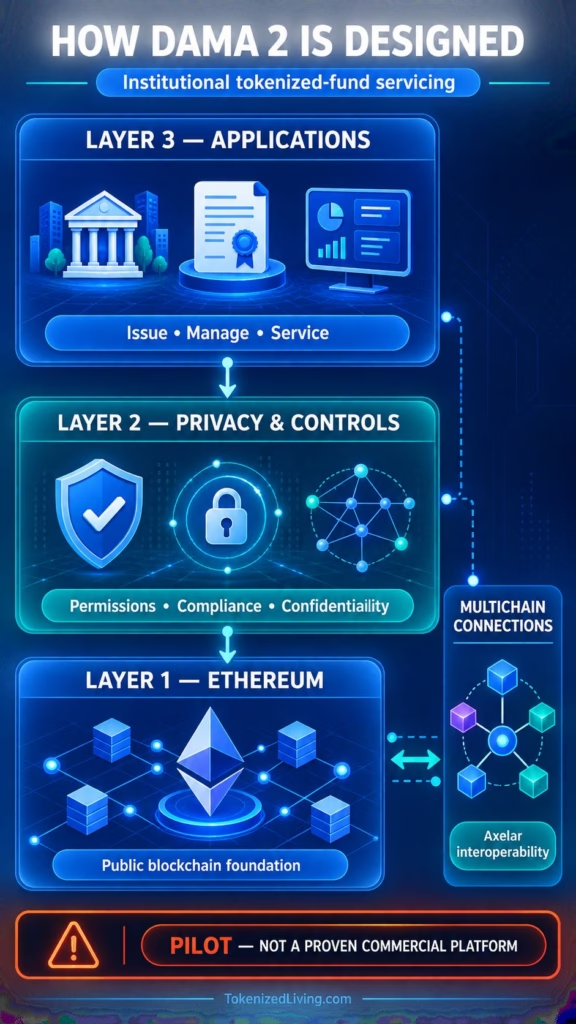
The proposed platform uses three main layers.
Layer 1: Public Ethereum
Ethereum provides the public blockchain foundation.
Using a public network may give institutions access to an established ecosystem, shared standards and broader connectivity. It can also reduce dependence on a closed platform controlled by one financial institution.
However, public blockchains raise concerns about transaction privacy, governance, fees, cybersecurity and regulatory compliance.
Layer 2: Privacy and institutional controls
Memento Blockchain designed a privacy-enabled institutional Layer 2 using ZKsync’s ZK Chain technology.
Zero-knowledge technology can allow parties to verify certain information without publicly revealing all underlying data. That capability may help institutions use public blockchain infrastructure while protecting sensitive transaction and investor information.
Nevertheless, privacy technology does not remove compliance obligations. Asset managers still need identity checks, anti-money-laundering controls, sanctions screening, record-keeping and regulatory reporting.
Layer 3: Applications for asset managers
The application layer aims to provide a familiar interface for asset managers, issuers and investment advisers.
Its proposed app store would provide access to fund smart contracts and other digital-asset services. A blockchain-as-a-service model could also reduce the need for every asset manager to build its own infrastructure.
This approach targets one of tokenization’s practical barriers: many financial institutions do not want to become blockchain software developers.
Multichain distribution
Interop Labs, the initial developer of the Axelar Network, provides the project’s interoperability component.
DAMA 2 is intended to support the issuance and distribution of managed tokens across multiple blockchains. This could allow an asset manager to reach investors or service providers operating on different networks.
Still, cross-chain functionality creates another layer of risk. Bridges, messaging protocols and smart contracts can fail or suffer attacks. Institutions must also reconcile transactions across blockchains and conventional financial records.
Why Tokenized Funds Need Asset Servicing
Issuing a token represents only one small part of running an investment fund.
A functioning fund requires investor onboarding, subscriptions, redemptions, valuation, reporting, corporate actions, compliance controls and custody. These activities continue after a token has been issued.
Therefore, Deutsche Bank’s role is less about selling tokens and more about providing institutional plumbing.
This strategy aligns with the bank’s existing securities-services business. Deutsche Bank already works with asset managers and institutional investors across fund administration, custody and transaction banking.
The same logic appears in the Calastone tokenized fund model, where blockchain infrastructure supports fund operations instead of replacing the underlying investment product.

What Could DAMA 2 Improve?
DAMA 2 targets several weaknesses in conventional fund administration.
Faster fund processing
Smart contracts could automate subscriptions, redemptions and certain lifecycle events. This may reduce manual reconciliation between fund managers, administrators, transfer agents and custodians.
However, faster processing depends on every relevant party connecting to the system. One blockchain platform cannot eliminate delays elsewhere in the transaction chain.
Lower technology barriers
A blockchain-as-a-service model could help smaller asset managers experiment with tokenized funds without building an internal blockchain team.
Lower technical barriers might encourage more issuers to enter the market. Yet users would become dependent on the platform’s operators, technology partners and governance arrangements.
Improved interoperability
Asset managers are unlikely to agree on one universal blockchain. Consequently, institutional service providers may need to support several public, private and permissioned networks.
DAMA 2 attempts to address this fragmentation through multichain distribution. Whether it can do so securely and economically at production scale remains unproven.
Programmable compliance
Smart contracts can restrict transfers to approved wallets or eligible investors. They may also automate selected checks and reporting requirements.
These controls can support compliance, but code cannot determine every legal question. Regulators and courts still decide whether a token represents a valid and enforceable financial claim.
What DAMA 2 Does Not Solve
The original article treated tokenization as if technical progress would automatically improve the financial system. That assumption is weak.
Several major problems remain.
Liquidity
Making a fund token transferable does not guarantee that anyone will buy it.
Liquidity requires buyers, sellers, pricing, market makers and compliant trading venues. A token can move within seconds and still be difficult to sell.
Our analysis of blockchain-powered secondary markets examines this problem in more detail.
Commercial demand
Asset managers will not adopt DAMA 2 simply because it uses advanced technology. The platform must provide measurable savings or new revenue opportunities.
Institutions will compare those benefits with integration costs, cybersecurity risks, regulatory requirements and the difficulty of maintaining conventional and blockchain systems simultaneously.
Legal recognition
A token may record ownership or entitlement, but its enforceability depends on contracts and applicable law.
Cross-border funds create additional complications. Investor protection, insolvency treatment, data rules and asset classification can differ between jurisdictions.
Privacy
Zero-knowledge technology can reduce public exposure of transaction data. Nevertheless, financial institutions may still need to share information with regulators, auditors, custodians and counterparties.
A privacy layer must balance confidentiality with legal disclosure requirements.
Operational resilience
Institutional finance cannot tolerate frequent outages, irreversible errors or unclear responsibility.
Before commercial deployment, the platform would need robust controls for software upgrades, private-key recovery, cyberattacks, transaction reversals and technology-provider failure.
DAMA 2 Is Only One Part of Deutsche Bank’s Strategy
Deutsche Bank’s digital-asset work extends beyond tokenized funds.
Tokenized deposits and stablecoins
In June 2025, Deutsche Bank and Ant International announced a partnership covering blockchain-based treasury management.
The companies said they would explore tokenized bank deposits and stablecoins for cross-border payments. However, this was a separate initiative from DAMA 2.
A tokenized deposit represents a claim against a commercial bank. A stablecoin usually represents a claim against a separate issuer or its reserves. Neither should be confused with a tokenized fund unit.
Our article on tokenized bank deposits explains these differences.
Blockchain-based settlement
Deutsche Bank also signed an agreement to join Partior as a euro and US-dollar settlement bank.
Partior uses blockchain infrastructure to support real-time settlement. This activity concerns the cash and payment side of digital finance rather than fund tokenization alone.
The distinction matters because a tokenized security still needs a dependable payment asset. Without an integrated cash leg, institutions may move the security on-chain while settling the payment through a separate system.
Custody and collateral
In May 2026, Deutsche Bank described tokenized money and collateral as areas attracting significant institutional attention.
The bank also acknowledged that adoption requires stronger interoperability, regulatory alignment and cybersecurity controls. Deutsche Bank’s representatives cautioned that institutions need to start small, prove the technology and expand gradually.
That assessment is far more realistic than claiming blockchain will immediately transform the entire financial system.
Is DAMA 2 Live?
The honest answer is unclear.
Deutsche Bank’s June 2025 DAMA 2 publication targeted a minimum viable product mainnet launch during the second half of 2025. Crucially, the bank described that proposed launch as non-commercial.
Deutsche Bank’s public materials reviewed for this August 2026 update do not establish that DAMA 2 has become a widely available commercial service. Nor do they provide public figures for client assets, transaction volume, revenue or cost savings generated through the platform.
Therefore, DAMA 2 should still be treated as an institutional infrastructure project rather than a proven commercial tokenization network.
This does not make the project meaningless. Detailed pilots can help institutions test compliance, privacy and operational controls before putting client assets at risk. Nevertheless, readers should not confuse technical development with market adoption.
What Does This Mean for Investors?
Retail investors cannot simply open a Deutsche Bank DAMA 2 account and purchase tokenized funds.
The project targets asset managers, issuers, investment advisers and institutional service providers. Any eventual investor access would depend on the funds issued through the platform, distribution arrangements and local regulations.
Moreover, a tokenized fund remains an investment fund. Investors would still need to examine:
- What assets the fund holds.
- Who manages and administers it.
- Which legal rights the token provides.
- Who controls custody and private keys.
- How subscriptions and redemptions work.
- Whether a secondary market exists.
- What fees the fund and platform charge.
- What happens if an issuer or technology provider fails.
Tokenization may change how an investment operates. It does not make a poor investment safe or a restricted investment liquid.
Final Verdict
Deutsche Bank is doing more than issuing optimistic statements about blockchain.
DAMA 1 produced a proof of concept. DAMA 2 developed that work into a detailed proposal for institutional token issuance and servicing. Meanwhile, the bank has pursued separate work involving blockchain settlement, digital-asset custody, stablecoins, tokenized deposits and collateral.
Even so, the evidence does not support the claim that Deutsche Bank has completed a broad shift to tokenized finance.
DAMA 2 remains best understood as a proposed bridge between public blockchain technology and regulated asset management. Its architecture addresses genuine problems involving privacy, multichain distribution and fund administration.
The harder test comes next. Deutsche Bank and its partners must demonstrate commercial demand, reliable operation, regulatory acceptance and measurable economic benefits.
Until then, DAMA 2 is a serious institutional experiment—not proof that the future of finance has already arrived.
Frequently Asked Questions
What is Deutsche Bank’s DAMA 2 project?
DAMA 2 is a Deutsche Bank-led pilot exploring infrastructure for issuing, distributing and servicing tokenized funds and other digital assets across blockchain networks.
Is DAMA 2 a commercial product?
Deutsche Bank targeted a non-commercial minimum viable product mainnet for the second half of 2025. Public information reviewed in August 2026 does not establish that DAMA 2 has become a widely available commercial service.
Does DAMA 2 use Ethereum?
Yes. Its proposed architecture uses Ethereum as the public Layer 1 foundation. A privacy-enabled institutional Layer 2 and an application layer sit above it.
What is Project Guardian?
Project Guardian is a Monetary Authority of Singapore-led initiative that brings policymakers and financial institutions together to test tokenization in regulated financial markets.
Can retail investors use DAMA 2?
DAMA 2 primarily targets asset managers, issuers, investment advisers and institutional service providers. It is not presented as a retail investment platform.
Is a tokenized fund the same as a cryptocurrency?
No. A tokenized fund token represents an interest or claim connected to a regulated investment fund. A cryptocurrency such as Bitcoin is a separate type of digital asset with different rights and risks.
Does tokenization guarantee liquidity?
No. Blockchain can make transfers technically faster, but liquidity still requires active buyers, sellers, market makers and compliant trading venues.
Editorial note: This article replaces an earlier version that covered Deutsche Bank’s initial Project Guardian announcement. It has been rewritten using Deutsche Bank and Monetary Authority of Singapore materials available on August 20, 2026.
Disclaimer: This article is for educational and informational purposes only. It does not provide financial, investment, legal or tax advice. Digital and tokenized assets can involve limited liquidity, technology failures, regulatory uncertainty and loss of capital.