

Tokenized fractional ownership in commercial real estate is transforming the investment scene.
TL;DR
- Most “tokenized real estate” is not property on-chain
- You usually own shares in a company, not the building itself
- Fractional access opens doors, but control is limited
- Income can be real, but structure matters more than hype
- The best setups focus on compliance, not marketing
Some links in this article may be affiliate links. If you choose to invest through them, we may earn a small commission at no extra cost to you.
Always do your own research before making any investment decisions.
What Is Tokenized Fractional Ownership Really?
Let’s strip this back.
Most people hear tokenized real estate and picture owning part of a building directly on-chain.
That’s not what’s happening.
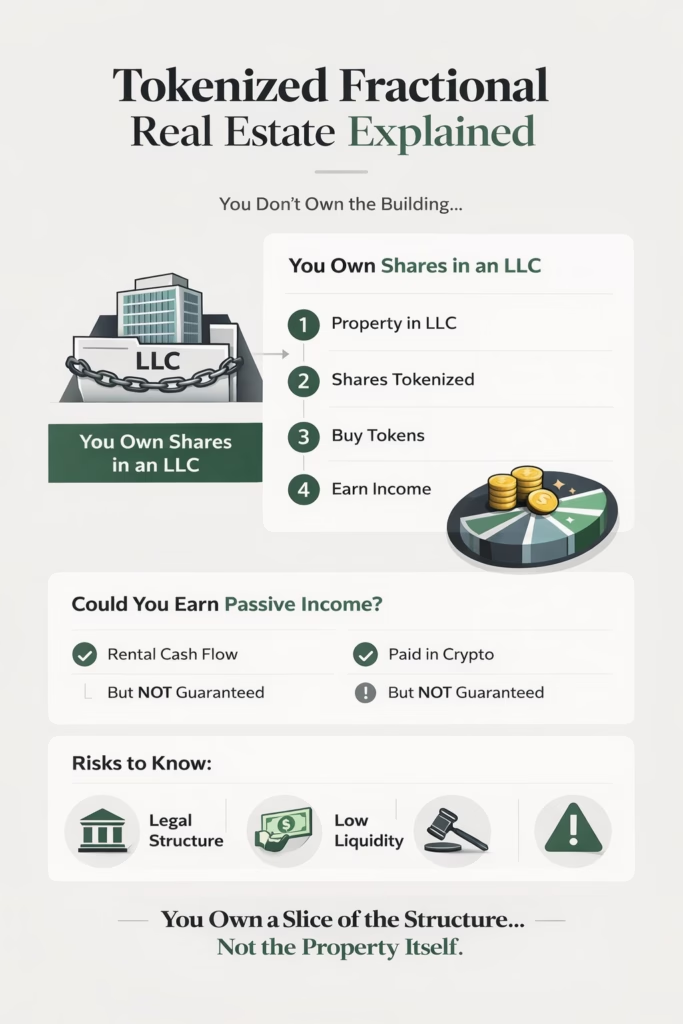
In most cases, a property sits inside a legal structure. Usually, an LLC. Sometimes a series LLC.
Then tokens represent shares in that entity.
So you don’t hold a deed.
You hold equity in something that holds the deed.
That distinction matters more than people think.
How Tokenized Fractional Ownership for Commercial Real Estate Actually Works
Here’s the simplified version:
- A commercial property is acquired
- It’s placed into a legal entity (LLC or SPV)
- That entity is split into shares
- Tokens represent those shares
- Investors buy tokens and receive income rights
Sounds clean.
But the key point is this:
You are investing in a structure, not directly in the property.
What You Actually Own (And What You Don’t)
This is where things get a bit uncomfortable.
You typically get:
- Economic rights (income, appreciation)
- Exposure to the asset
- Sometimes voting rights (limited)
You usually don’t get:
- Direct ownership of the property title
- Control over decisions
- A say in refinancing or sale (in most cases)
So if the property gets sold or refinanced…
You are along for the ride.
Why This Model Is Getting So Much Attention
Because, honestly, it fixes a real problem.
Commercial real estate has always been locked behind large capital requirements.
Tokenization changes that.
Instead of needing $500K+ to access deals…
You can start with a few hundred dollars.
That’s a big shift.
And it’s why platforms like RealT, Reental, and BinaryX are gaining traction.
Not because the structure is new.
But because access is.
The Part Most Articles Skip
Here’s where it gets interesting.
If the title itself was truly tokenized…
Every token holder would technically need to agree to major actions.
Selling the property. Refinancing it. Changing terms.
That’s not practical.
So instead, platforms keep the legal structure off-chain and tokenize the equity layer.
It’s a workaround.
A smart one.
But still a workaround.
Income Potential from Tokenized Fractional Ownership for Commercial Real Estate
This is where people lean in.
Because income is usually the main draw.
- Income from rent gets distributed to token holders
- Payments can be weekly, monthly, or quarterly
- Some platforms pay in stablecoins
So yes, you can generate cash flow.
But…
It depends heavily on:
- Occupancy rates
- Property management quality
- Fee structure
- Legal clarity
Not the token itself.
Risks That Actually Matter
Let’s keep this grounded.
1. Structure Risk
If the legal wrapper fails, your tokens don’t save you.
2. Liquidity Risk
Secondary markets exist, but they’re still thin.
You might not be able to exit when you want.
3. Control Risk
You are not the decision-maker.
Even if you own “a share.”
4. Regulatory Risk
This space is still evolving.
Some platforms are compliant.
Others… less so.
Market Insight
Tokenization isn’t replacing commercial real estate ownership.
It’s repackaging it.
In a more accessible way.
That’s the real shift.
And over time, the platforms that survive will be the ones that:
- Prioritize compliance
- Build real liquidity
- Treat tokens as securities, not marketing tools
Quick Comparison
| Feature | Traditional CRE | Tokenized CRE |
|---|---|---|
| Minimum Investment | High | Low |
| Liquidity | Low | Medium (improving) |
| Ownership Type | Direct | Indirect (via entity) |
| Control | High | Low |
| Accessibility | Limited | Global |
The Bigger Opportunity (And Where This Goes)
This is where things start to get interesting long-term.
Once these structures mature…
You can start layering in:
- DeFi lending against property-backed tokens
- Automated income distribution
- Cross-border ownership without friction
That’s when it stops being just “tokenized fractional ownership for commercial real estate.”
And starts becoming programmable real estate finance.
Still early.
But you can see where it’s heading.

Pull Quote
“You don’t own the building. You own a slice of the structure that owns the building. And that difference shapes everything.”
FAQ
Is tokenized commercial real estate the same as owning property?
No. You usually own shares in an entity, not the title itself.
Can I sell my tokens anytime?
Not always. Liquidity depends on the platform and market demand.
Is tokenized fractional ownership for commercial real estate safe?
It can be — but only if the legal structure is solid and compliant.
Do I earn passive income?
Often yes, through rental distributions. But returns are not guaranteed.
Final Thought
There’s a tendency to oversell this space.
Either as the future of everything…
Or as something fundamentally broken.
Reality sits somewhere in the middle.
Tokenized fractional ownership of commercial real estate works.
But not in the way most people think.
And once you understand the structure…
You can actually use it properly.
Disclaimer: As with any investment venture, it is essential to conduct thorough research, seek professional advice, and make informed decisions that align with your financial objectives and risk profile.
Finally, we refined and enhanced the article using ChatGPT.