

Tokenized real estate taxes look simple on the surface.
You buy tokens. You earn income. Then, you sell later.
But the tax side? That is where things get messy fast.
Most investors think it works like a normal property.
It does not.
And if you get it wrong, you do not just lose money.
You create problems you did not even know existed.
TL;DR
- Rent income from tokenized property is usually taxed as income
- Selling tokens may trigger capital gains tax
- Some tokens are treated as securities, not real estate
- Reporting rules are tightening, especially for digital assets
- Record keeping is now critical, not optional
- Tax treatment depends heavily on structure and location
What Makes Tokenized Real Estate Different?
Let’s be clear.
In most cases, you are not directly owning property.
You are holding:
- Shares in an LLC
- Rights to income
- Or a token linked to a legal structure
That distinction matters.
Because tax authorities do not care about the marketing.
They care about what you actually own on paper.
👉 How tokenized real estate works
How Tokenized Rent Income Is Taxed
If the platform distributes income, that is usually treated as:
👉 Regular income
Not passive in the way many expect.
You may be taxed on:
- Rental distributions
- Platform payouts
- Profit shares
And here is where people slip:
Even if the income stays on the platform…
You may still owe tax on it.
👉 Earning income from tokenized property
What Happens When You Sell Tokens
Selling your tokens is usually a taxable event.
That triggers:
👉 Capital gains tax
The calculation is simple in theory:
- Buy price
- Sell price
- Profit = taxable gain
But in practice, it gets messy.
Because you also need to track:
- Fees
- Exchange rates
- Platform costs
- Transfer history
Miss those, and your numbers are wrong.
Income vs Capital Gains (Quick Breakdown)
| Type of Activity | Likely Tax Treatment |
|---|---|
| Rental payouts | Income |
| Token sale | Capital gains |
| Platform rewards | Income |
| Secondary trading | Capital gains |
Simple table.
Complicated reality.
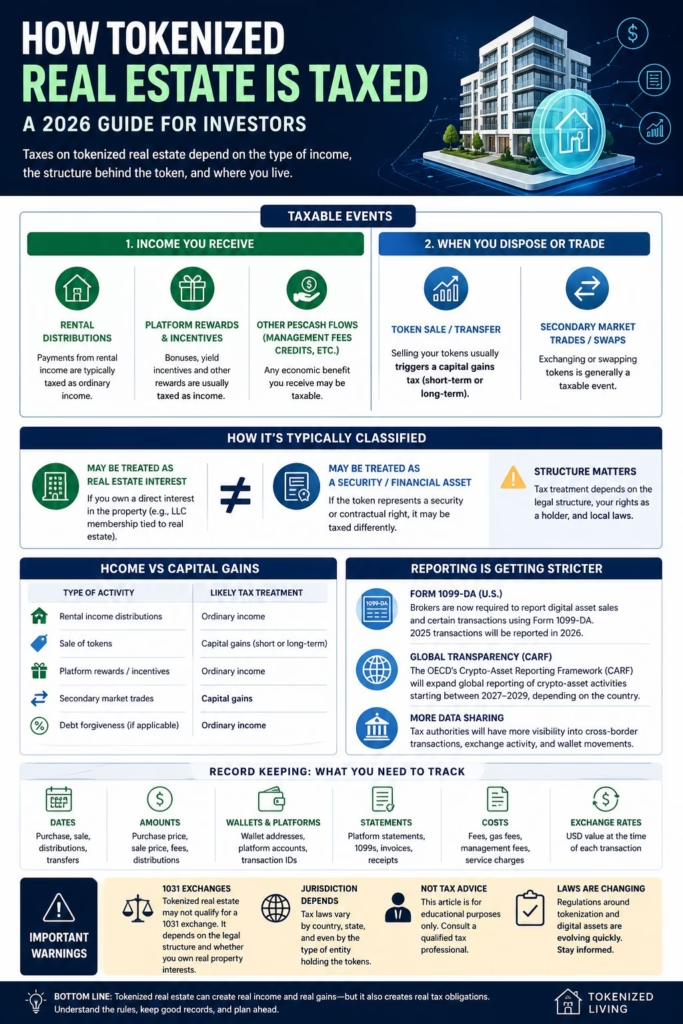
👉 Buying and selling tokenized real estate
🧠 Market Insight
Tokenized real estate is moving into a grey zone between property and financial assets.
That matters.
Because regulators are starting to treat many of these tokens more like:
- Securities
- Financial instruments
- Digital assets
Not traditional real estate.
That shift changes how taxes are applied.
And most investors are still behind on this.
⚠️ The 1031 Exchange Trap
This is where bad advice spreads fast.
Some articles suggest you can use a 1031 exchange with tokenized real estate.
That is risky.
Because:
- Many token structures do not qualify as direct property ownership
- Some are treated as securities
- Others are contractual rights
And 1031 exchanges typically require real property interests
Not tokens.
If you assume this works and it does not…
You create a tax bill you did not plan for.
Global Reporting Is Tightening
This is the part most investors are ignoring.
Reporting is getting stricter.
In the U.S., digital asset transactions are moving toward standardized reporting.
Globally, frameworks are being introduced to track:
- Wallet activity
- Platform transactions
- Cross-border holdings
The direction is clear.
Less privacy. More reporting.
Record Keeping Is Now Critical
This is not optional anymore.
You need to track:
- Purchase price
- Sale price
- Dates of transactions
- Rental income received
- Platform fees
- Wallet transfers
- Exchange rates
If you cannot prove it, you cannot defend it.
And that becomes your problem, not the platform’s.
⚖️ Legal Reality Box
Tax treatment depends on:
- Your country of residence
- The platform structure
- Whether the token is classified as a security
- Local digital asset laws
There is no universal rule.
If you are investing serious money, you need professional advice.
Anything else is guesswork.
Where Investors Get This Wrong
Most mistakes come from assumptions:
- “It is real estate, so taxes are simple”
- “I only pay tax when I withdraw”
- “Tokens are treated like property everywhere”
All three can be wrong.
And usually are.
💬 Pull Quote
“Tokenized real estate is not just property on-chain. In many cases, it is a financial asset with very different tax rules.”
What this Means for Tokenized Real Estate Taxes
This space is still early.
But one thing is already clear:
👉 Tax complexity is increasing, not decreasing
As adoption grows, enforcement will follow.
And casual investors will be the first to get caught out.
Final Thought
Tokenized real estate opens new doors.
But it also creates new responsibilities.
If you treat it like traditional property, you will miss the risks.
And in tax, missing the details is where the damage happens.
FAQ
Do I pay tax on rental income from tokenized real estate?
Yes. In most cases, it is treated as income, even if not withdrawn.
Are tokenized properties taxed like normal real estate?
Not always. Many are structured as financial assets or securities.
Do I only pay tax when I sell?
No. Income distributions may be taxable before any sale.
Can I use a 1031 exchange?
Possibly, but often not. It depends on the legal structure.
Do I need to track every transaction?
Yes. Detailed records are now essential.