
Tokenization in asset management has moved beyond white papers and small-scale experiments.
However, much of the discussion remains exaggerated.
Tokenization does not automatically remove intermediaries. It does not guarantee liquidity. Furthermore, putting a fund on a blockchain does not change the investments held inside it.
Calastone offers a more practical model.
Instead of asking asset managers to rebuild their funds from scratch, Calastone connects existing regulated funds with blockchain-based distribution channels.
That distinction matters.
The company is not trying to replace the asset-management industry. Instead, it is building a bridge between traditional fund infrastructure and digital markets.
TL;DR
| Question | Answer |
|---|---|
| What is Calastone? | A global fund transaction and distribution network |
| What gets tokenized? | Units or share classes in existing investment funds |
| What does not change? | The underlying fund structure, investments and service providers |
| Which networks are supported? | Ethereum, Polygon, Canton and other compatible networks |
| Is the system live? | Yes. Legal & General liquidity funds joined the network in April 2026 |
| Can retail investors buy directly from Calastone? | No. Calastone is infrastructure, not a retail investment platform |
| Main advantage | It gives traditional funds access to blockchain-based distribution |
| Main limitation | Tokenization does not guarantee liquidity, lower fees or unrestricted access |
What Is Calastone?
Calastone operates technology that connects asset managers, fund administrators, transfer agents, custodians and distributors.
Its network handles fund orders, settlements, transfers, dividends and reporting.
According to the company, more than 4,500 clients across 58 countries use its network. Calastone also says it processes over £300 billion of investment value each month through more than 40,000 trading links.
This scale makes Calastone different from a blockchain startup launching an experimental token.
It already sits inside the traditional fund-distribution system.
In October 2025, financial-services technology company SS&C Technologies completed its acquisition of Calastone for approximately £766 million. The deal placed Calastone within SS&C’s wider fund-administration and investor-servicing business.
Therefore, Calastone’s tokenization strategy is not an isolated crypto project. It forms part of a much larger financial infrastructure operation.
You can view the latest network figures on the Calastone company overview and details of the SS&C acquisition.
What Does Calastone Actually Tokenize?
Calastone’s model does not normally tokenize every asset held inside an investment fund.
For example, imagine a money market fund holding government debt, bank deposits and short-term financial instruments.
Calastone can create a blockchain-based representation of the fund’s units. However, it does not need to tokenize every Treasury bill or deposit held in the portfolio.
The token represents an interest in the fund.
It is not a separate cryptocurrency. Nor does it replace the underlying investments.
This is similar to placing a new digital distribution layer around an existing financial product.
If you need a simpler introduction to the concept, read our guide explaining what tokenization means.
Fund tokenization in simple terms
A traditional investor may purchase fund units through a bank, broker or investment platform.
Under Calastone’s model, authorized investors can access tokenized versions of those units through supported blockchain-based channels.
The asset manager can continue using its existing:
- Fund structure
- Administrator
- Transfer agent
- Custodian
- Investment strategy
- Pricing process
- Regulatory framework
Therefore, the blockchain becomes another way to distribute and record fund interests.
It does not make the traditional fund disappear.
How Calastone Tokenized Distribution Works
Calastone launched its Tokenised Distribution solution in April 2025.
The system connects existing funds on the Calastone network with public, private or hybrid blockchain environments.
Here is the simplified process.
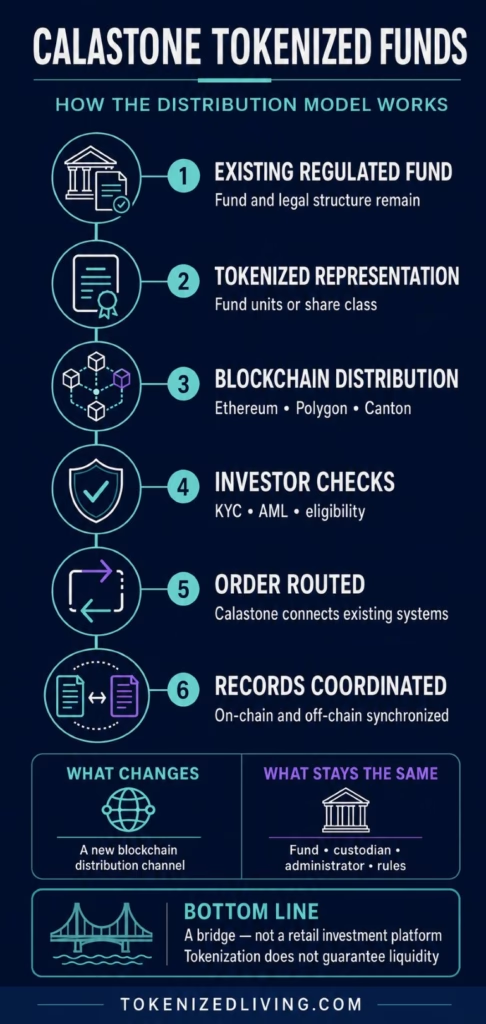
1. An asset manager selects an existing fund
The manager does not have to create an entirely new blockchain fund.
Instead, it can make an existing fund or share class available in tokenized form.
2. Calastone creates the tokenized representation
Calastone provides the technology for token creation and management.
The token represents units in the selected fund. Its legal rights still depend on the fund documents and applicable regulations.
3. The token becomes available through digital channels
Authorized investors or platforms can access the fund through supported blockchain networks.
Calastone currently identifies Ethereum, Polygon and Canton among its supported distribution environments.
4. The investor completes compliance checks
Blockchain access does not remove identity checks.
Investors may still need to complete:
- Know Your Customer checks
- Anti-money-laundering screening
- Investor eligibility verification
- Sanctions screening
- Jurisdictional checks
As a result, owning a compatible wallet does not automatically make someone eligible.
5. Calastone translates the blockchain order
An order initiated through a blockchain channel must still reach the fund’s existing operational systems.
Calastone translates and routes that instruction through its network. It can then connect with the fund administrator, transfer agent and other service providers.
6. The system coordinates the fund and token records
The transaction can trigger token creation, transfer, reconciliation and settlement processes.
However, the exact settlement method depends on the fund, blockchain, payment rail and participating institutions.
Calastone describes the system as a bridge between traditional funds and blockchain-native markets rather than a complete replacement for existing infrastructure.
Its Tokenised Distribution service provides further technical details.
Traditional Fund Distribution vs Calastone’s Model
| Area | Traditional distribution | Calastone tokenized distribution |
|---|---|---|
| Investor access | Banks, brokers and fund platforms | Traditional channels plus authorized blockchain channels |
| Order entry | Conventional fund messages | Blockchain instruction translated into existing fund processes |
| Fund structure | Existing regulated structure | Existing regulated structure remains |
| Investor record | Mainly conventional databases | Integrated on-chain and off-chain records |
| Settlement | Banking and fund settlement systems | Blockchain-enabled settlement alongside existing systems |
| Transferability | Controlled by fund rules | Still controlled by fund rules and programmable restrictions |
| Service providers | Administrator, custodian and transfer agent | Existing providers can remain in place |
This hybrid structure is the main attraction.
Asset managers gain access to blockchain distribution without replacing every part of their operating model.
Why the Calastone Model Matters
Many institutional tokenization projects struggle with the same problem.
A new token may work technically. Yet it remains disconnected from the fund administrator, transfer agent, compliance systems and investor records.
Calastone already connects many of those participants.
Consequently, it can introduce tokenized distribution without forcing each organization to build a separate blockchain system.
Access to digital-native investors
Some companies, stablecoin issuers and blockchain organizations hold significant amounts of capital on-chain.
However, moving that capital into a traditional fund may require several conversions, transfers and intermediaries.
Tokenized funds could give these organizations access to regulated investment products through familiar blockchain infrastructure.
Money market funds are particularly relevant because organizations may use them to seek yield on short-term cash.
Less operational disruption
Asset managers do not need to abandon established fund structures.
They can also continue working with existing administrators and transfer agents.
This reduces the size of the operational change required.
Greater automation
Smart contracts can help automate token issuance, transfers and eligibility controls.
Blockchain records may also support faster reconciliation between participants.
However, automation only works when the underlying data and legal processes remain accurate.
A smart contract cannot repair a badly designed fund.
More distribution options
A fund can remain available through traditional platforms while adding digital distribution channels.
Therefore, tokenization can expand access without forcing existing investors to change how they hold their investments.
Legal & General Provides the First Major Test
The strongest evidence for Calastone’s model arrived in April 2026.
Legal & General Asset Management made its liquidity funds available through the Calastone Tokenised Distribution Network.
The funds cover US dollar, euro and pound sterling strategies. Legal & General reported that it manages more than £50 billion in liquidity assets across the range.
Calastone provides the infrastructure for token creation, order routing, trade aggregation, reconciliation and on-chain settlement.
Meanwhile, access remains permissioned. Only authorized users can buy, hold or transfer the tokens within the regulated system.
The tokenized versions initially became available through Ethereum and compatible EVM networks.
Legal & General’s full announcement explains the launch of its liquidity funds on Calastone.
What the £50 billion figure does—and does not—mean
The figure is impressive, but it needs context.
Legal & General had more than £50 billion under management across the relevant liquidity strategies. The announcement made those strategies available through tokenized distribution.
It does not mean £50 billion immediately moved onto a blockchain.
Nor does it represent £50 billion in new tokenized investment inflows.
The real test will be how much capital investors place through the blockchain-based channel.
Other useful measures will include:
- Number of active blockchain investors
- Tokenized transaction volumes
- Settlement times
- Operational cost reductions
- Assets held in tokenized share classes
- Number of additional fund managers joining the network
Availability is an important first step. Nevertheless, usage will determine whether the model succeeds.
Is Calastone the Same as BlackRock BUIDL?
No.
BlackRock’s BUIDL product is a separate tokenized investment fund developed with digital-securities infrastructure provider Securitize.
Calastone’s Tokenised Distribution service can place blockchain-based representations around existing fund share classes without requiring the manager to rebuild the fund.
Both models bring traditional financial products on-chain. However, they enter the market from different directions.
BUIDL started as a blockchain-based institutional liquidity product. Calastone starts with funds already operating through conventional distribution infrastructure.
You can learn more in our guide to the BlackRock BUIDL tokenized fund.
Why the United States and Asia Are Paying Attention
The weaker version of this article claimed that the US and Asia were leading asset-management tokenization. However, it offered almost no evidence.
The real picture is more complicated.
United States
US asset managers have launched several tokenized funds and Treasury-related products.
At the same time, tokenized securities remain securities.
In January 2026, SEC staff explained that changing a security’s format does not remove existing securities-law requirements. Registration, investor protection and transfer rules still apply.
The SEC also distinguished issuer-backed tokenized securities from third-party products that may only provide indirect or synthetic exposure.
That distinction is critical. Investors need to know whether a token represents an actual fund interest, a custodial entitlement or merely exposure created by another company.
The SEC statement on tokenized securities provides more detail.
Singapore
Singapore has focused on institutional standards and interoperability through Project Guardian.
The initiative has examined tokenized funds, asset servicing, settlement and digital financial infrastructure.
This approach fits Calastone’s model because institutional adoption requires more than issuing tokens. Funds also need common operating standards, compliance processes and reliable settlement assets.
Hong Kong
Hong Kong has developed Project Ensemble to test transactions involving tokenized deposits and digital assets.
The Hong Kong Monetary Authority moved the project into a new phase in November 2025, supporting real-value transactions rather than isolated technical demonstrations.
These developments show why Asian institutions are interested in fund tokenization.
However, the region is not building one unified tokenized market. Singapore, Hong Kong, Japan and other jurisdictions are developing different rules and infrastructures.
As a result, interoperability remains one of the biggest challenges.
The Benefits of Calastone Tokenized Funds
Calastone’s model offers several credible advantages.
Existing funds can reach new channels
Asset managers can distribute established products to authorized blockchain-based platforms and investors.
Traditional investors are not forced to move
Conventional fund channels can continue operating alongside the tokenized versions.
Fund managers can preserve existing relationships
Administrators, custodians and transfer agents do not necessarily need replacing.
Transactions may become more efficient
Automation can reduce duplicate data entry, manual reconciliation and processing delays.
Tokens may support new uses
Depending on the legal and technical structure, tokenized fund units could eventually support collateral, treasury management and other programmable financial activities.
However, these benefits depend on adoption, regulation and integration. They do not appear simply because a token exists.
The Limitations and Risks
Calastone solves part of the tokenization problem. It does not solve everything.
Tokenization does not guarantee liquidity
A token can move quickly while still having almost no buyers.
Real liquidity requires active investors, approved venues, market makers and sufficient trading demand.
Access remains restricted
These are regulated financial products.
Jurisdiction, investor classification and compliance requirements may limit who can participate.
Therefore, tokenized distribution does not automatically democratize institutional funds.
On-chain transfers may not equal instant redemption
Authorized users may transfer tokens quickly.
However, converting those tokens into cash can still depend on the fund’s dealing schedule, valuation process and settlement arrangements.
Blockchain networks introduce technical risks
Smart-contract failures, wallet compromises, network interruptions and faulty integrations remain possible.
A permissioned system can reduce some risks. Nevertheless, it cannot eliminate them.
The bridge creates dependencies
Calastone connects blockchain activity with traditional fund infrastructure.
That connection is useful, but it also becomes an important operational dependency.
If the bridge, reconciliation process or connected service provider fails, transactions could face delays.
Interoperability remains unfinished
Ethereum, Polygon, Canton and other networks use different technical and governance structures.
Moving assets and data between them safely remains a challenge.
Cost savings remain projections
Calastone has estimated that tokenization could produce up to $135 billion in annual savings across the asset-management industry.
That is a modelled industry estimate. It is not evidence that Calastone clients have already achieved those savings.
Actual results will depend on transaction volume, legacy-system integration and whether firms retire old processes instead of operating two systems permanently.
Can Individual Investors Use Calastone?
Calastone is not a retail investment marketplace.
You cannot normally visit its website, open an account and purchase tokenized funds directly.
Instead, Calastone provides infrastructure to asset managers, distributors and financial institutions.
An individual could eventually access a Calastone-supported fund through an approved investment platform. However, availability would depend on the fund and the investor’s country and eligibility.
This is another reason not to describe Calastone as a tokenized investment platform.
It is closer to financial plumbing.
That may sound less exciting. Yet financial plumbing is exactly what tokenization needs before it can operate at scale.
What Investors Should Check
Before purchasing any tokenized fund, examine the structure behind the token.
Important questions include:
- What legal interest does the token represent?
- Who maintains the official ownership record?
- Which fund or share class sits behind the token?
- Who holds the underlying assets?
- What investor restrictions apply?
- Where can the token be transferred?
- How does redemption work?
- Which fees apply?
- What happens if the blockchain service fails?
- Can ownership be recovered after losing wallet access?
The token itself is only the digital wrapper.
The investment rights, fund documentation and operating structure determine its real value.
Our beginner’s guide to RWA tokenization explains why investors should always examine what sits behind an on-chain asset.
Final Verdict
Calastone represents one of the more credible approaches to tokenized asset management.
Its model is not credible because it uses fashionable technology. It is credible because it starts with the unglamorous infrastructure that already processes fund transactions.
The company is not promising to destroy traditional asset management.
Instead, it allows existing funds to connect with blockchain-based investors and distribution channels.
Legal & General’s 2026 launch shows that the system has moved into live use. However, availability is not the same as mass adoption.
Calastone still needs to prove that tokenized distribution can attract meaningful capital, lower real operating costs and work across multiple networks.
Therefore, the most important numbers will not be theoretical market forecasts.
They will be actual tokenized assets, transaction volumes, active investors and verified cost reductions.
Calastone has built a serious bridge between traditional and blockchain finance.
Now investors need to see how much traffic crosses it.
FAQs
What is Calastone?
Calastone is a global technology network connecting asset managers, fund administrators, transfer agents, distributors and other financial institutions.
What are Calastone tokenized funds?
They are blockchain-based representations of units or share classes in investment funds connected to Calastone’s network.
Does Calastone tokenize the assets inside a fund?
Not necessarily. Its Tokenised Distribution service primarily tokenizes the fund units used for distribution. The underlying portfolio can continue holding conventional assets.
Which blockchains does Calastone support?
Calastone identifies Ethereum, Polygon and Canton among the networks its Tokenised Distribution service can support. Specific availability depends on the fund and distribution arrangement.
Can retail investors invest directly through Calastone?
No. Calastone provides financial infrastructure rather than a direct retail-investment platform.
Do Calastone tokens trade freely?
Not automatically. Transfers can remain subject to investor eligibility rules, fund restrictions, jurisdictional limits and available trading venues.
Does tokenization guarantee lower fees?
No. Automation may reduce some operating costs, but savings depend on adoption and integration. Running blockchain and legacy systems together could also increase costs during the transition.
Why was the Legal & General launch important?
It placed more than £50 billion of existing liquidity strategies within reach of Calastone’s tokenized distribution network. However, that figure represents the strategies made available, not the amount already invested through blockchain channels.