

Updated date: August 17, 2026
Hong Kong has moved beyond talking about tokenized securities.
Since 2023, the city has issued three government digital green bonds. Regulators have also approved tokenized investment products for retail access. Meanwhile, new rules now support secondary trading through licensed platforms.
However, the real story is not that Hong Kong has placed everything on a blockchain.
Instead, the city is connecting tokenization with its existing legal, banking and capital-market infrastructure.
That approach is slower than the crypto version of tokenization. Nevertheless, it may prove more durable.
TL;DR
| Question | Answer |
|---|---|
| What are tokenized securities? | Regulated investments represented by blockchain-based tokens |
| Who regulates them in Hong Kong? | Primarily the Securities and Futures Commission |
| Is GF Securities the regulator? | No. GF Securities is a financial-services company |
| Can retail investors participate? | Some SFC-authorized tokenized products can serve retail investors |
| Does tokenization guarantee liquidity? | No. A secondary market still needs buyers and market makers |
| What is Hong Kong’s main advantage? | It connects digital assets with established financial and legal infrastructure |
| What is the biggest remaining challenge? | Scaling trading, settlement and interoperability beyond controlled products |
“Hong Kong is not replacing traditional finance with blockchain. It is building a regulated digital layer around the financial system that already exists.”
What Are Tokenized Securities?
A tokenized security is a regulated financial product represented by a digital token.
The underlying investment might be:
- a government bond
- a corporate bond
- a money market fund
- an investment fund
- a structured product
- equity in a company
- an asset-backed security
The blockchain records the token. However, the legal documents define the investor’s rights.
For example, a token could represent ownership in a fund. Another might represent a bondholder’s claim against an issuer. In other cases, the token may provide only beneficial ownership through a custodian.
Therefore, investors should never assume that holding the token creates direct ownership of an underlying asset.
Our plain-English guide to tokenization explains why the digital token is only one layer of the investment.
For a wider explanation of how traditional assets move onto blockchain networks, read our beginner’s guide to RWA tokenization.
Why Hong Kong Is Pursuing Tokenized Securities
Hong Kong already operates as a major international financial centre.
It has established banks, asset managers, legal firms, exchanges and settlement infrastructure. The city also connects international markets with Mainland China.
Tokenization could strengthen that position by making parts of the financial system more programmable.
Potential improvements include:
- faster issuance and settlement
- clearer ownership records
- automated compliance checks
- easier distribution across approved channels
- better integration between assets and digital money
- reduced reconciliation between financial institutions
Still, blockchain does not remove the traditional system.
Banks, custodians, lawyers, regulators and settlement providers remain involved. In many cases, they take on new responsibilities related to wallets, smart contracts and digital ownership records.
Hong Kong is not replacing traditional finance. It is adding a controlled digital layer to it.
Hong Kong’s Tokenized Securities Timeline
Hong Kong’s development has taken place in stages.
| Date | Development |
|---|---|
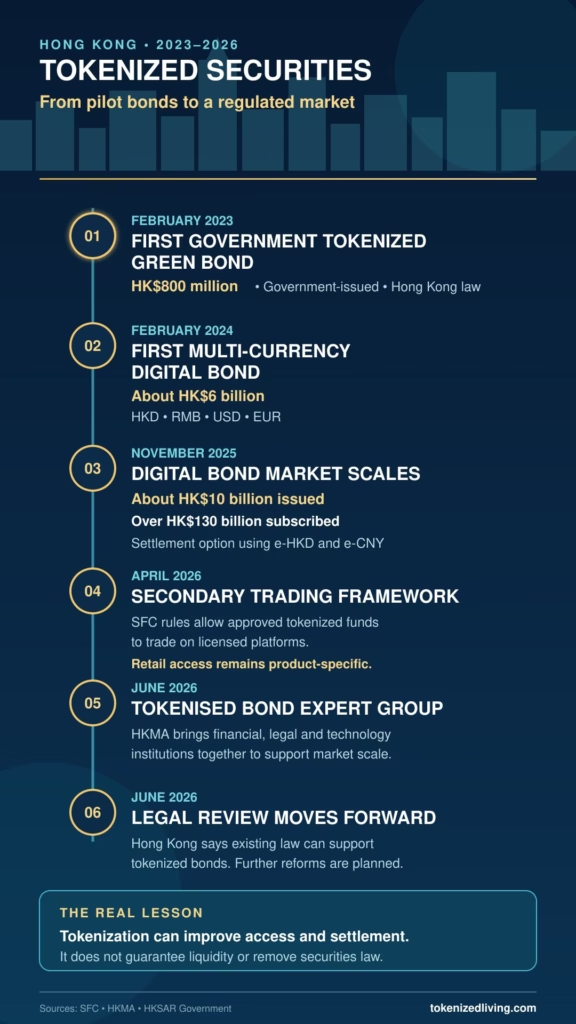
| February 2023 | Government issued its first HK$800 million tokenized green bond |
| November 2023 | SFC introduced guidance for tokenized securities and investment products |
| January 2024 | GF Securities completed a tokenized securities issuance under Hong Kong law |
| February 2024 | Government issued approximately HK$6 billion in multi-currency digital green bonds |
| March 2024 | HKMA launched Project Ensemble |
| 2024 | SFC authorized Hong Kong’s first retail tokenized investment product |
| Early 2025 | SFC authorized three retail tokenized money market funds |
| June 2025 | Government published its Digital Assets Policy Statement 2.0 |
| November 2025 | Government issued approximately HK$10 billion in digital green bonds |
| November 2025 | Project Ensemble entered its real-value transaction phase |
| April 2026 | SFC introduced updated rules for tokenized products and secondary trading |
| June 2026 | HKMA formed a Tokenised Bond Expert Group |
| June 2026 | Government confirmed that existing laws can support tokenized bond issuance |
This progression matters.
Hong Kong has moved from testing whether tokenization works to examining how it can operate at greater scale.
GF Securities Was an Issuer, Not the Regulator
The original version of this article incorrectly described GF Securities as Hong Kong’s securities regulator.
That was wrong.
The Securities and Futures Commission regulates Hong Kong’s securities and futures markets. GF Securities is a financial-services company.
In January 2024, GF Securities Hong Kong issued tokenized securities under Hong Kong law. According to the company, it became the first Chinese brokerage firm to mint, issue and distribute tokenized financial assets originated by itself.
The transaction used the public Ethereum network. It also followed the SFC’s November 2023 regulatory guidance.
GF Securities provided an important private-sector example. However, it did not create Hong Kong’s tokenized-securities framework.
You can read the GF Securities announcement for details of the transaction.
Hong Kong’s Three Government Digital Bond Offerings
Government bond issuance provides the strongest evidence of Hong Kong’s progress.
The 2023 Tokenized Green Bond
In February 2023, the Hong Kong government issued an HK$800 million tokenized green bond.
It was the world’s first tokenized green bond issued by a government.
The one-year bond used distributed-ledger technology for its primary issuance and settlement processes. The transaction helped Hong Kong test how existing laws and financial infrastructure could support digital bonds.
More importantly, it produced evidence that a tokenized bond could operate within the conventional financial system.
The 2024 Multi-Currency Digital Green Bonds
Hong Kong expanded the model in February 2024.
The government issued approximately HK$6 billion in digital green bonds across four currencies:
- Hong Kong dollars
- renminbi
- US dollars
- euros
This became the world’s first multi-currency digitally native bond offering.
The bonds used HSBC Orion as the digital-assets platform. Investors could also access them through existing infrastructure connected to Euroclear and Clearstream.
That hybrid access was important.
It allowed traditional institutional investors to participate without forcing them to adopt an entirely blockchain-native system.
The official 2024 bond announcement provides the complete structure.
The 2025 HK$10 Billion Offering
The third issuance arrived in November 2025.
Hong Kong priced approximately HK$10 billion in digital green bonds. Once again, the offering covered Hong Kong dollars, renminbi, US dollars and euros.
Subscriptions exceeded HK$130 billion. At the time, it was the world’s largest digital bond issuance.
The transaction also introduced settlement using tokenized central-bank money for the Hong Kong dollar and renminbi tranches. Investors could use e-HKD and e-CNY alongside traditional settlement methods.
This connected two sides of the transaction:
- the tokenized security
- the tokenized money used for settlement
Connecting both sides can reduce settlement delays and counterparty exposure.
However, the transaction still used regulated institutions, the HKMA’s Central Moneymarkets Unit and HSBC Orion. It was not an anonymous blockchain trade.
Hong Kong’s government has since committed to making tokenized bond issuance a regular programme. The 2025 digital green-bond announcement confirms the figures and settlement structure.
How Hong Kong Regulates Tokenized Securities
Hong Kong generally applies existing financial rules to tokenized products.
A security does not stop being a security because somebody places it on a blockchain.
The SFC uses what it calls a “see-through approach.” Regulators examine the underlying product before considering its tokenized format.
Therefore, a tokenized fund must still comply with the rules that apply to the original fund. The tokenization layer then introduces additional requirements.
Under the SFC’s revised April 2026 guidance, product providers remain responsible for:
- maintaining accurate ownership records
- protecting investors’ data
- managing cybersecurity risks
- preparing for system outages
- testing smart-contract integrity
- maintaining recovery and continuity plans
- explaining whether settlement becomes final on-chain or off-chain
- disclosing what legal or beneficial ownership the token represents
Distributors must also be regulated intermediaries.
As a result, investors still face identity checks, onboarding rules and suitability requirements. Holding a compatible wallet does not automatically provide access.
What Changed for Secondary Trading in 2026?
The SFC introduced another important change in April 2026.
Its new framework allows secondary trading of approved tokenized investment products through SFC-licensed virtual-asset trading platforms.
The requirements mainly target tokenized versions of SFC-authorized open-ended funds. Other products may receive approval under modified conditions.
Retail investors can participate in approved products. However, platforms and product providers must introduce safeguards.
These include:
- price-deviation warnings
- real-time or near-real-time net asset value information
- market-making arrangements
- liquidity monitoring
- risk disclosures
- trading controls
- client confirmation of the risks
- contingency plans if market makers withdraw
These rules expose an uncomfortable truth.
Tokenization does not create liquidity by itself.
The SFC specifically warns that trading may become extremely thin. Prices could also move above or below the fund’s net asset value, especially during weekends or outside normal Hong Kong market hours.
A token can transfer quickly while remaining difficult to sell at a fair price.
The SFC secondary-trading circular explains these protections and limitations.
Can Retail Investors Buy Tokenized Securities in Hong Kong?
Some can.
In 2024, the SFC authorized Hong Kong’s first tokenized investment product for retail access. The product gave investors fractional exposure to physical gold.
During the first quarter of 2025, the SFC also authorized three retail tokenized money market funds.
By the end of March 2025, those funds held more than HK$700 million in combined assets under management, according to a Hong Kong government response to the Legislative Council.
Nevertheless, this does not mean every tokenized security is open to the public.
Access depends on:
- SFC authorization
- the product structure
- investor classification
- distribution rules
- jurisdiction
- platform eligibility
- suitability requirements
Government digital bonds have mainly targeted institutional investors. Private tokenized notes may also remain limited to professional investors.
Consequently, investors must examine each product separately.
Project Ensemble Connects Tokenized Assets and Money
Issuing a tokenized asset solves only part of the transaction.
Investors also need a reliable form of money for settlement.
The Hong Kong Monetary Authority launched Project Ensemble in March 2024. The project explores financial infrastructure for transactions involving tokenized deposits and digital assets.
Its early sandbox examined use cases involving investment funds, bonds, commodities and real-world asset revenue streams.
In November 2025, the HKMA moved the project into Ensemble TX. This pilot supports real-value transactions rather than using test assets alone.
Tokenized bank deposits play a central role.
These deposits represent claims against commercial banks. Participating institutions can use them to settle transactions involving approved tokenized assets.
This matters because fragmented settlement remains one of tokenization’s largest weaknesses.
A tokenized fund on one network is not especially useful if the investor must move money through several disconnected banking and blockchain systems.
Project Ensemble attempts to connect those layers.
Hong Kong’s approach also complements institutional fund-distribution systems such as Calastone’s tokenized fund network. Both focus on financial infrastructure rather than speculative crypto trading.
Policy Statement 2.0 and the LEAP Framework
Hong Kong published its second digital-assets policy statement in June 2025.
The policy introduced the LEAP framework:
- Legal and regulatory streamlining
- Expanding tokenized products
- Advancing real-world use cases
- People and partnership development
The government committed to regular tokenized bond issuance. It also supported secondary trading of tokenized exchange-traded funds through licensed channels.
Furthermore, policymakers identified possible use cases involving metals, renewable energy and other real-world assets.
However, the strategy does not treat tokenization as a regulatory shortcut.
The policy emphasizes investor protection, risk management and licensed service providers. It also calls for further legal analysis covering settlement, ownership records and tokenized bond transactions.
The Digital Assets Policy Statement 2.0 provides the full roadmap.
Hong Kong’s Tokenised Bond Expert Group
In June 2026, the HKMA formed a Tokenised Bond Expert Group.
The group includes financial institutions, industry organizations, legal advisers and technology providers. Its purpose is to identify the barriers preventing tokenized bonds from reaching greater scale.
By that point, Hong Kong’s three government issuances had exceeded HK$16 billion in total value.
The problem was no longer whether Hong Kong could issue a digital bond.
The harder questions concerned:
- legal ownership records
- electronic documentation
- market standards
- interoperability
- secondary trading
- integration with existing settlement infrastructure
Later that month, Hong Kong completed the first phase of its legal review.
The government concluded that the existing framework was already flexible enough to support tokenized bond issuance. It also confirmed that companies could maintain registers of debenture holders using distributed-ledger technology.
The next phase will examine electronic execution and how concepts such as possession and transfer apply to digitally native fixed-income instruments.
That work could remove some of the remaining legal friction. The June 2026 government update explains the proposed changes.
Tokenized Securities vs Traditional Securities
| Area | Traditional Securities | Tokenized Securities |
|---|---|---|
| Ownership record | Central registers and custodians | Blockchain record connected to regulated ownership records |
| Settlement | Conventional clearing and banking systems | Can combine DLT with tokenized deposits or central-bank money |
| Market hours | Usually follows exchange or fund hours | May support extended trading, subject to platform rules |
| Transfers | Brokers, custodians and settlement providers | Digital transfers through approved networks |
| Compliance | Conducted by regulated intermediaries | Still required and can include programmable controls |
| Liquidity | Depends on the market and buyers | Still depends on buyers and market makers |
| Technology risk | Mainly centralized-system risk | Adds smart-contract, wallet and blockchain risks |
The underlying security may remain unchanged.
A tokenized money market fund still holds money-market assets. A digital bond still represents debt owed by the issuer.
Tokenization changes the infrastructure around the investment. It does not transform the investment itself.
Potential Benefits for Hong Kong
More Efficient Issuance
Digital records can reduce repeated data entry and reconciliation between participants.
Faster Settlement
Tokenized money and securities can move within connected systems. Therefore, institutions may reduce settlement delays and counterparty exposure.
New Distribution Channels
Asset managers can make existing funds available through approved blockchain channels.
Programmable Compliance
Smart contracts can restrict transfers to eligible investors and approved jurisdictions.
Stronger Financial Infrastructure
Banks, law firms, custodians and technology providers can develop new services around tokenized markets.
International Market Position
Hong Kong can position itself as a bridge between traditional capital markets, Mainland China and international digital-asset infrastructure.
These are credible benefits.
Still, Hong Kong needs evidence of sustained trading volume, lower operating costs and broader issuer participation. Announcements alone do not prove economic transformation.
Risks and Limitations
Liquidity Risk
A marketplace does not guarantee a buyer.
Thin trading can create large spreads or force investors to sell below the product’s underlying value.
Platform and Custody Risk
Investors may depend on licensed platforms, wallet providers, custodians and tokenization agents.
A failure at any point could delay access or recovery.
Smart-Contract Risk
Errors in smart contracts may affect transfers, ownership records or settlement.
Audits reduce this risk but cannot eliminate it.
Legal Complexity
A token may represent legal title, beneficial ownership or another contractual interest.
Investors must understand the exact structure.
Fragmentation
Different banks and platforms may use separate blockchains, token standards and settlement systems.
Without interoperability, tokenization can create new silos instead of removing old ones.
Price-Tracking Risk
A tokenized fund may trade above or below its net asset value.
Extended trading hours can increase this problem when the underlying market is closed.
Traditional Investment Risk
Tokenization does not remove credit, interest-rate or market risk.
A weak bond remains weak after tokenization.
Legal risk: A blockchain record does not replace the offering documents. Investors should verify the issuer, ownership structure, custody arrangements, transfer restrictions and legal rights before investing.
What Investors Should Check
Before buying a Hong Kong tokenized security, ask:
- What does the token legally represent?
- Has the SFC authorized the product?
- Who issued the underlying security?
- Who maintains the official ownership record?
- Which platform or custodian holds the token?
- Can investors recover access after losing wallet credentials?
- Who may purchase the token?
- Where can it be traded?
- Does the marketplace have genuine trading activity?
- How closely does the market price follow net asset value?
- Which fees apply to buying, holding and selling?
- What happens if the platform or market maker withdraws?
Do not stop after confirming that a product uses blockchain.
The structure behind the token determines its value.
What Happens Next?
Hong Kong has already proved that it can issue large digital bonds.
The next test is market depth.
Investors should watch:
- private-sector digital bond issuance
- trading volumes for tokenized funds
- adoption of tokenized deposits
- progress under Ensemble TX
- new legal rules for electronic bond documentation
- interoperability between financial networks
- use of tokenized securities as collateral
- evidence of real cost savings
Secondary-market activity will matter more than another headline-grabbing pilot.
If tokenized products remain difficult to trade, their digital format will have limited value.
Final Verdict
Hong Kong has become one of the most credible tokenized-securities markets in Asia.
That credibility comes from its financial infrastructure, not from blockchain hype.
The city has issued more than HK$16 billion in government digital bonds. It has approved retail tokenized investment products and introduced controlled secondary trading. Project Ensemble has also moved into real-value transactions.
Nevertheless, Hong Kong has not created an open, instantly liquid market for every investor.
Most products remain regulated financial instruments. Access restrictions, intermediaries and conventional investment risks still apply.
The token changes how the security is recorded and transferred.
It does not remove the law, the issuer or the risk.
Hong Kong’s strategy is less revolutionary than the original article suggested. However, it is far more serious.
FAQs
Are tokenized securities legal in Hong Kong?
Yes. Hong Kong permits tokenized securities within its existing financial laws and SFC regulatory framework. Product providers may also need specific authorization or prior approval.
Is GF Securities Hong Kong’s regulator?
No. GF Securities is a financial-services company. The Securities and Futures Commission regulates Hong Kong’s securities market.
Can retail investors buy tokenized securities?
Retail investors can access certain SFC-authorized tokenized investment products. However, many private notes and institutional digital bonds remain restricted.
Does a tokenized security provide direct ownership?
Not always. The token might represent legal ownership, beneficial ownership, fund units, debt or contractual rights. Investors must read the offering documents.
Are Hong Kong’s tokenized securities issued on Ethereum?
Some private issuances, including GF Securities’ 2024 transaction, used Ethereum. Government digital bonds and institutional projects may use other regulated platforms and networks.
Can tokenized securities trade 24 hours a day?
The technology may support extended trading. However, platform rules, market makers, fund dealing windows and the availability of underlying price data can restrict trading.
Does tokenization guarantee liquidity?
No. Liquidity depends on buyers, sellers, market makers and trading demand. A token can move quickly while remaining difficult to sell.