

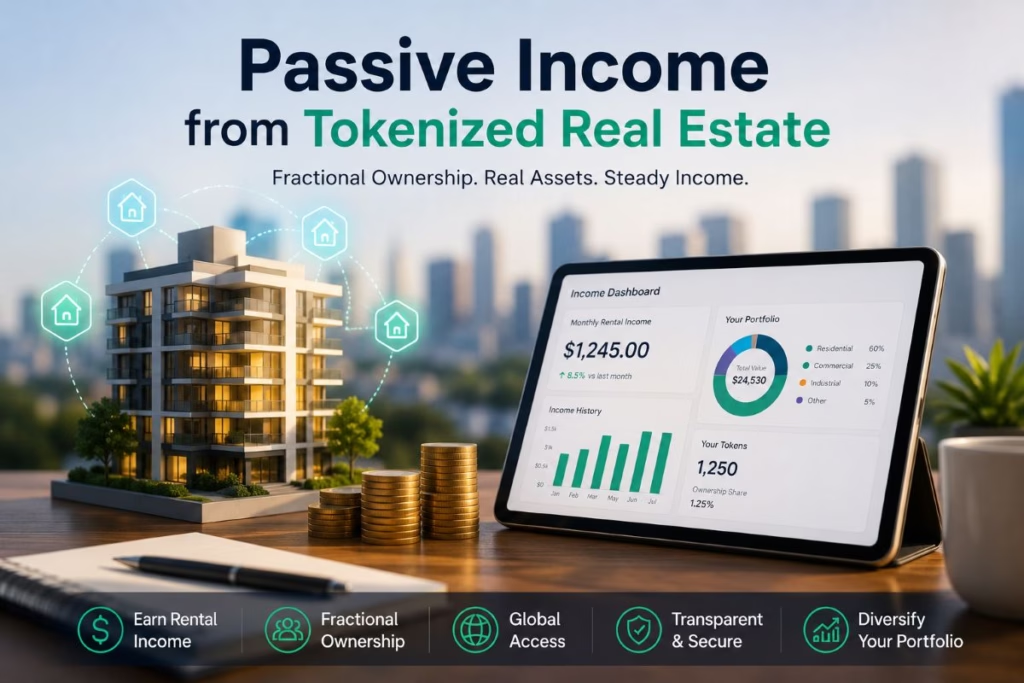
Tokenized real estate is often sold as a simple way to earn passive income from property.
That sounds attractive, but it needs a reality check.
A token does not remove vacancy risk, repair costs, weak management, tax issues, or platform failure. It only changes how access to the property investment is structured.
So the real question is not whether tokenized real estate can produce income.
The better question is how that income is created, who controls it, what can reduce it, and whether investors can sell their tokens later.
This guide explains how passive income from tokenized real estate works, where the money comes from, which risks matter, and what to check before investing.
TL;DR — Passive Income from Tokenized Real Estate
Tokenized real estate lets investors buy fractional exposure to property through digital tokens.
Most income comes from rent collected by the underlying property.
Platforms may distribute income weekly, monthly, quarterly, or according to their own rules.
Returns are not guaranteed. Vacancies, repairs, fees, taxes, poor management, and weak demand can reduce or stop payments.
Liquidity should never be assumed. A token can still be difficult to sell.
The legal structure matters more than the blockchain.
Passive income from tokenized real estate may suit a diversified portfolio, but it should not be treated as a shortcut to financial freedom.
Some links in this article may be affiliate links. If you choose to invest through them, we may earn a small commission at no extra cost to you.
This article is for education only. It is not financial, legal, or tax advice.
What Passive Income Means in Tokenized Real Estate
Passive income from tokenized real estate usually means income paid to investors from a rental property or real estate project.
In many cases, a platform lists a property, divides the investment into smaller digital units, and sells those units to investors.
Each token may represent ownership in a legal entity, a share of income rights, or another claim linked to the asset.
Rent is collected from tenants. Operating costs are deducted. The remaining amount may then be distributed to token holders.
That process can feel passive because investors are not handling tenants, repairs, insurance, or rent collection themselves.
However, someone still has to manage the asset.
A property manager must keep tenants in place. The platform must calculate payments correctly. Legal agreements must protect investors. Local rules must be followed.
For that reason, tokenized real estate is not effortless income. It is outsourced property exposure.
That distinction matters.
How the Income Flow Works
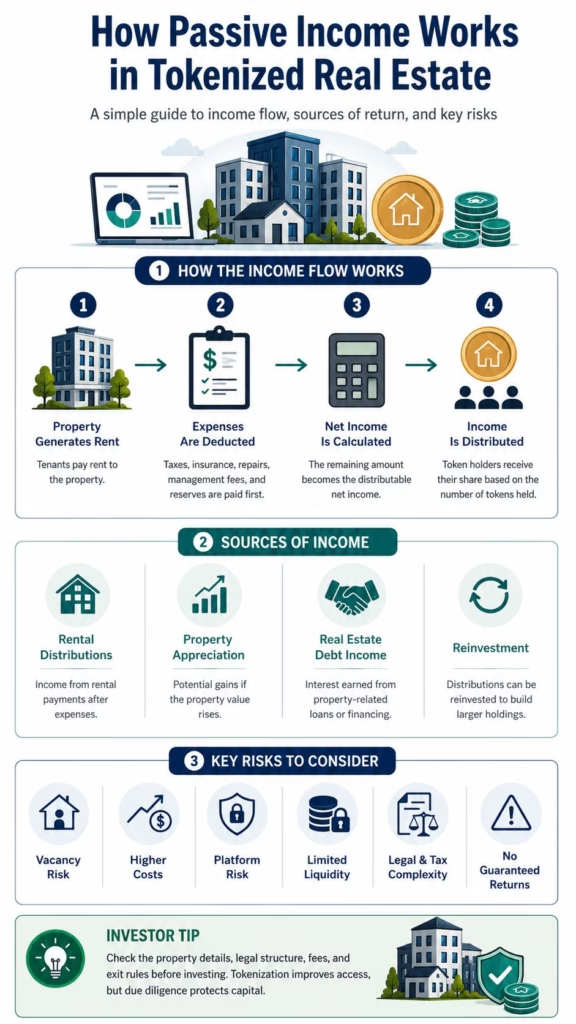
The income path normally follows a simple chain.
First, a platform or sponsor selects a property.
Next, the property is placed inside a legal structure, such as an LLC, SPV, company, or fund.
After that, tokens are issued to represent fractional rights connected to that structure.
Tenants pay rent to the property owner or manager.
Operating expenses come out before investors receive anything.
Those expenses may include repairs, insurance, property taxes, platform fees, management fees, legal costs, and reserves.
Once the net amount is calculated, eligible token holders receive their share.
On paper, this looks clean.
In practice, the details decide whether the investment is attractive.
A high gross rent figure means little if maintenance costs are heavy. Regular payments look good until a property becomes vacant. A smooth app can hide weak legal rights.
Investors need to follow the money from tenant payment to final distribution.
Anything vague in that chain is a warning sign.
A Simple Example
Imagine a rental property valued at $200,000.
The platform divides the investment into 20,000 tokens.
An investor buys 200 tokens, giving them 1% of the tokenized economic interest.
During the year, the property collects $16,000 in rent.
Management fees, repairs, insurance, taxes, and reserves reduce the distributable amount to $10,000.
With a 1% share, the investor receives $100 before personal taxes.
That example is basic, but it shows the key point.
Projected yield is not the same as final income.
Gross rent is not the same as cash received.
A serious investor checks net income after costs, not just the advertised return.
Where the Income Comes From
Tokenized real estate income can come from several sources.
Rental Distributions
Rental income is the main model for many tokenized property platforms.
A tenant pays rent. The property manager collects it. Costs are deducted. Token holders may receive a share.
This model is easy to understand because it is based on ordinary property economics.
Still, rental income can fall. A tenant may leave. Repairs may rise. Local taxes or insurance costs may increase.
No blockchain can fix a bad tenant or a weak property market.
Property Appreciation
Some investors also hope the property rises in value.
When a property is sold, token holders may receive part of the gain if the legal structure allows it.
Appreciation should be treated as uncertain.
Interest rates, employment trends, local demand, regulation, and property condition can all affect value.
Buying tokens for income is one thing. Depending on future price growth is another.
Real Estate Debt
Not every tokenized real estate product works like ownership.
Some products are closer to real estate lending.
In that model, investors may earn interest from a loan connected to a property, developer, or project.
Debt products require a different set of questions.
Who is the borrower? What protects lenders? Is the loan secured? Where do investors sit if something goes wrong?
A debt token can look simple, but the risk may be hidden inside the loan terms.
Reinvestment
Certain platforms allow investors to reinvest distributions into more tokens.
Compounding can help over time if the assets perform well.
Yet reinvestment also increases exposure.
Keeping every payment on the same platform can create concentration risk. The investor may end up with too much money tied to one company, one legal structure, or one market.
Reinvestment is a tool, not a guarantee.
Tokenized Real Estate vs REITs vs Direct Property
Tokenized real estate is often compared with REITs and direct property ownership.
That comparison is useful, but investors need to understand the trade-offs.
| Feature | Tokenized Real Estate | REITs | Direct Property |
|---|---|---|---|
| Entry cost | Often lower | Usually low for public REITs | High |
| Income source | Rent, project income, or loan income | Dividends | Rent |
| Liquidity | Limited or platform-dependent | Usually higher for public REITs | Low |
| Control | Low | Very low | High |
| Management work | Usually outsourced | Handled by REIT | Owner responsibility |
| Diversification | Depends on assets bought | Often broad | Usually limited |
| Complexity | Medium to high | Low to medium | High |
Public REITs are usually easier to buy and sell.
Direct property gives more control, but it demands more capital and more work.
Tokenized real estate sits between those two options. It may offer property-level exposure with smaller investment amounts, while still requiring serious due diligence.
For many investors, the right question is not which option sounds most exciting.
A better question is which one fits their risk tolerance, time horizon, tax position, and need for liquidity.
Benefits of Tokenized Real Estate for Passive Income
The benefits are real.
The hype around those benefits is the problem.
Lower Entry Amounts
Traditional property investing often needs a large deposit, legal fees, financing, and ongoing cash reserves.
Tokenized real estate can reduce the starting amount.
Smaller entry points may help investors spread money across several properties instead of concentrating everything in one asset.
Less Day-to-Day Management
Token holders usually do not handle tenants, rent collection, inspections, or repairs.
That makes the experience more passive than owning a rental property directly.
Still, passive management creates reliance on other people.
If the manager performs badly, investors feel the damage through weaker income and lower asset value.
Property-Level Choice
Some platforms allow investors to review individual properties before buying.
That can be useful because investors can compare location, tenant status, yield estimates, purchase price, and costs.
Even so, choosing a property from a dashboard is not the same as controlling it.
Most token holders cannot choose tenants, approve repairs, refinance debt, or decide when to sell.
Diversification
Fractional investing may allow investors to spread capital across different properties, cities, and asset types.
That can reduce damage from a single vacancy or local issue.
Diversification only works if the risks are genuinely different.
Owning ten tokens on the same platform, in the same market, under the same structure, is not as diversified as it may look.
More Efficient Distribution
Digital ownership records can make income tracking and distribution more efficient.
Automation may reduce friction compared with older private real estate structures.
Efficiency is useful, but it should not distract from the asset itself.
The property still has to produce income.
Risks Investors Must Understand
Old articles often hide the risks in a short disclaimer.
That is not good enough for this topic.
Income Is Not Guaranteed
Rental distributions depend on property performance.
Vacancy, late payment, repairs, legal disputes, higher taxes, insurance costs, and management problems can reduce income.
Expected yield should be treated as an estimate.
Only actual payments matter.
Liquidity May Be Weak
Tokenized real estate can be easier to transfer than a whole property.
That does not mean it is easy to sell.
A platform may use an internal marketplace. Buyer demand may be thin. Rules may limit who can purchase the token. Some assets may have lockups or transfer restrictions.
Anyone who may need quick access to cash should be careful.
Semi-liquid assets do not belong in an emergency fund.
Platform Risk Is Serious
A tokenized property investor relies on the platform.
The platform may handle onboarding, compliance, payment tracking, investor records, asset updates, and secondary trading.
If the company fails or operates badly, investors may face delays, confusion, or losses.
Strong property economics are not enough when the platform layer is weak.
Legal Rights Matter More Than Token Mechanics
The token is only the wrapper.
Real protection comes from legal documents, ownership structure, investor rights, custody arrangements, and local regulation.
Does the token represent equity, debt, income rights, or something else?
Can token holders vote?
What happens if the property is sold?
Which court or regulator has authority?
Clear answers are essential.
Fees Can Eat the Yield
Platforms and property managers may charge several types of fees.
Acquisition fees, management fees, maintenance reserves, selling fees, legal costs, currency conversion, and blockchain transaction costs can all reduce returns.
Net income matters more than headline yield.
A property with an attractive gross return can look average after costs.
Tax Can Be Messy
Tax treatment depends on where the investor lives, where the property is located, and how the investment is structured.
Distributions may be treated differently depending on whether they come from rent, dividends, interest, or capital gains.
Cross-border investing can add withholding tax, reporting rules, and currency issues.
Guessing is a bad strategy.
Property Risk Still Exists
A tokenized property remains a property investment.
Markets can fall. Tenants can leave. Buildings can need repairs. Local rules can change.
Tokenization improves access, but it does not remove real estate fundamentals.
That is the part many sales pages underplay.
Platform Examples
Several platforms have helped bring tokenized real estate to retail investors.
Our RealT review looks at how the platform approaches tokenized rental property exposure.
Our Lofty review covers its fractional U.S. real estate model and income features. Lofty focuses on fractional U.S. real estate with low minimum investment amounts and rental income features.
Our Reental review explains its approach to tokenized real estate and rental income distributions.
These examples show the range of models in the market.
They should not be treated as automatic recommendations.
Before using any platform, compare the legal structure, property details, fees, liquidity rules, investor protections, and tax documents.
A platform’s marketing page is only the starting point.
Checklist Before Investing
Use this checklist before buying any tokenized real estate asset.
Property Checks
Where is the property?
Is it already rented?
Who manages it?
What are the current costs?
Are repairs expected?
How realistic is the projected income?
What happens during vacancy?
Platform Checks
Who operates the platform?
How long has it been active?
What records does it publish?
How are distributions calculated?
What happens if the platform shuts down?
Does support answer clearly?
Legal Checks
What does the token represent?
Which legal entity owns the property?
Do token holders have voting rights?
What happens if the property is sold?
Which jurisdiction controls the agreement?
Is the offering regulated?
Liquidity Checks
Can tokens be sold?
Where does selling happen?
Are there enough buyers?
Do transfer restrictions apply?
What fees apply when exiting?
How long could a sale take?
Tax Checks
What tax documents are provided?
Are distributions treated as rent, dividends, interest, or capital gains?
Does foreign withholding tax apply?
Will currency conversion create extra reporting?
Is specialist tax advice needed?
Weak answers should stop the investment.
Confusion is not a minor detail when money is involved.
Who Might Consider Tokenized Real Estate?
Tokenized real estate may suit investors who want smaller exposure to income-producing property.
It may also interest people who already understand real estate risk and want another way to diversify.
The best fit is usually a patient investor.
Liquidity may be limited, so the money should not be needed quickly.
A cautious allocation makes more sense than a large bet.
For most people, tokenized real estate should sit around the edges of a portfolio, not at the centre.
Emergency savings, debt control, pensions, retirement accounts, and broad investments still come first.
Who Should Avoid It?
Many people should avoid tokenized real estate.
Anyone needing fast access to cash should stay away.
Investors who do not understand the legal structure should wait.
People chasing yield without reading documents are asking for trouble.
A beginner who wants simple exposure to property may be better served by learning about REITs first.
Complex investments are not automatically better.
Sometimes boring is safer.
Common Mistakes
The first mistake is believing projected yield.
A forecast is not income.
The second mistake is confusing tokenization with liquidity.
A token can be recorded on a blockchain and still have no buyer.
Another mistake is focusing on the technology instead of the property.
The tenant, location, costs, legal rights, and manager usually matter more than the blockchain.
Over-concentration is also common.
Buying several assets on one platform may still leave the investor exposed to the same company, marketplace, legal setup, and operational risk.
Real diversification needs more than multiple tokens.
Market Insight: Access Is the Real Story
The strongest case for tokenized real estate is access.
Smaller investment sizes may allow more people to participate in property-backed income.
Digital records may also make ownership and distributions easier to manage.
That is useful.
It does not make the asset safe.
Serious investors should focus on net yield, legal rights, exit options, fees, taxes, and downside risk.
Ignore anyone selling tokenized real estate as effortless income.
Final Thoughts
Passive income from tokenized real estate is possible.
It is not guaranteed.
In the best version, tokenized real estate gives investors a smaller and more flexible way to access income-producing property.
The weak version becomes another overhyped investment wrapped in smooth technology and weak explanations.
Due diligence decides the difference.
Check the property. Review the platform. Read the legal documents. Understand the fees. Think about tax. Plan for limited liquidity.
Tokenized real estate may earn a place in a diversified portfolio, but it should never be treated as a shortcut to financial freedom.
Legal Risk Box
Tokenized real estate can involve securities law, property law, digital asset regulation, and cross-border tax rules.
Rules vary by jurisdiction.
A token does not automatically give investors the same rights as direct property ownership.
Before investing, read the platform documents and speak with a qualified financial, legal, or tax professional where needed.
This article is for informational purposes only and should not be taken as investment advice.
Frequently Asked Questions
Can tokenized real estate generate passive income?
Yes, some tokenized real estate platforms distribute income from rental properties or real estate projects. Income depends on property performance, fees, occupancy, tax treatment, and platform rules.
Is passive income from tokenized real estate guaranteed?
No. Vacancies, repairs, higher costs, platform problems, market downturns, and legal changes can reduce or stop distributions.
How often do platforms pay income?
Payment schedules vary. Some platforms may pay weekly, monthly, quarterly, or after specific project events. Always check the terms before investing.
Is tokenized real estate better than REITs?
Not always. REITs are usually simpler and more liquid, especially if publicly traded. Tokenized real estate may offer property-level exposure, but it often requires more due diligence.
Can I sell my tokenized real estate tokens anytime?
Not necessarily. Selling depends on platform rules, buyer demand, transfer restrictions, and secondary market access.
Do I own the actual property?
That depends on the structure. Some tokens may represent ownership in a legal entity. Others may represent income rights, debt, or another claim. Read the legal documents before investing.
What is the biggest risk?
The biggest risks are limited liquidity, weak legal rights, platform failure, poor property performance, unclear regulation, and tax complexity.
Is tokenized real estate suitable for beginners?
Beginners should learn the basics first. Understanding tokenization, fractional ownership, REITs, income distributions, liquidity, and platform risk matters before investing.