
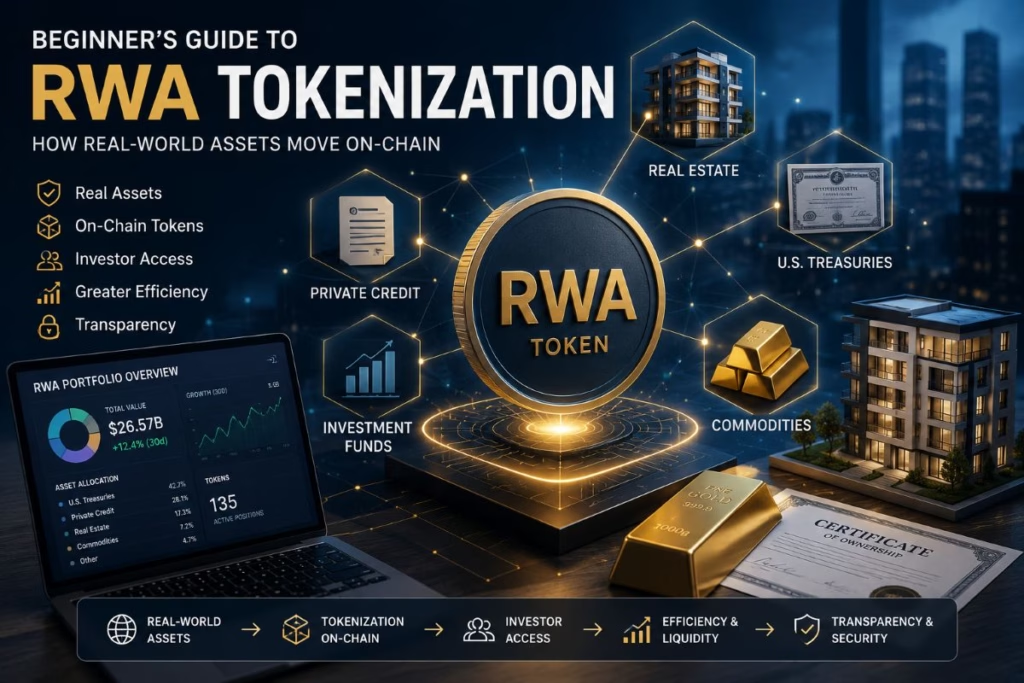
RWA tokenization is moving from crypto theory into real financial markets.
That sounds impressive, but beginners need a plain-English starting point. The phrase can feel technical, and too many explanations make it worse.
Here is the simple version.
RWA tokenization means using blockchain-based tokens to represent rights, claims, shares, or exposure linked to real-world assets.
These assets can include property, government bonds, money market funds, private credit, commodities, invoices, carbon credits, and investment funds.
A building does not move onto a blockchain. Gold does not become software. A Treasury bill does not turn into a crypto coin.
Instead, the token usually points to a legal or financial structure around the asset.
That detail matters more than most marketing pages admit.
For beginners, the first question should not be, “Which token should I buy?”
A better question is this:
What does this token actually represent?
Everything starts there.
TL;DR: RWA Tokenization in Simple Terms
RWA tokenization uses blockchain-based tokens to represent real-world assets or financial claims linked to them.
The asset itself usually stays off-chain.
Blockchain can help record ownership, manage transfers, support settlement, and improve transparency.
Legal structure decides what investors actually own.
One token might represent a fund share. Another may represent a debt claim, company interest, redemption right, or economic exposure.
Beginners should never assume the token equals direct ownership of the underlying asset.
In many cases, it does not.
Why RWA Tokenization Matters Now
Tokenization has been discussed for years.
Early projects often stayed small, overhyped, or poorly explained. Many promised easy access to assets without showing enough legal detail.
Today, the market looks more serious.
RWA.xyz tracks tokenized real-world asset markets across categories such as Treasuries, private credit, commodities, equities, and other products. Its dashboard shows a distributed tokenized RWA value above $26 billion, with much larger represented asset value when stablecoins and broader tokenized asset categories are included.
Large asset managers have also entered the space. BlackRock launched its BUIDL tokenized fund through Securitize in 2024, while Franklin Templeton’s BENJI product is tied to the Franklin OnChain U.S. Government Money Fund.
This does not mean every RWA product is safe.
Serious names help validate the trend, but they do not remove the need for due diligence. Every product still needs clear legal rights, custody, disclosures, transfer rules, and exit options.
For institutions, the appeal goes beyond fractional ownership.
Banks, asset managers, and market infrastructure firms care about settlement, collateral movement, recordkeeping, compliance, and operational efficiency.
Retail investors often focus on smaller entry points.
Both angles matter, but they are not the same.
What Are Real-World Assets?
Real-world assets, often shortened to RWAs, are assets that exist outside blockchain networks.
They can be physical, financial, contractual, or legal.
Common examples include:
- Real estate
- U.S. Treasuries
- Bonds
- Money market funds
- Private credit
- Commodities such as gold
- Art and collectibles
- Carbon credits
- Invoices
- Fund shares
- Private equity interests
An asset does not need to be physical to count as an RWA.
A loan agreement can qualify. So can a bond, fund share, or property-owning company.
Bitcoin is not an RWA. Ether is not an RWA. Meme coins are not RWAs.
A tokenized Treasury fund, however, can be an RWA product.
Property tokens may also fit the category when they represent rights linked to a real estate structure.
The key point is simple: an RWA token points to something outside the blockchain world.
What Is Tokenization?
Tokenization is the process of creating a digital token that represents something else.
In RWA markets, that “something else” connects to a real-world asset or financial claim.
A token may represent:
- A share in a fund
- An interest in a company
- A claim on cash flow
- A debt instrument
- A unit in a money market product
- A right to redeem an asset
- A digital ownership record
- Access to a financial product
This is where many beginners get misled.
A token is not always the asset itself.
For example, a property-linked token may not give you direct ownership of bricks, land, or the deed.
With a gold-backed token, the real question is whether you have a clear claim on metal held in custody.
In private credit, the token may only represent exposure to a loan pool rather than direct ownership of the loan agreement.
Value depends on the legal structure behind the token.
That structure may include a company, trust, fund, custodian, transfer agent, broker-dealer, smart contract, or regulated platform.
Blockchain is only one layer.
The legal wrapper usually matters more.
A token is not always the asset. In many RWA deals, the token is only a digital record of a legal or financial claim.
How RWA Tokenization Works
Most RWA tokenization follows a simple pattern.
Details change by asset class, but the core process usually looks similar.
1. An Asset Is Selected
First, an issuer chooses an asset to tokenize.
That asset might be a property, Treasury fund, private credit pool, commodity reserve, or another financial product.
Good candidates usually have clear ownership, reliable valuation, and defined legal rights.
Tokenized U.S. Treasuries have gained attention partly because they are easier to understand than many private assets. Pricing is clearer. Market depth is stronger. Their role in finance is already well established.
Real estate is more complicated.
Every property has its own title, location, tenants, tax rules, repairs, and management costs.
None of that makes tokenized property impossible.
It simply means the structure needs more scrutiny.
2. A Legal Structure Is Created
After the asset is selected, a legal structure is usually created.
This structure could be a fund, company, trust, special purpose vehicle, or series LLC.
For example, a property may sit inside a company. Investors may then buy tokenized interests linked to that company.
This step is not boring paperwork.
It decides what investors actually own.
The legal wrapper can affect voting rights, payout rights, transfer limits, tax treatment, investor eligibility, and what happens if something goes wrong.
Beginners who skip this part are not doing due diligence.
They are guessing.
3. Tokens Are Issued
Once the structure is ready, tokens are created on a blockchain.
These tokens may record ownership, investor rights, or economic exposure.
Some products use public blockchains. Others use permissioned systems or controlled networks.
Many RWA tokens are not freely tradable like popular crypto tokens.
Compliance rules often apply.
A platform may require identity checks, wallet approval, investor accreditation, or transfer restrictions. Some tokens use allowlists so only approved wallets can hold or receive them.
That may feel less open than crypto.
In regulated markets, restrictions are often part of the design.
4. Investors Buy or Receive Tokens
Investors usually access RWA tokens through a platform, issuer, broker, marketplace, or fund provider.
The process may include KYC checks, eligibility screening, document review, wallet setup, and risk acknowledgements.
For regulated products, this feels more like fintech than old-school crypto.
That is not a bad thing.
When real-world assets are involved, compliance matters.
A slick buying process does not make an investment safe, but serious onboarding can signal that the issuer understands the legal side.
5. The Token Records Rights or Ownership
After purchase, the token records the investor’s position.
Depending on the structure, that position may represent fund shares, company interests, debt exposure, revenue rights, or another type of claim.
Blockchain can make records easier to track.
Smart contracts may also help automate transfers, compliance checks, or investor payouts.
Useful? Yes.
Magic? No.
A smart contract does not replace property law. It does not remove securities rules. It cannot fix a weak custodian or a bad legal claim.
Automation helps only when the surrounding structure works.
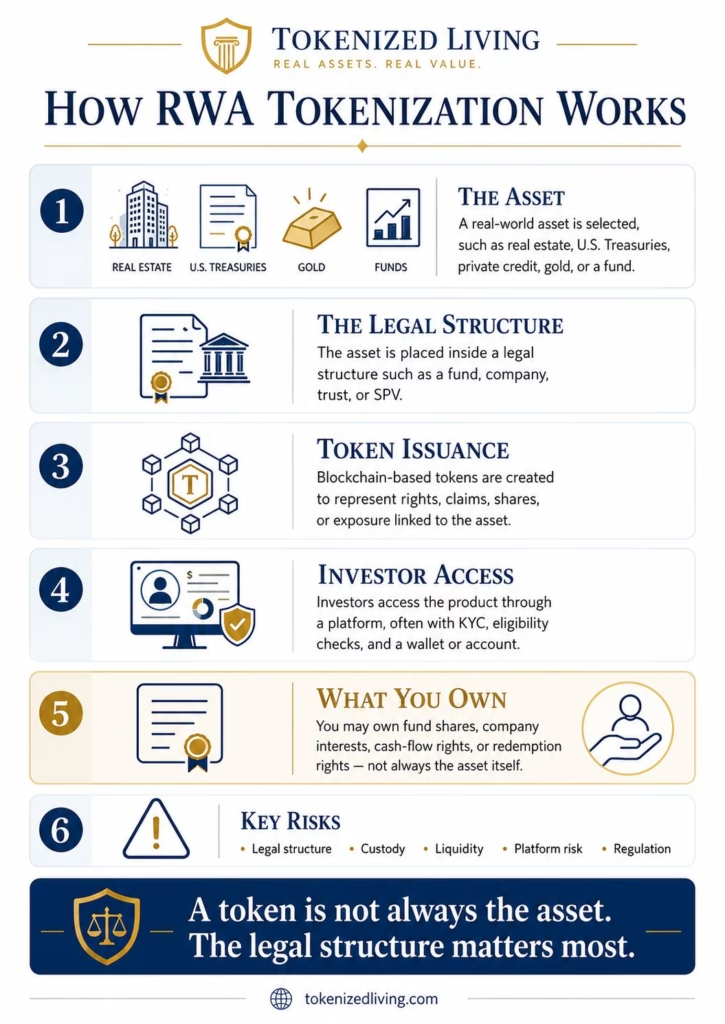
What Do You Actually Own?
This is the most important question in RWA tokenization.
Ownership depends on the product.
You might own:
- A token representing fund shares
- A tokenized interest in a company
- A claim on cash flow
- A debt-linked token
- A digital record of a security
- Asset-backed exposure through a custodian
- Redemption rights under specific terms
You might not own:
- The physical property directly
- The legal deed
- The gold bar itself
- The loan contract itself
- The underlying bond directly
- A guaranteed liquid investment
That difference is huge.
It separates real due diligence from fantasy investing.
Before buying any RWA token, ask four questions.
What legal claim sits behind the token?
Who controls the underlying asset?
How do investors receive value?
Can the token be sold, redeemed, or transferred?
Weak platforms avoid these questions.
Serious platforms answer them clearly.
Common Types of Tokenized Real-World Assets
RWA tokenization is not one single market.
It includes several asset classes, each with different risks.
A tokenized Treasury fund does not behave like a tokenized apartment building.
Private credit, commodities, real estate, and tokenized funds all need separate analysis.
Beginners need to compare the structure, not just the category name.
Not all RWA products work the same way. The table below shows what the token usually represents and where the biggest risk sits.
| Asset Type | What the Token Represents | Main Risk |
|---|---|---|
| Tokenized Real Estate | An interest in a property-owning company, fund, or income-producing structure | Limited liquidity, property risk, and no guaranteed direct ownership of the deed |
| Tokenized U.S. Treasuries | A share or unit in a fund or structure holding short-term government debt | Restricted access, custody risk, and dependence on the legal structure |
| Tokenized Private Credit | Exposure to loans, credit pools, or debt-linked structures | Borrower defaults, weak reporting, and uncertain collateral quality |
| Tokenized Commodities | A claim linked to physical assets held in custody, such as gold | Custody, reserve audits, redemption rights, and storage fees |
| Tokenized Funds | Tokenized shares or units in an investment fund | Investor restrictions, fund fees, and reliance on service providers |
The lesson is simple: the asset type matters, but the legal structure matters more. Two products may both be called “RWA tokens,” yet offer very different rights, risks, and exit options.
Tokenized U.S. Treasuries and Money Market Funds
Tokenized Treasuries and money market funds are among the strongest early RWA use cases.
These products give eligible investors blockchain-based access to short-term government securities or funds that hold them.
The appeal is clear.
Treasuries are familiar, pricing is transparent, and the market is large. Institutional demand already exists.
Crypto markets also need yield-bearing, high-quality collateral.
That makes tokenized Treasury products a natural bridge between traditional finance and blockchain-based markets.
For beginners, this category matters because it shows where serious adoption started.
Momentum did not begin with fantasy assets, vague “asset-backed” tokens, or empty metaverse promises.
Early traction came from boring financial instruments that institutions already understand.
That should shape how you read the wider RWA market.
Tokenized Real Estate
Tokenized real estate is one of the most popular RWA topics for retail investors.
The pitch is easy to understand.
Instead of buying an entire property, investors may buy smaller digital interests linked to a property, property company, or real estate fund.
That can make real estate exposure more accessible.
However, this category is also where beginners make dangerous assumptions.
A tokenized property investment does not always mean direct ownership of the property.
Often, the property is held by a company or legal entity. Token holders may own interests connected to that entity rather than the deed itself.
That structure can be useful.
Smaller investment sizes, digital records, and easier transfers may create real benefits.
Old real estate risks remain.
Tenants can leave. Repairs can rise. Property taxes can change. Local rules can shift. Management can be poor. Legal disputes can freeze property cash flow.
Tokenization does not remove those problems.
It only changes how the investment is packaged and managed.
Tokenized Private Credit
Private credit is another major RWA category.
This usually involves loans or credit products represented through blockchain-based tokens.
Investors may be attracted by yield. Borrowers may see tokenization as a new capital channel.
Platforms can also use blockchain to improve reporting, transparency, and access.
Still, private credit is not beginner-friendly.
Loans can default. Borrowers can fail. Collateral can lose value. Recovery can take time. Reporting may be incomplete.
Putting a loan on-chain does not make it safer.
A bad loan with a token attached is still a bad loan.
Anyone looking at tokenized private credit needs to understand borrower risk, collateral quality, default procedures, and platform reporting.
Without that, the yield number is just bait.
Tokenized Commodities
Commodities such as gold can also be tokenized.
In this model, a token may be backed by physical assets held by a custodian.
At first glance, this sounds simple.
One token. A clear claim. Physical assets sitting in storage.
Reality is more complicated.
Investors still need to know where the commodity is stored, who audits the reserves, whether redemption is allowed, what fees apply, and what happens if the custodian fails.
Reserve transparency matters.
So does the legal claim.
A gold-backed token is only as strong as the custody, audit, and redemption framework behind it.
The token alone proves very little.
Tokenized Funds
Funds may also issue tokenized shares or units.
This area could become important because asset managers already understand fund structures.
Blockchain may improve shareholder recordkeeping, transfer management, settlement, and access to digital asset infrastructure.
Some tokenized funds are designed for institutions. Others may serve accredited or qualified investors.
Retail access is not always available.
That point matters.
“On-chain” does not automatically mean open to everyone.
A product can use blockchain and still have strict investor restrictions.
In fact, many serious RWA products will have limits because they sit inside regulated financial markets.
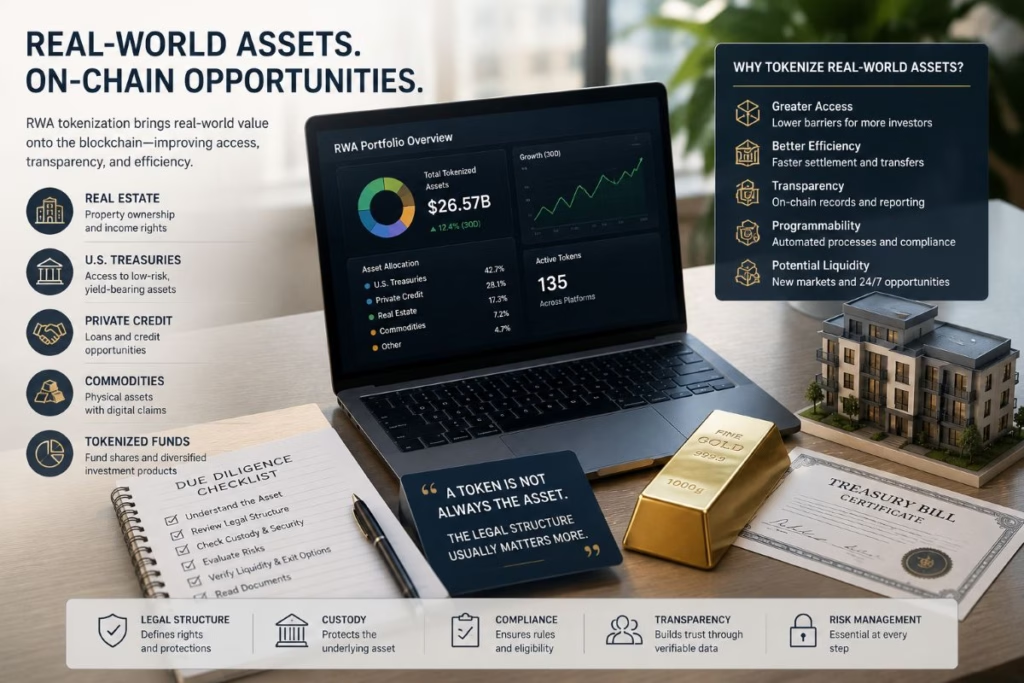
Why Institutions Care About RWA Tokenization
Retail audiences often talk about fractional ownership.
Institutions care about a wider set of problems.
Large financial firms spend huge amounts of time and money on settlement, custody, reconciliation, reporting, collateral movement, and compliance.
Tokenization may help improve some of those processes.
Potential benefits include:
- Faster settlement
- Clearer ownership records
- Easier collateral movement
- Better audit trails
- Programmable compliance
- 24/7 transfer possibilities
- Reduced manual reconciliation
Those benefits sound less exciting than “own a piece of a building.”
They are also more important.
Financial markets are full of old systems that do not communicate smoothly.
Tokenization offers a way to rethink parts of that infrastructure.
That does not mean every institution will rush in.
Legacy systems are slow to change. Regulation takes time. Internal risk teams move carefully.
Even so, the direction is clear.
Tokenization is no longer just a crypto experiment.
It is becoming part of a bigger financial infrastructure conversation.
Market Insight: The First Winners Are Boring
The first serious RWA winners are likely to be boring.
That is not an insult.
Boring assets often have the best chance of adoption because investors already understand them.
Treasuries, money market funds, and fund shares have clearer rules, better pricing, and stronger institutional demand.
Messier assets will take longer.
Real estate has huge potential, but every property is different. Private credit can be attractive, but borrower risk is hard to assess. Commodities need strong custody and reserve checks.
This is why beginners should be careful with loud projects promising instant access to every asset class.
Markets do not usually transform from the messiest corner first.
They start where trust, pricing, and legal clarity are strongest.
RWA Tokenization vs Crypto
RWA tokens and crypto-native tokens are different.
A crypto-native asset exists on a blockchain network.
Bitcoin is the asset. Ether is the asset. Network tokens do not need an apartment building, bond fund, or custodian behind them.
RWA tokens are different because they point to something off-chain.
That creates extra dependencies.
A real-world asset token may rely on legal contracts, custodians, banks, property managers, courts, auditors, transfer agents, and regulators.
None of this makes RWA tokenization bad.
It simply changes the risk profile.
With crypto-native assets, the main risks often sit inside the network, protocol, market, or custody setup.
For RWAs, the bridge between on-chain records and off-chain rights becomes the critical point.
Beginners should pay close attention to that bridge.
RWA Tokenization vs Fractional Ownership
RWA tokenization and fractional ownership are related, but they are not the same thing.
Fractional ownership means an asset or investment is split among multiple participants.
Tokenization means blockchain-based tokens are used to represent rights, records, or exposure.
You can have fractional ownership without blockchain.
REITs, ETFs, syndications, and crowdfunding platforms already give investors fractional access to assets.
Tokenization can also exist without broad retail ownership.
A tokenized institutional fund may run on blockchain while remaining closed to everyday investors.
Here is the clean distinction.
Fractional ownership is about splitting access. Tokenization is about how that access is recorded, transferred, or managed.
Sometimes they overlap.
Other times, they do not.
Benefits of RWA Tokenization
RWA tokenization can offer real benefits when the structure is strong.
Marketing often exaggerates those benefits.
So let’s keep this grounded.
Smaller Investment Sizes
Tokenization can make assets easier to divide into smaller units.
That may help more investors access markets that were previously harder to enter.
Still, a lower minimum does not make an investment attractive by itself.
A poor deal split into tiny pieces remains a poor deal.
Faster Settlement
Traditional finance often depends on slow settlement cycles, intermediaries, and back-office reconciliation.
Blockchain-based records can support faster transfers and settlement.
For institutions, this could be one of the most practical benefits.
Speed matters when assets move between funds, banks, exchanges, or collateral systems.
Better Transparency
Some tokenized products allow investors to view token supply, transfers, or ownership records on-chain.
That can improve visibility.
However, on-chain transparency has limits.
A blockchain record may show that a token moved. It does not automatically prove that the off-chain asset is safe, properly valued, or legally protected.
Investors still need documents, audits, custody details, and issuer disclosures.
Programmability
Smart contracts can automate parts of the process.
Transfers, compliance checks, and distributions may become easier to manage.
Used well, automation can reduce manual work and operational friction.
Used badly, it creates a new layer of technical risk.
Code matters, but it cannot rescue a weak legal structure.
Potential Liquidity
Tokenization may improve secondary market access over time.
That is one of the biggest promises.
Beginners need to be careful here.
A marketplace is not the same as liquidity.
Real liquidity means buyers, volume, fair pricing, and the ability to exit when needed.
Many RWA products are not there yet.
Key Risks Beginners Should Understand
Most beginner guides treat risk too lightly.
That is a serious mistake.
RWA tokenization can be useful, but weak structures can hurt investors.
Legal Risk
The token’s legal status matters.
It may represent a security, a fund unit, debt claim, company interest, or something else.
If the legal claim is unclear, the product becomes dangerous.
Marketing language does not protect investors.
Documents do.
Custody Risk
Someone must hold, control, or administer the real-world asset.
That party might be a custodian, trustee, fund manager, company, or property-owning entity.
Weak custody weakens the whole product.
A token cannot compensate for poor asset control.
Platform Risk
Many investors focus on the asset and ignore the platform.
That is backwards.
The platform may handle onboarding, investor records, transfers, wallet access, compliance, documents, and communication.
If it fails, investors may face delays, confusion, frozen transfers, or worse.
A good asset on a weak platform can still become a problem.
Liquidity Risk
Liquidity is one of the biggest traps in RWA tokenization.
A token may exist, but that does not mean someone wants to buy it.
Secondary markets can be thin. Transfer restrictions can block sales. Buyer demand may disappear when conditions worsen.
Never assume instant exits.
Check the real trading activity.
Valuation Risk
Some assets are easier to price than others.
Treasuries are relatively clear. Real estate requires appraisals and local market knowledge. Private credit can be harder still.
Poor valuation can lead investors to overpay.
If the price looks too smooth or too convenient, dig deeper.
Smart Contract Risk
Smart contracts can fail.
Bugs, exploits, poor upgrades, and bad integrations can create losses.
Security audits help, but they do not remove all risk.
Technical protection should support the legal structure, not replace it.
Regulatory Risk
Rules can change.
A token available in one country may be restricted in another. Some products may only accept accredited, qualified, or institutional investors.
Regulators may also challenge weak offerings.
Compliance is not an annoying side issue.
It shapes who can buy, hold, sell, and redeem the token.
Beginner Due Diligence Checklist
Before trusting any RWA tokenization platform, slow down and ask better questions.
What asset backs the token?
Vague answers are not enough.
“Real estate-backed” tells you almost nothing.
You need specifics. Is it a property, fund, loan pool, commodity reserve, or legal entity? Who controls it? Where are the documents?
Details matter.
What does the token represent?
Find out whether the token represents equity, debt, fund shares, cash-flow rights, or another type of claim.
This question matters more than the website design.
Beautiful dashboards do not equal strong investor rights.
Who owns or controls the asset?
Look for the legal owner.
A property may sit inside an LLC. Fund products may hold securities through a custodian. Commodity tokens may depend on vault storage.
If the ownership chain is unclear, treat it as a warning sign.
How are investor payouts calculated?
For property, expenses usually come first.
Maintenance, insurance, taxes, management fees, reserves, and platform costs may reduce investor payouts.
For credit products, defaults and recoveries matter.
Fund products also need fee and redemption checks.
Always check the calculation, not just the advertised yield.
Can you sell the token?
Look beyond the word “marketplace.”
Does trading actually happen?
Are buyers active?
Do transfer restrictions apply?
Can the issuer freeze, approve, or block transfers?
Potential liquidity is not enough.
What regulations apply?
Check investor eligibility, securities disclosures, offering documents, jurisdiction rules, and transfer limits.
Strong compliance may make a product less open, but it can also make the structure more credible.
No regulation at all is not automatically freedom.
Sometimes it is just danger wearing a crypto hoodie.
What happens if the platform shuts down?
This question exposes weak setups fast.
Investor records, asset claims, legal documents, and redemption procedures should survive platform failure.
If everything depends on one website staying online, the structure is fragile.
Simple Example: Tokenized Property
Imagine a company buys an apartment building.
The deed belongs to that company or a related legal entity.
Next, the issuer creates digital tokens linked to interests in the structure.
Investors buy those tokens.
The property collects rent from tenants.
Before anyone receives payouts, expenses are deducted. These may include repairs, property management, taxes, insurance, legal costs, platform fees, and reserves.
After that, remaining property cash flow may be distributed to token holders.
On the surface, this sounds simple.
Important questions sit underneath it.
Who owns the deed?
What rights do token holders have?
Can investors vote?
How are repairs approved?
What happens during vacancies?
Are payouts guaranteed?
Can tokens be sold?
What happens if the property is sold?
Those answers decide whether the investment makes sense.
The token is only the visible layer.
Simple Example: Tokenized Treasury Fund
Now imagine a regulated fund that holds short-term U.S. government securities.
The fund issues tokenized shares or units.
Each token represents a position in that fund.
Investors may hold the token through an approved platform or compatible wallet.
Blockchain helps record ownership and manage transfers.
Behind the scenes, traditional financial infrastructure still matters.
Legal documents, asset managers, custodians, administrators, compliance procedures, and investor rules remain part of the product.
Compared with tokenized real estate, this structure may be easier to understand because the underlying assets are more standardized.
That is one reason tokenized Treasury products have gained traction earlier.
The asset is familiar.
Operational benefits are clearer.
What Beginners Get Wrong About RWA Tokenization
Most beginner mistakes come from oversimplification.
The market is easy to misunderstand because the language sounds cleaner than the reality.
Mistake 1: Thinking the Token Is the Asset
A token often represents a right, a claim, share, or record.
It is not always the asset itself.
Mistake 2: Ignoring the Legal Wrapper
The legal structure matters more than the blockchain.
A clean smart contract cannot fix a weak legal claim.
Mistake 3: Assuming Liquidity
Existence does not equal liquidity.
A token can sit on a marketplace with almost no buyers.
Mistake 4: Trusting Platform Marketing
Every platform says it improves access.
That statement means very little on its own.
Documents, disclosures, asset quality, and exit options matter more.
Mistake 5: Treating All RWAs the Same
A tokenized Treasury fund is not the same as a tokenized apartment building.
Private credit, commodities, real estate, and funds all carry different risks.
Beginners who lump them together will miss important details.
Is RWA Tokenization Safe?
RWA tokenization can be safer or riskier depending on the product.
A regulated tokenized money market fund from a major asset manager is very different from an anonymous website selling vague “asset-backed” tokens.
Technology is not the deciding factor.
Structure is.
Safety depends on asset quality, legal rights, custody, issuer credibility, regulation, platform operations, liquidity, transparency, and investor protections.
So the better question is not:
“Is RWA tokenization safe?”
Ask this instead:
Is this specific tokenized product well structured?
That is how serious investors think.
The Future of RWA Tokenization
RWA tokenization will probably grow, but not every asset class will grow at the same speed.
The clearest progress is likely to come from assets with strong legal frameworks, reliable pricing, and clear institutional demand.
Treasuries, money market funds, and fund shares fit that pattern.
Compared with private assets, they are easier to value, explain, and use at an institutional scale.
Real estate sits in a different category.
The opportunity is obvious, but execution is harder. Every property has its own title, tenants, costs, repairs, local rules, and management problems.
Private credit may also expand as investors search for yield.
However, credit risk does not disappear because a loan sits behind a token. Borrowers can still default. Collateral can still lose value. Reporting can still disappoint.
Over time, the strongest RWA platforms will not win because they use blockchain.
They will win because they make ownership rights, reporting, custody, and investor exits clearer than the old system.
That is the real test.
The market does not need more shiny tokens attached to vague assets.
It needs better structures, cleaner disclosures, stronger compliance, and products that solve real financial problems.
Some platforms will get there.
Many will not.
Final Thoughts: Start With the Claim, Not the Token
RWA tokenization could become one of the most important bridges between traditional finance and blockchain.
The idea has real value.
Assets can become easier to divide, record, transfer, and manage. Investors may also gain new ways to access real estate, bonds, funds, credit, and commodities.
Still, beginners need to stay grounded.
A token does not automatically mean direct ownership. Liquidity is not guaranteed. Legal risk still exists. Weak investments do not become strong because someone adds a blockchain layer.
The real question is simple:
What claim sits behind the token?
Before trusting any RWA product, check the asset, legal structure, custodian, issuer, fees, restrictions, and exit options.
Look at how investor payouts work.
Read the documents.
Then ask what happens if the platform fails.
That is where proper due diligence starts.
RWA tokenization is not just a blockchain trend. It is a new way to package, record, and move financial claims.
Useful products will emerge.
So will dressed-up speculation.
The token may catch your eye.
But the structure decides whether the investment deserves your money.
FAQs
What does RWA tokenization mean?
RWA tokenization means creating blockchain-based tokens that represent rights, claims, shares, or exposure linked to real-world assets. These assets can include real estate, bonds, money market funds, private credit, commodities, or investment funds.
What are examples of tokenized real-world assets?
Common examples include tokenized U.S. Treasuries, tokenized money market funds, tokenized real estate, tokenized private credit, tokenized gold, and tokenized fund shares.
Do RWA tokens mean I own the real asset directly?
Not always. Some tokens represent direct ownership records, but many represent shares, fund units, debt claims, membership interests, or economic rights. The legal structure decides what you actually own.
Is tokenized real estate the same as owning property?
Usually, no. Many tokenized real estate products give investors an interest in a company or structure connected to the property, not direct ownership of the deed.
Why are institutions interested in RWA tokenization?
Institutions are interested because tokenization may improve settlement, collateral movement, recordkeeping, transparency, and operational efficiency. It may also support programmable compliance and faster transfers.
Are RWA tokens regulated?
Many RWA tokens may fall under securities, fund, or financial product rules, depending on the country and structure. Some products restrict access to accredited, qualified, or institutional investors.
Can I sell an RWA token anytime?
Not always. Many RWA tokens have limited liquidity, transfer restrictions, or small secondary markets. Beginners should never assume instant exits.
What is the biggest risk with RWA tokenization?
The biggest risk is misunderstanding what the token represents. A token without a strong legal claim, reliable custody, clear disclosures, and real liquidity can be dangerous.