

Updated: August 20, 2026
Artificial intelligence and asset tokenization are often presented as one unstoppable financial trend.
They are not one technology.
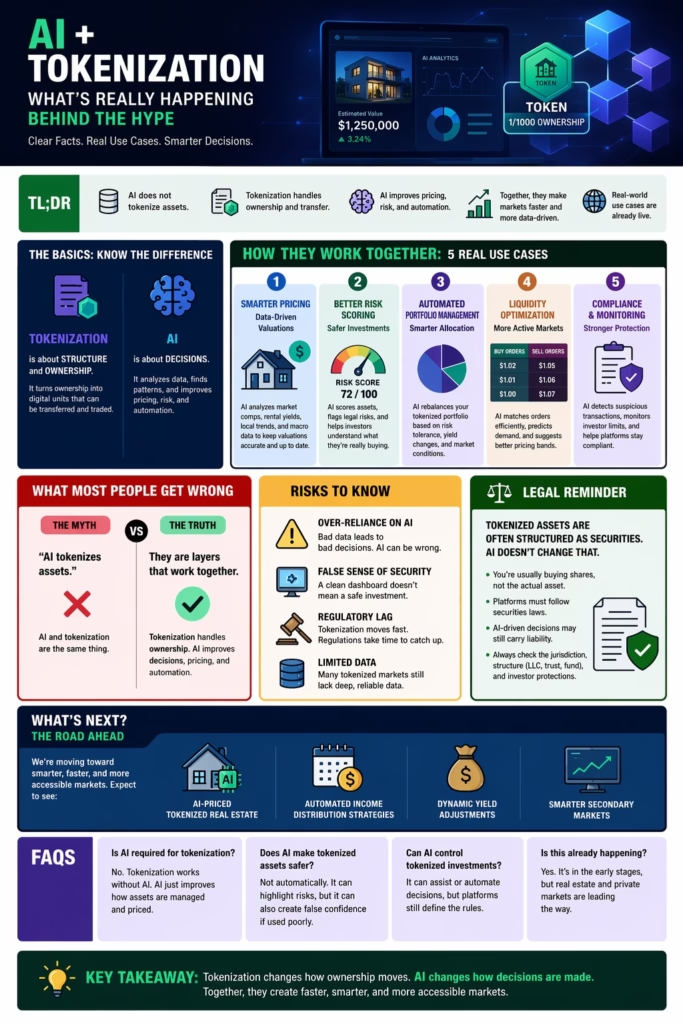
AI analyzes information, identifies patterns and supports decisions. Asset tokenization uses digital tokens and distributed ledgers to record or transfer rights connected to an asset.
Both technologies are already used in finance. However, their direct integration is much less mature than the marketing suggests.
Tokenized funds, bonds and other securities are live. Financial institutions also use AI for fraud detection, document processing, risk analysis and operational support.
That does not mean AI is autonomously valuing, trading and governing large tokenized portfolios. Public evidence for that level of integration remains limited in 2026.
This article explains where AI can genuinely support asset tokenization. It also separates working applications from pilots, vendor claims and speculation.
This article provides general information and does not constitute financial, legal, investment or tax advice.
TL;DR
- AI and asset tokenization perform different jobs.
- Tokenization records or transfers asset-related rights. AI analyzes data and supports decisions.
- The most credible AI applications involve document processing, fraud detection, compliance, valuation support, risk monitoring and operational exceptions.
- AI cannot create legal ownership, verify every off-chain fact or make an illiquid asset liquid.
- Tokenized funds and securities are live, but fully autonomous AI-managed tokenized markets remain early.
- AI outputs can be wrong, biased or manipulated. Human accountability and reliable data remain essential.
- Investors should examine the legal asset and platform controls before paying attention to an “AI-powered” label.
AI Tokenization vs Asset Tokenization
The phrase “AI tokenization” creates an immediate problem because it has two different meanings.
In artificial intelligence, tokenization means breaking text, code or other information into smaller units that a model can process. A word might become one token, several tokens or part of a token.
In finance, asset tokenization means creating a digital representation of an asset, right or financial claim. The token may represent a fund share, company interest, debt claim, ownership record or contractual entitlement.
These meanings should not be mixed together.
| Term | What it means | Simple example |
|---|---|---|
| AI tokenization | Dividing information into units for an AI model | Breaking a sentence into model-readable tokens |
| Asset tokenization | Representing rights or claims through digital tokens | Recording a fund share on a blockchain |
| AI and asset tokenization | Using AI around a tokenized asset workflow | Flagging unusual transactions or extracting data from documents |
This article focuses on the third meaning.
What Asset Tokenization Actually Requires
Asset tokenization begins with an asset and a legal structure. It does not begin with AI.
For example, a property might sit inside a company. Tokens may then represent shares or membership interests in that company. Alternatively, a token could represent debt, a fund unit or a contractual claim against an issuer.
Our guide to what tokenization means explains these structures in more detail.
The legal rights must exist before software can record or transfer them.
In January 2026, staff from three divisions of the US Securities and Exchange Commission published a statement on tokenized securities. It distinguished issuer-sponsored securities from custodial and synthetic third-party structures.
That distinction matters because two tokens referencing the same asset may provide different rights. One may represent an official security. Another may only provide indirect or synthetic exposure.
The SEC document also makes an important point: changing a security’s format does not remove federal securities laws. The statement represents staff views rather than a formal Commission rule, but its structural explanation is useful.
A credible tokenized product therefore needs several connected layers.
| Layer | Main purpose | Can AI replace it? |
| Legal structure | Defines the holder’s enforceable rights | No |
| Asset or security | Provides the underlying economic value | No |
| Ownership record | Records who holds the relevant interest | No, although AI may check records |
| Blockchain and token | Supports digital issuance or transfer | No |
| Compliance controls | Restrict access and transfers where required | AI can assist, but accountable parties remain responsible |
| Custody and settlement | Protects assets and completes transactions | AI can support operations, but cannot remove counterparty risk |
AI is an optional analytical layer around this structure. It is not the foundation of ownership.
Where AI Can Actually Support Tokenized Finance
The strongest uses of AI are less dramatic than the headlines. Most involve improving existing financial and operational work.
1. Document Review and Data Extraction
Tokenized assets depend on documents.
A real estate offering may include an operating agreement, deed, valuation, inspection, rent roll and management contract. A tokenized fund may need a prospectus, shareholder records, eligibility rules and regular reports.
AI can extract key fields from those documents. It can compare names, dates and figures across several files. It may also flag missing information or inconsistent terms for human review.
This can reduce manual work. However, an AI summary is not legal due diligence.
A model might misread a clause, overlook an exception or invent a confident answer. A lawyer, compliance officer or other accountable professional must still determine what the documents mean.

2. Identity, Fraud and Transaction Monitoring
Tokenized securities and funds often restrict who can invest. Platforms may need to verify identity, jurisdiction, sanctions status and investor eligibility.
AI can support document checks and detect unusual behavior. It can also prioritize transaction alerts for compliance teams.
These are established financial applications. A 2024 Bank of England and Financial Conduct Authority survey found that internal process optimization, cybersecurity and fraud detection were among the most common AI uses reported by financial firms.
The same tools can support a tokenized platform. Still, the platform should explain where AI is used and who reviews its decisions.
A false match could block a legitimate investor. Meanwhile, a poor model may miss a sophisticated fraudster. An appeal process and human oversight remain necessary.
3. Valuation and Asset Data
AI can help analyze the data used to estimate an asset’s value.
In property markets, automated valuation models may use comparable sales, transaction history, property characteristics and geographic data. Some models use machine learning, while others rely on conventional rules.
The Royal Institution of Chartered Surveyors says these models can support lending and professional valuation. It also warns that they work better where reliable data and comparable properties exist.
Commercial property creates a harder problem. Buildings differ by tenant quality, lease terms, condition, location and intended use. An algorithm may miss a defect or an unusual legal restriction that a human professional would identify.
Therefore, an AI-generated estimate is an input. It is not automatically an official valuation or a price at which somebody will buy the token.
This distinction is particularly important for tokenized property. A dashboard can update every minute while the underlying building remains difficult to value and sell.
4. Risk Analysis and Portfolio Monitoring
AI can process data across several tokenized holdings.
For example, it might compare property occupancy, bond duration, issuer concentration, cash flow or currency exposure. It can also highlight a change that deserves attention.
However, analysis is not the same as unrestricted portfolio control.
The Bank of England survey found that many financial AI uses included some automated decision-making. Yet fully autonomous decision-making represented only a small minority of applications.
That caution matters even more in tokenized markets. A system cannot rebalance a portfolio unless the assets can legally transfer, the investor is eligible, the venue is available and another party is willing to trade.
An AI signal does not override a lockup, whitelist, custody rule or empty order book.
5. Operations, Reconciliation and Corporate Actions
Many tokenized products still operate across blockchain and conventional systems.
One database may record verified investor identities. Another holds tax information. A blockchain records token movements, while a transfer agent maintains the legally relevant shareholder record.
These systems can disagree.
AI can help operations teams identify mismatches, prioritize exceptions and search large volumes of messages. It may also assist with dividend processing, redemptions, reporting and corporate actions.
This operational layer is where the convergence looks most credible. A 2026 Broadridge analysis of capital-markets operations described AI being used for workflow triage, reconciliation, KYC processing and settlement coordination. The same analysis treated tokenization as a separate infrastructure change that must connect with those workflows.
That is a far more realistic model than an autonomous AI controlling the entire asset.
6. Trading and Liquidity Support
AI can analyze order flow, estimate demand and help route trades.
These tools already operate in large conventional markets. The International Monetary Fund says AI may improve risk management, market monitoring and liquidity. It also warns that faster automated trading could increase opacity, volatility and cyber risk.
Tokenized markets add another limitation: many remain small.
AI may help a venue match existing orders. It cannot create a buyer who does not exist. Nor can it make a private asset worth the seller’s preferred price.
Our guide to tokenized secondary markets explains why technical transferability and real liquidity are different.
How Mature Is AI and Asset Tokenization in 2026?
The honest answer depends on which layer we examine.
| Application | Maturity in 2026 | What the evidence shows |
| Tokenized funds and securities | Live | Products such as tokenized money market funds already use blockchain-based ownership and transfer records |
| AI in financial operations | Live | Firms use AI for internal processes, cybersecurity, fraud detection and analytical support |
| AI-assisted property analysis | Live but not token-specific | Valuation and document tools exist, although reliability depends on the asset and data |
| AI monitoring of digital transactions | Live in some finance workflows; still experimental in others | Institutions are testing privacy-preserving and federated approaches |
| AI-managed tokenized portfolios | Early | Public evidence is limited, while legal, liquidity and governance restrictions remain |
| Autonomous AI controlling tokenized assets | Experimental | Strong guardrails, permissions and human accountability are still required |
The first two rows are well established. The final two are where marketing frequently outruns deployment.
BlackRock’s BUIDL and Franklin Templeton’s BENJI demonstrate that tokenized funds are real. Our BUIDL guide examines the BlackRock structure. Franklin Templeton says its BENJI recordkeeping system uses public blockchains to process transactions and record fund-share ownership.
Neither example proves that AI independently values the fund, approves investors or controls the portfolio.
Meanwhile, AI adoption across finance is also real. Broadridge’s 2026 industry survey described AI as increasingly embedded in daily operations while calling tokenization the next structural change in market infrastructure.
That wording captures the current position. The two technologies are beginning to meet inside operations, but they have not merged into one autonomous financial system.
Project AIKYA Shows Both the Potential and the Limits
Project AIKYA provides a useful institutional example.
Kinexys by J.P. Morgan and BNY developed the proof of concept to test federated learning for anomaly detection. Federated learning allows institutions to train a shared model without pooling their raw data in one place.
The project material published by BNY says the combined model improved predictive coverage compared with isolated models.
However, the project used synthetic data in a controlled environment. Its public code and documentation also state that it is not production-ready and should not support compliance-sensitive workflows without further work.
Therefore, AIKYA is meaningful evidence of institutional experimentation. It is not evidence that autonomous AI is already protecting every transaction on a live tokenized market.
How AI and Tokenization Should Work Together
A safer model separates analysis from authority.
- The issuer establishes the asset and legal rights. Contracts, company records and regulation determine what investors own.
- Verified systems collect the relevant data. These sources might include registries, custodians, banks, property managers and market venues.
- AI analyzes the information. It can extract fields, detect anomalies, estimate risk or recommend an action.
- A human or approved rules engine reviews the decision. High-impact actions require clear accountability and override procedures.
- The authorized system executes the action. A smart contract, transfer agent or settlement platform follows defined permissions.
- All relevant records are reconciled. The blockchain and legally authoritative off-chain systems must remain aligned.
This separation matters because AI models and smart contracts behave differently.
A smart contract normally follows deterministic instructions. An AI model produces a probabilistic output based on its data and design.
Allowing a probabilistic model to move valuable assets without limits can turn one bad prediction into an irreversible transaction.
Main Risks of Combining AI and Tokenization
Adding AI does not remove the existing risks of tokenized assets. Instead, it introduces another layer that needs governance.
Poor or Manipulated Data
A blockchain records the information it receives. AI analyzes the information it receives.
Neither can guarantee that an off-chain fact is true.
An outdated property valuation, false occupancy figure or incorrect ownership record can produce a convincing but worthless output. Oracles and data providers therefore become critical points of dependence.
The Bank for International Settlements’ summary of tokenization risks highlights reliance on custodians, oracles, bridges and other external service providers. These dependencies can affect both platform operation and token valuation.
Model Opacity and Bias
Some models are difficult to explain.
That becomes a serious problem when a system rejects an investor, changes a risk score or recommends selling an asset. Affected users need to understand the basis of important decisions and have a route to challenge mistakes.
Biased training data can also reproduce discrimination. Faster automation does not make a biased decision fair.
Automation at the Wrong Speed
Automated systems can react faster than people.
That helps during normal operations. During a model failure, cyberattack or market shock, it can accelerate losses.
The IMF has warned that wider AI adoption could increase market speed and volatility under stress. Tokenized systems may add round-the-clock operation and rapid settlement to that risk.
Third-Party Concentration
A platform may depend on one cloud provider, data supplier or AI model company.
If that provider fails, changes its product or suffers an attack, several tokenized services could be affected at once.
The Financial Stability Board identifies third-party concentration, cyber risk, model risk and weak data governance as important AI-related vulnerabilities in finance.
Privacy and Security
AI systems often require large datasets. Tokenized finance also processes identity, transaction and ownership information.
Combining those datasets creates attractive targets for attackers. It may also expose investors to surveillance, profiling or data-protection violations.
Public blockchain transparency does not justify placing personal documents or sensitive financial data on-chain.
AI-Washing
“AI-powered” has become a marketing label.
A platform might use a basic chatbot or third-party document scanner and then present the entire investment as intelligent. That tells investors nothing about asset quality, legal rights or model performance.
The label deserves evidence, not excitement.

What Investors Should Check
Before trusting an AI-supported tokenized product, ask:
- What legal right does the token represent?
- Which ownership record is legally authoritative?
- Where exactly is AI used in the product?
- Does the model advise a person, or can it make and execute decisions?
- Which data sources feed the model, and how often are they updated?
- Can an investor challenge an automated decision?
- Who is accountable when the model is wrong?
- Has an independent party tested the model or performance claims?
- What happens if the AI, data or cloud provider becomes unavailable?
- Is there genuine trading demand, or only a technical ability to transfer tokens?
These questions matter more than the model’s name.
What AI Cannot Fix
AI cannot repair weak ownership rights.
If the token is not properly connected with an asset, a better algorithm does not solve the problem.
It cannot improve a bad investment either. A poorly located property, weak borrower or overpriced fund remains risky after tokenization.
AI also cannot guarantee liquidity. It may help buyers and sellers find each other, but somebody still needs to take the other side of the trade.
Finally, it cannot remove platform risk. Investors still depend on governance, custody, cybersecurity, recordkeeping and business continuity.
If you are new to these structures, start with our beginner’s guide to RWA tokenization. Issuers should also examine the trade-offs in our guide to choosing a blockchain for tokenization.
Where the Market Is Heading
The near-term opportunity is operational rather than revolutionary.
AI will probably play a larger role in document review, transaction monitoring, reconciliation, data quality and exception management. Tokenized products can benefit because they create digital workflows that produce structured information.
AI agents may also carry out tightly controlled tasks. For example, an approved agent could gather data, prepare a redemption instruction or recommend a collateral transfer.
However, permissions should remain narrow. High-value actions need spending limits, approved counterparties, audit logs and human override procedures.
The less credible near-term vision is a completely autonomous global market where AI agents value, trade and govern every tokenized asset without accountable institutions.
Finance still depends on law, trusted records, settlement assets and people who carry responsibility when something goes wrong.
Final Verdict
AI and asset tokenization can work together.
The most useful combination is not an “intelligent asset” making its own decisions. It is a controlled financial workflow where AI helps people understand data and tokenization helps authorized parties record or transfer rights.
That can improve document processing, risk monitoring, fraud detection and operational efficiency.
Nevertheless, the limits are equally important.
AI cannot create enforceable ownership, guarantee a valuation or manufacture liquidity. It can also introduce bad data, opaque decisions, cyber risk and dangerous automation.
In 2026, the infrastructure is converging faster than the investment products.
Investors should therefore ignore the futuristic language and examine the structure underneath it.
The token shows how a right moves.
The AI explains or recommends what might happen next.
The law, data and governance still determine whether either one can be trusted.
Frequently Asked Questions
What is AI tokenization?
In artificial intelligence, tokenization means breaking information into units that a model can process. In finance, people sometimes use the phrase to describe AI working alongside tokenized assets. These are different meanings.
Can AI create a tokenized asset?
AI can help draft documents, analyze data or produce code. However, an issuer, legal structure and authorized tokenization system must create and connect the token with enforceable rights.
Can AI value tokenized real estate?
AI can support a property estimate using sales, geographic and economic data. The result depends on data quality and may miss property-specific problems. It does not guarantee a sale price or replace every professional valuation.
Does AI make tokenized assets safer?
Not automatically. AI may detect fraud or operational anomalies, but it also creates model, data, privacy and cybersecurity risks. Safety depends on governance and human oversight.
Can AI solve liquidity problems?
No. AI can help analyze demand, route orders or match existing buyers and sellers. It cannot guarantee that a buyer exists or that an investor can sell at a fair price.
Are AI-managed tokenized portfolios already live?
AI and automated portfolio tools already exist in finance, while tokenized funds and securities are also live. However, public evidence of fully autonomous AI managing and trading broad tokenized portfolios remains limited in 2026.