

Tokenized real estate sounds simple. A property is divided into digital tokens, investors buy a small piece, and income distributions may be paid over time.
That is the easy version.
The real version is more serious. Tokenized real estate can make property investing more accessible, but it also adds legal, platform, liquidity, custody, tax, and technology risks. Anyone who only talks about the upside is selling a fantasy.
The benefits and risks of tokenized real estate need to be looked at together. Smaller entry amounts are useful. Fractional ownership is useful. Easier diversification is useful. But none of that matters if the legal structure is weak, the platform fails, the secondary market has no buyers, or the investor does not understand what they actually own.
Tokenized securities are financial instruments represented by crypto assets or recorded on blockchain-style ledgers, and includes tokenized fund shares, including real estate funds, as examples of tokenized securities.
This guide looks at both sides clearly.
TL;DR
Tokenized real estate can help investors access property markets with smaller amounts of money.
The main benefits include fractional ownership, income distributions, easier diversification, digital record-keeping, and the potential for secondary markets.
Risks include liquidity problems, platform failure, legal uncertainty, tax complexity, custody issues, weak disclosures, and overhyped returns.
A token is not magic. It does not remove normal property risk.
Before investing, you need to understand the property, the platform, the legal structure, the fees, the exit options, and the tax treatment.
What Tokenized Real Estate Means
Tokenized real estate is the process of representing an interest in a property, property fund, debt instrument, or real estate-related entity through digital tokens.
That does not always mean you own part of the building directly.
In many cases, the token may represent an interest in a company, fund, loan, legal entity, or contractual claim linked to a real estate asset. This difference matters. Owning a token linked to a property is not always the same as owning a deeded share of the property itself.
The structure can vary widely. One platform may use an LLC. One platform may use an LLC. Others may use a fund, debt exposure, or a marketplace model.l. Some offerings may fall under securities rules such as Regulation Crowdfunding, Regulation D, or Regulation A, depending on the jurisdiction and structure. SEC investor materials explain that securities offerings generally need registration or a valid exemption, and private placements can involve limited disclosure and high illiquidity.
That is why investors should never stop at the headline yield.
You need to ask: what do I legally own?
Main Benefits of Tokenized Real Estate
1. Smaller Entry Amounts
Traditional real estate usually requires serious capital. Even a small rental property can involve a deposit, mortgage approval, legal fees, repairs, insurance, and ongoing management.
Tokenized real estate can reduce the starting amount. Some platforms allow investors to buy exposure to property with much smaller sums than direct ownership would require.
This is useful for younger investors, international investors, and people who want property exposure without putting a large amount into one asset.
But smaller does not mean safer. It only means access is easier.
2. Fractional Ownership
Fractional ownership is one of the clearest benefits.
Instead of one investor buying an entire property, many investors can hold smaller interests connected to the same asset. This can make expensive property markets more accessible.
For example, an investor may not be able to buy an apartment building, but they may be able to buy a small tokenized interest linked to one.
This helps spread capital across more than one property. It also lets investors test a platform before committing more money.
Still, fractional ownership does not remove the need for due diligence. A small share of a bad deal is still a bad deal.
3. Income Distributions
Many tokenized real estate platforms focus on income-generating properties.
If the property earns income after expenses, investors may receive income distributions based on the structure of the offering. These may come from rent, loan payments, or fund-level returns.
This is one reason tokenized real estate attracts investors looking for passive income.
However, income is not guaranteed. Tenants may leave. Repairs may increase. Insurance costs may rise. Property taxes may change. Management fees may reduce returns.
The dangerous mistake is assuming that a projected yield is the same as a fixed return.
It is not.
4. Easier Diversification
Direct property ownership can create concentration risk.
An investor who buys one rental property is exposed to one location, one tenant base, one building, and one local market. If something goes wrong, the whole investment can suffer.
Tokenized real estate may allow an investor to spread money across several properties, cities, or property types.
That could include residential property, short-term rentals, commercial buildings, development projects, or real estate debt.
Diversification does not guarantee profit, but it can reduce the damage from one poor-performing asset.
5. Digital Record-Keeping
Blockchain-based records can make ownership records easier to track.
A tokenized system may provide a clearer digital trail of transactions, ownership changes, and distributions.
This can be useful when compared with slow manual paperwork, especially in private markets.
But do not get carried away. A clean blockchain record does not automatically prove the off-chain legal structure is strong. The real property still exists in the real world. Courts, contracts, land registries, custodians, managers, and local laws still matter.
The token is only part of the system.
6. Potential Secondary Markets
One of the biggest promises of tokenized real estate is easier resale.
In theory, investors may be able to sell tokens on a secondary market instead of waiting years for a property sale or fund exit.
That sounds powerful.
In practice, this is where many people get misled.
Secondary markets only help if there are buyers. A token may be technically transferable but still hard to sell. The Financial Stability Board has warned that tokenization can create liquidity and maturity mismatch when the token appears more liquid than the underlying asset.
Real estate is naturally illiquid. Putting it on a blockchain does not magically create demand.
7. Global Access
Tokenized real estate can make cross-border property investing easier.
An investor in one country may be able to access property exposure in another country through a digital platform.
That can open up more choice.
It also creates more complexity. Investors may face currency risk, tax reporting issues, different securities laws, withholding taxes, platform restrictions, and local property rules.
Global access is a benefit only when the investor understands the extra layers.
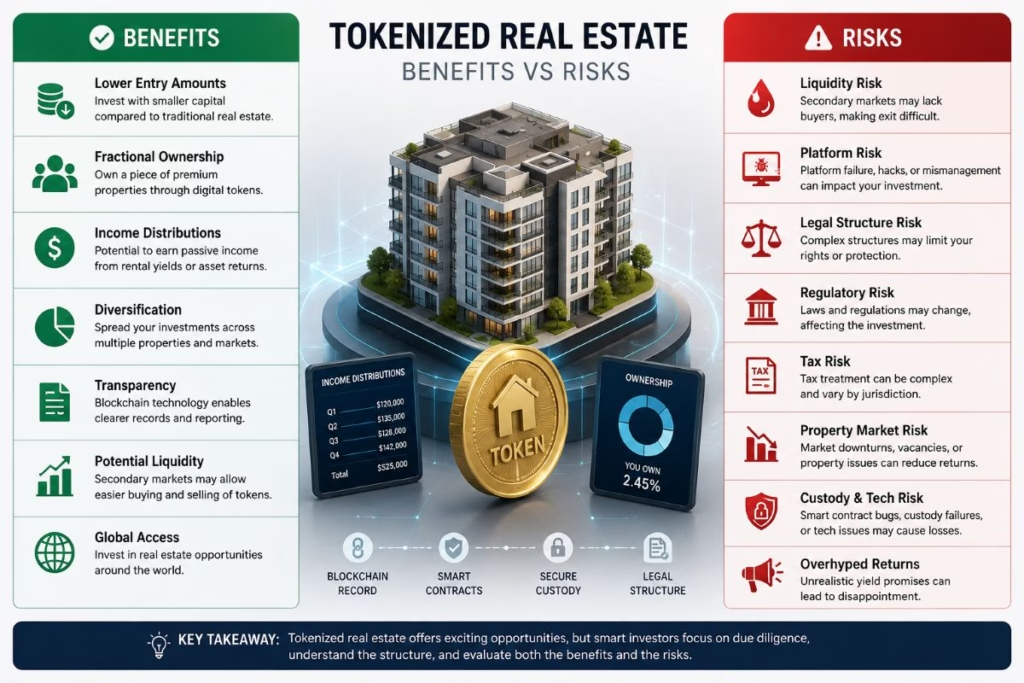
Main Risks of Tokenized Real Estate
1. Liquidity Risk
Liquidity risk is the big one.
Many tokenized real estate platforms promote easier exits, but investors should be careful. A marketplace does not guarantee a buyer. A secondary market does not guarantee fair pricing.
Some private or crowdfunding-style investments can be difficult to resell. SEC investor guidance on Regulation Crowdfunding warns that investors may be limited in their ability to resell for the first year and may need to hold the investment for an indefinite period.
That point matters for tokenized real estate.
You may be able to buy quickly. Selling may be much harder.
2. Platform Risk
With direct property, you worry about the property.
With tokenized real estate, you also worry about the platform.
The platform may handle onboarding, documents, investor dashboards, income distributions, wallets, compliance, secondary trading, and communication. If the platform is badly managed, underfunded, hacked, sued, or shut down, investors may face delays or losses.
This does not always mean the underlying property disappears.
But it can make recovery painful.
A serious investor should check the platform’s track record, ownership, legal documents, fees, security practices, and investor communication.
If the platform hides basic information, walk away.
3. Legal Structure Risk
This is where many beginners get trapped.
They see “tokenized property” and assume they own real estate.
Maybe they do. Maybe they do not.
The token might represent shares in a company, or might represent a loan. It might represent a fund interest. It might represent a contractual right. Alternatively, it might carry voting rights, or it might not.
The legal wrapper matters more than the technology.
Before investing, check:
- Who owns the property?
- What does the token represent?
- Are investors equity holders, lenders, members, beneficiaries, or something else?
- What happens if the platform fails?
- What rights do investors have if income stops?
- Can the issuer change terms?
- Are there transfer restrictions?
If you cannot answer these questions, you do not understand the investment.
4. Regulatory Risk
Tokenized real estate often sits near securities law.
That does not make it bad. It does mean the rules matter.
Offerings may need registration, an exemption, investor limits, disclosures, transfer restrictions, or platform-level compliance. Private placements and crowdfunding offerings can also provide less disclosure than public securities. SEC investor materials warn that private placements may involve limited information, restricted resale, and the possibility of total loss.
Regulation can also change.
A platform that works under one model today may need to adjust tomorrow. That can affect availability, liquidity, investor eligibility, and reporting.
Do not assume “blockchain” means outside the law.
5. Tax Risk
Tokenized real estate can create tax complexity.
Income distributions may be taxable. Token sales may create gains or losses. Cross-border investments may create additional reporting issues. Some investors may also need to track wallet transactions, cost basis, currency conversions, and platform statements.
The IRS says digital assets are treated as property for U.S. tax purposes, and income from digital assets is taxable. IRS also says selling virtual currency can trigger capital gain or loss.
The exact tax result depends on the structure.
A token linked to property income may not be taxed the same way as a REIT dividend, a partnership interest, a debt note, or a direct property sale.
Do not guess. Use a tax professional if the amounts are meaningful.
6. Property Market Risk
Tokenization does not remove real estate risk.
Property values can fall. Local markets can weaken. Tenants can stop paying. Maintenance costs can rise. Insurance can become more expensive. Interest rates can affect valuations. Bad management can destroy returns.
A tokenized apartment building is still an apartment building.
If the property performs badly, the token will not save the investment.
This is why deal-level analysis matters. You need to look at location, occupancy, debt, expenses, property condition, tenant quality, valuation, and exit plan.
The blockchain layer is not a substitute for real estate analysis.
7. Smart Contract and Custody Risk
Tokenized real estate may involve wallets, smart contracts, custodians, transfer agents, or blockchain infrastructure.
That creates extra operational risk.
Your wallet may be compromised. A smart contract may contain a bug. Your private key may be lost. A custodian may fail, or a blockchain network may face outages, congestion, or security problems.
FINRA warns that crypto assets can be volatile, less liquid than traditional financial instruments, and may lack some investor protections depending on the asset and how it is held.
Even when the underlying property is real, the digital access layer can still fail.
8. Overhyped Returns
This is the ugliest part of the market.
Some tokenized real estate marketing makes the investment look too easy. Buy tokens. Earn income. Sell anytime. Build wealth passively.
Reality is less clean.
Projected returns are not guaranteed. Past distributions do not prove future performance. High yields may reflect high risk. A beautiful dashboard can hide weak property fundamentals.
Be especially careful with:
- Unrealistic income claims
- No clear explanation of fees
- No proper legal documents
- No independent property valuation
- No clear exit route
- Anonymous or vague management teams
- Pressure to invest quickly
- Promises of easy liquidity
A serious platform explains risk clearly. Weak platforms sell dreams.
Benefits vs Risks Table
| Area | Benefit | Risk |
|---|---|---|
| Access | Investors can start with smaller amounts | Easier access may attract inexperienced investors |
| Ownership | Fractional exposure to property assets | Token rights may be weaker than expected |
| Income | Potential income distributions | Income can fall or stop |
| Diversification | Easier to spread capital across properties | Diversification does not remove bad deal risk |
| Records | Digital ownership records may improve transparency | Blockchain records do not replace legal rights |
| Liquidity | Secondary markets may help investors exit | Buyers may be limited or unavailable |
| Global reach | Investors may access overseas property exposure | Tax, currency, and regulatory issues increase |
| Automation | Some processes may become faster | Smart contract and custody risks remain |
Tokenized Real Estate vs REITs vs Direct Property
| Feature | Tokenized Real Estate | REITs | Direct Property |
|---|---|---|---|
| Entry amount | Often lower | Low for public REITs | High |
| Control | Usually limited | Very limited | High |
| Liquidity | Varies by platform | Usually strong for public REITs | Low |
| Income | May offer distributions | Dividends possible | Rental income possible |
| Diversification | Possible across tokenized deals | Built into many REITs | Harder unless wealthy |
| Legal complexity | Medium to high | Lower for public REITs | High |
| Tax complexity | Can be high | Usually simpler | Can be high |
| Platform risk | High | Lower for listed REITs | Lower, but manager risk remains |
| Property-level choice | Often specific deals | Usually fund-level exposure | Full choice |
Tokenized real estate is not automatically better than REITs or direct property.
It sits between them.
Additionally, it may offer more specific property exposure than a REIT, but less control than direct ownership. Furthermore, it may offer smaller entry amounts than direct ownership, but more complexity than buying a listed REIT.
That makes it useful for some investors and unsuitable for others.
Who Tokenized Real Estate May Suit
Tokenized real estate may suit investors who want exposure to property without buying and managing a full property.
Moreover, it may suit people who want to test fractional ownership with smaller amounts before committing larger capital.
It can make sense for investors who:
- Understand that income is not guaranteed
- Can hold for several years
- Are comfortable with private-market risk
- Want exposure to specific properties or markets
- Can read legal documents carefully
- Accept that liquidity may be limited
- Understand the tax reporting burden
The best fit is usually someone curious, cautious, and realistic.
Not someone chasing easy passive income.
Who Should Avoid Tokenized Real Estate
Some people should stay away.
Tokenized real estate is probably not suitable for investors who need quick access to cash. It is also a bad fit for anyone who does not understand private markets, legal structures, or platform risk.
Avoid it if:
- You need guaranteed income
- You may need to sell quickly
- You cannot afford to lose the money
- You do not understand what the token represents
- You are investing only because of a high projected yield
- You have not read the offering documents
- You think blockchain removes normal property risk
That last one is important.
Tokenization changes access and administration. It does not cancel risk.
Investor Due Diligence Checklist
Before investing in any tokenized real estate deal, check the basics first.
Property
- Where is the property?
- What type of property is it?
- Is it occupied?
- Who are the tenants?
- What is the local market like?
- Is there debt on the property?
- What are the expenses?
- Who manages the property?
- Is there an independent valuation?
Platform
- Who owns the platform?
- How long has it operated?
- Has it handled previous exits?
- Are distributions paid on time?
- What happens if the platform shuts down?
- Are investor funds segregated?
- Are there clear support channels?
Legal Structure
- What exactly does the token represent?
- Is it equity, debt, fund interest, membership interest, or another claim?
- What rights do token holders have?
- Can investors vote?
- Are there transfer restrictions?
- What jurisdiction governs the deal?
- What happens in a dispute?
Returns
- Are returns projected or historical?
- What assumptions are used?
- Are expenses clearly shown?
- What fees does the platform charge?
- What could reduce income?
- How realistic is the exit plan?
Liquidity
- Is there a secondary market?
- How active is it?
- Are there buyers?
- Are there lock-up periods?
- Can the platform restrict transfers?
- What happens if you want to sell during a weak market?
Tax
- What tax forms are provided?
- Are income distributions taxable?
- How are gains or losses reported?
- Are there cross-border tax issues?
- Do you need to track digital asset transactions separately?
Do not invest until these questions are answered clearly.

Legal and Tax Warning Box
Tokenized real estate may involve securities laws, private offering rules, digital asset reporting, property law, tax reporting, and cross-border restrictions.
This article is for education only. It is not financial, legal, or tax advice.
Before investing, read the offering documents carefully. Check whether the platform is properly registered or operating under a valid exemption. Speak to a qualified professional if you are unsure.
If a platform cannot explain the legal structure in plain English, that is a red flag.
Market Insight
The strongest tokenized real estate platforms will not win because they use blockchain.
They will win because they combine real property discipline with clear legal structures, honest reporting, strong investor communication, and realistic exit options.
The weak platforms will hide behind buzzwords.
That is the split investors need to watch.
Watch This Trend
The next stage of tokenized real estate will likely focus less on hype and more on compliance, reporting, custody, and secondary-market depth.
That is healthy.
The market does not need more flashy dashboards. It needs better investor protection, cleaner documents, and real liquidity.
Final Thoughts
In conclusion, tokenized real estate is useful, but it is not magic.
The benefits are real. Smaller entry amounts, fractional ownership, income distributions, digital records, and easier diversification all matter. For investors locked out of traditional property markets, this is a serious development.
However, the risks are just as real.
Liquidity can disappoint. Platforms can fail. Legal structures can be weak. Taxes can be messy. Smart contracts can break. Property markets can fall. Returns can be overhyped.
The smart way to look at tokenised real estate is simple: treat it first as a real estate investment and second as a blockchain investment.
Start with the property. Then study the legal structure. Next, check the platform and finally, think about the token.
That order will save investors from a lot of expensive mistakes.
FAQ
What are the main benefits of tokenized real estate?
The main benefits are smaller entry amounts, fractional ownership, potential income distributions, easier diversification, digital record-keeping, and possible secondary-market access.
What are the biggest risks of tokenized real estate?
The biggest risks are liquidity risk, platform risk, legal structure risk, regulatory risk, tax complexity, property market risk, custody risk, and overhyped return claims.
Is tokenized real estate safer than direct property?
Not automatically. Tokenized real estate may reduce the amount needed to invest, but it can add platform, legal, custody, and liquidity risks that direct property owners may not face.
Can I sell tokenized real estate anytime?
Not always. Some platforms offer secondary markets, but that does not guarantee buyers. Some offerings may also include lock-up periods or transfer restrictions.
Do tokenized real estate investors receive income?
Some tokenized real estate investments may pay income distributions, but they are not guaranteed. Income depends on the property, expenses, tenants, debt, platform fees, and legal structure.
Is tokenized real estate better than a REIT?
It depends. REITs are usually easier to buy and sell, especially public REITs. Tokenized real estate may offer more specific property exposure, but it can be less liquid and more complex.
What should I check before investing?
Check the property, platform, legal structure, fees, projected returns, income history, secondary-market rules, tax reporting, and investor rights. Never invest based only on the advertised yield.