

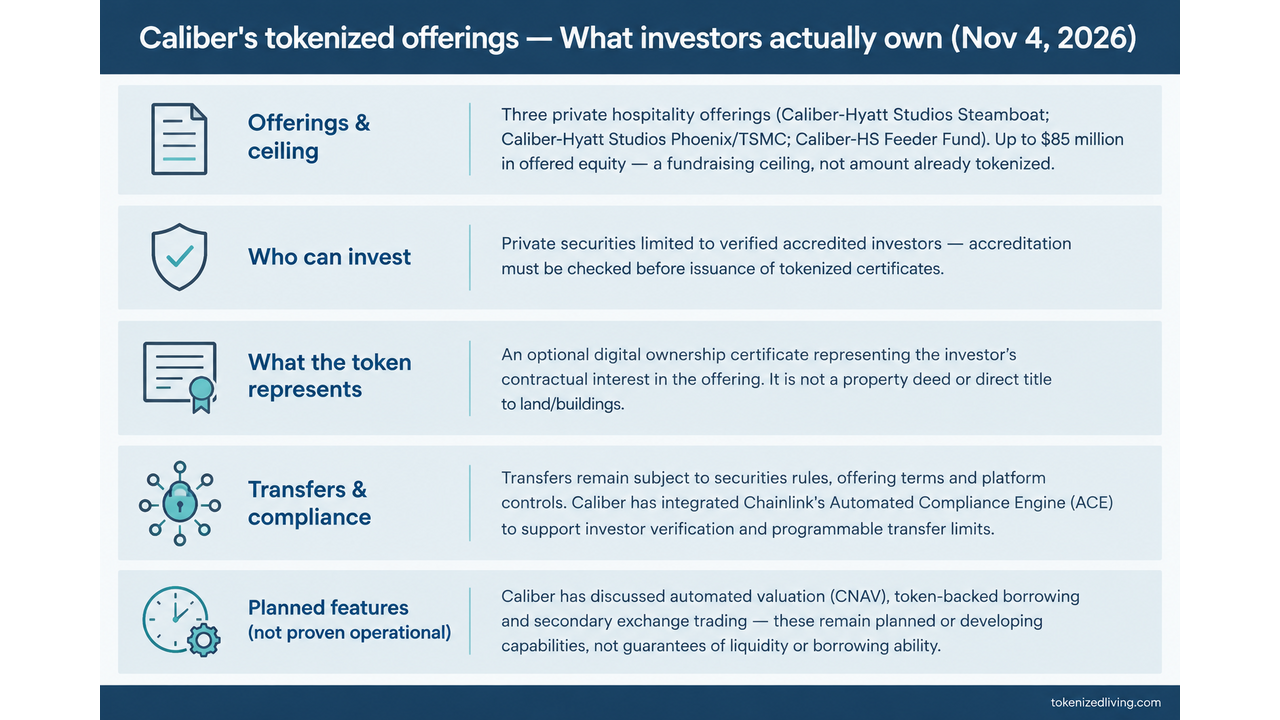
CaliberCos Inc. announced on November 4, 2026, that accredited investors can choose tokenized ownership certificates for three private real estate offerings. Together, the offerings cover up to $85 million in offered equity.
That figure is a fundraising ceiling, not money already raised or recorded on a blockchain. Caliber has not disclosed how much equity investors have chosen to tokenize.
Key Takeaways
- Caliber added optional tokenized certificates to three private hospitality real estate offerings.
- The $85 million figure represents maximum offered equity, not completed investment volume or assets already tokenized.
- Each token represents an interest in the applicable offering, not direct ownership of a hotel or property deed.
- Only verified accredited investors can participate, and transfers remain subject to legal and technical controls.
- Automated valuation, token-backed borrowing and exchange trading remain planned or developing capabilities.
What Caliber Announced
Caliber made tokenized ownership available for Caliber-Hyatt Studios Steamboat, Caliber-Hyatt Studios Phoenix/TSMC and the Caliber-HS Feeder Fund. Accredited investors can access the relevant offering materials and elect a digital certificate where available.
According to the November 4 SEC filing, the three offerings represent up to $85 million in offered equity. However, filing the announcement with the SEC does not mean the agency approved the offerings or verified Caliber’s claims.
The launch follows Caliber’s August 2026 tokenization of its PURE Pickleball & Padel offering. Therefore, four Caliber offerings now have an announced tokenization option. Still, the maximum equity offered across these investments should not be confused with the amount actually issued or recorded on-chain.
What Is Caliber?
Caliber is a real estate asset manager focused on hospitality and related developments. The company describes its business as acquiring, developing and operating hotels and lifestyle properties.
CaliberCos is also a public company whose shares trade on Nasdaq under the ticker CWD. Buying CWD stock is different from subscribing to one of these private offerings.
Public shares represent equity in CaliberCos itself. By contrast, these private investments provide rights in a specific project or fund under separate offering documents.

The Three Offerings
Caliber-Hyatt Studios Steamboat and Caliber-Hyatt Studios Phoenix/TSMC are development-level offerings. An investor’s economic exposure is tied to the applicable project and the rights defined in that project’s legal documents.
The Caliber-HS Feeder Fund uses a different structure. A feeder fund pools investor capital and provides exposure to multiple underlying investments rather than one named development.
As a result, a project-level investment depends more directly on one property’s performance, timing and eventual outcome. A feeder-fund investor instead owns an interest in the fund, subject to its allocation, distribution and management terms.
In either case, the token does not create new rights beyond the legal investment. Readers unfamiliar with these structures can explore our complete guide to tokenized real estate and explanation of what fractional ownership means.
What Does the Token Represent?
Caliber describes its token as an optional digital ownership certificate. It represents the investor’s contractual interest in the relevant offering and is governed by that offering’s documents.
Investors can hold the certificate in a digital wallet instead of receiving a paper certificate.. However, it is not a hotel deed, and it does not give the wallet holder direct title to the underlying land or building.
The main difference is the certificate’s format and recordkeeping system. A token can make ownership records machine-readable and allow compliance rules to operate on-chain, but the legal documents still determine distributions, voting rights and transfer limits.
For a broader explanation, see what investors own when they buy a tokenized asset.
Who Can Invest and Transfer the Tokens?
These are private securities offerings limited to accredited investors. Caliber says an investor’s accredited status must be verified before investing and before a tokenized certificate can be issued.
Caliber has also integrated Chainlink’s Automated Compliance Engine, or ACE. As described in a July 2026 SEC exhibit, ACE supports investor verification, reusable on-chain credentials and programmable transfer controls.
In practice, those controls can check whether a proposed recipient meets the offering’s rules. Consequently, holding a token does not authorize unrestricted transfers, public trading or cross-border sales.
Any resale would remain subject to securities laws, offering terms and platform controls. Our guide to tokenized asset secondary markets explains why blockchain-based transfers do not automatically create liquidity.
What Remains Under Development?
Caliber has discussed an automated valuation capability called CNAV, along with potential borrowing against tokenized interests. It has also presented secondary exchange trading as part of its longer-term plans.
The available disclosures do not establish that these features are broadly operational. In particular, investors should not assume they can obtain an automated market value, pledge a token for a loan or sell it on an exchange today.
Tokenization may provide infrastructure for those services later. Yet lenders, compliant trading venues, transfer approvals and willing counterparties would still be necessary.
Current Limitations
Caliber has not disclosed how much of the three offerings investors have actually tokenized. It also has not identified an institutional custody provider or confirmed a broadly available secondary venue for these interests.
Investors must therefore rely on each offering’s legal documents for the rights, restrictions and risks involved. The token changes how an interest may be recorded and managed; it does not remove the limits of a private real estate investment.