

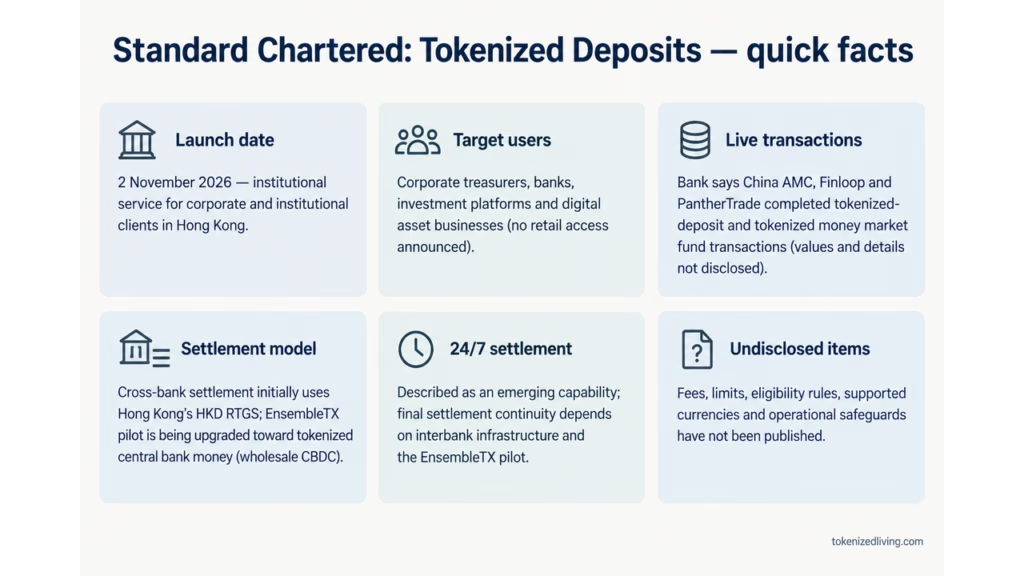
Standard Chartered has launched a Tokenized Deposits service for corporate and institutional clients in Hong Kong, connecting regulated commercial bank money with digital treasury and tokenized investment workflows.
Announced on 2 November 2026, the service allows eligible clients to use digital representations of deposits held with Standard Chartered. Potential uses include managing intragroup liquidity, transferring money between corporate entities and settling purchases of tokenized investment products.
The service also connects with EnsembleTX, the Hong Kong Monetary Authority’s controlled pilot infrastructure for real-value tokenized transactions. Although the pilot is moving towards continuous settlement using tokenized central bank money, some interbank payments initially rely on Hong Kong’s existing real-time gross settlement system.
Key Takeaways
- Standard Chartered’s service targets corporate treasurers, banks, investment platforms and digital asset businesses, not retail customers.
- The bank says China AMC, Finloop and PantherTrade completed live tokenized-deposit and tokenized money market fund transactions.
- Cross-bank settlement initially uses Hong Kong’s HKD RTGS system, with EnsembleTX being upgraded to support tokenized central bank money.
- Claims of 24/7 operation need qualification because the supporting infrastructure remains a controlled pilot in transition.
- Fees, limits, detailed eligibility rules, transaction values and launch-specific supported currencies have not been disclosed.
What Standard Chartered launched
According to Standard Chartered’s launch announcement, its Tokenized Deposits service represents regulated commercial bank deposits on the bank’s blockchain infrastructure.
The token is therefore intended to function as a digital representation of money deposited with Standard Chartered. It remains a liability of the commercial bank rather than becoming a separate investment product or privately issued stablecoin.
For companies, the practical aim is to bring bank money into digital workflows that can operate alongside tokenized assets. A corporate treasury could use the service to manage liquidity between related entities. Meanwhile investment platforms could use tokenized deposits as the payment leg when settling tokenized securities or funds.
This is an institutional service. Standard Chartered identifies corporate treasurers, banks, investment platforms and digital asset businesses as its target users. It has not announced retail access.
The published material does not provide detailed admission criteria. It does not say whether every existing corporate client qualifies, whether clients must be incorporated or booked in Hong Kong, or what technical, compliance and transaction-volume requirements apply. The bank has also not disclosed specific onboarding or geographic restrictions.
For readers new to the underlying concept, our guide to what tokenization means explains how rights or assets can be represented on digital infrastructure.
How companies could use the service
One use is corporate treasury management. Large businesses often hold liquidity across subsidiaries, accounts and legal entities. Standard Chartered says tokenized deposits can support near-real-time transfers between corporate entities, potentially making it easier to move liquidity within an approved digital treasury environment.
The service can also support cross-bank transfers through EnsembleTX. This matters because a tokenized deposit issued by one bank is a liability of that particular bank. Moving value to a customer of another participating bank therefore requires an interbank settlement mechanism, not just a change to a shared digital record.
A third use is settling tokenized investments. Standard Chartered specifically refers to tokenized money market funds. In this context, the tokenized deposit can act as the cash leg of a delivery-versus-payment transaction, while the tokenized fund share forms the asset leg. Linking the two can reduce the risk that one side transfers value without receiving the corresponding asset.
These capabilities form part of the wider market for real-world assets, or RWAs, in which financial claims such as fund shares are represented and transferred through tokenized systems.
How EnsembleTX handles interbank settlement
EnsembleTX is the pilot phase of the HKMA’s Project Ensemble. It was designed to support real-value transactions involving tokenized deposits and tokenized assets, building on earlier sandbox experiments.
Standard Chartered uses this infrastructure for interbank transfers and settlement. However, EnsembleTX should not be mistaken for an unrestricted public payment network or a fully completed wholesale digital currency system.
The HKMA’s 2 November announcement describes EnsembleTX as a pilot. Participating banks and industry organisations operate within a controlled environment while the authority and industry address legal, technical, regulatory and commercial obstacles.
Initially, interbank settlement is facilitated through Hong Kong’s existing Hong Kong dollar real-time gross settlement system, commonly known as HKD RTGS. In broad terms, participating banks can use tokenized deposits in the client-facing transaction, while the resulting obligation between the banks is settled through established central bank payment infrastructure.
The HKMA plans to upgrade EnsembleTX progressively so that interbank settlement can occur in tokenized central bank money, also described as wholesale central bank digital currency or wholesale CBDC. Unlike a commercial bank deposit, central bank money is a liability of the central bank. Using its tokenized form could allow the payment and asset-transfer processes to operate more closely together on digital infrastructure.
This RTGS-first approach allows real-value activity to proceed without waiting for the full tokenized central bank money layer to be completed. It also means that tokenized commercial bank deposits do not yet move between every participating bank through a wholly tokenized, round-the-clock settlement chain.
The HKMA has been developing this model over time. Its November 2025 announcement of EnsembleTX’s real-value phase identified tokenized money market funds and treasury management among the initial areas of focus.
Is the service available 24/7?
Standard Chartered describes its service as supporting around-the-clock digital treasury workflows. The HKMA is also advancing EnsembleTX towards 24/7 settlement in tokenized central bank money.
That does not establish that every Standard Chartered transaction, in every currency and between every participating bank, already receives uninterrupted 24/7 final settlement.
The distinction lies between the availability of Standard Chartered’s blockchain-based service and the operating conditions of the interbank settlement layer. Where a transaction relies on HKD RTGS, settlement remains connected to the capabilities of that system. Continuous tokenized central bank money settlements are part of EnsembleTX’s progressive upgrade.
Users should therefore treat 24/7 settlement as an infrastructure direction and emerging capability, rather than assume universal round-the-clock finality across all transactions from launch.

What the live transactions established
Standard Chartered says China AMC, Finloop and PantherTrade executed live tokenized-deposit transactions and settlements involving tokenized money market funds through EnsembleTX. This moves the activity beyond a simulation because the HKMA says the pilot supports real-value transactions.
The bank has not disclosed the value, number or frequency of these transactions. It has also not provided a breakdown showing which organisation performed each transaction, the exact counterparties, the currencies used or the settlement times achieved.
Public statements from the three named organisations independently detailing the transactions were not available as of 6 November 2026. The completed activity is therefore a claim made by Standard Chartered and repeated in media coverage, rather than a set of transactions for which all parties have published matching details.
It is also important to separate these transactions from the other organisations named in the announcement. Standard Chartered announced a partnership with Fireblocks intended to provide access to its capabilities through the digital asset infrastructure provider. That partnership does not establish that the reported live transactions used a completed Fireblocks integration.
HashKey was named as a participant in the wider ecosystem. Its participation should not be interpreted as evidence that it was a counterparty to the transactions involving China AMC, Finloop or PantherTrade.
The bank has not published a timetable for broader commercial integrations or expansion beyond Hong Kong.
Tokenized deposits are not stablecoins
A tokenized bank deposit represents a claim against the bank that accepted the deposit. Its tokenized form changes how the claim may be recorded and transferred within the relevant system. This does not turn the deposit into a separate reserve-backed cryptoasset.
A stablecoin is issued under its own contractual and legal structure. The holder’s claim, redemption rights and exposure depend on the issuer, governing terms and backing arrangements. A stablecoin may seek to maintain a stable value using reserve assets, but it is not automatically equivalent to a deposit at a regulated commercial bank.
Tokenized deposits still carry exposure to the issuing bank. The public launch material does not explain how proprietary rights, insolvency treatment or cross-border recognition would work in every scenario. Those questions depend on applicable law and the contracts and ledger arrangements used.
Tokenization should therefore not be read as removing credit, legal or operational risk.
Tokenized deposits are also different from tokenized fund shares
The distinction is equally important when tokenized deposits are used to settle tokenized money market funds.
The deposit represents money owed by the commercial bank. The tokenized fund share represents an interest in an investment fund. Tokenizing the share can change how it is issued, recorded or transferred, but it does not remove the fund’s underlying investment risks.
The fund’s value and returns depend on its assets and structure. Returns are not guaranteed merely because settlement uses tokenized deposits or EnsembleTX. The tokenized deposit can serve as the payment asset, while the fund share remains the investment being purchased.
This separation between the cash and investment legs is central to understanding the transaction. Readers exploring the broader mechanics can consult our beginner’s guide to RWA tokenization.
What remains undisclosed
Standard Chartered has not confirmed the precise currencies supported by this Hong Kong service at launch. The bank has referred to Hong Kong dollars, offshore renminbi and US dollars in earlier tokenization initiatives. However, those references do not establish that all three currencies are operational in this specific product.
No public fee schedule, per-transaction limit or daily limit has been released. The bank has also not disclosed minimum balances, settlement cut-off arrangements, service-level commitments or the conditions under which a client can move tokenized balances back into conventional account workflows.
Operational safeguards remain another open area. The announcements do not explain recovery procedures if a participant or node becomes unavailable. Furthermore, they don’t set out public processes for reconciliation. Nor do they set out any for disputed transfers or access to underlying account balances during a technical interruption.
Standard Chartered-specific participant numbers and settlement volumes are also unknown. Although the HKMA has discussed participation across the wider EnsembleTX pilot, those aggregate figures should not be treated as the number of users of Standard Chartered’s service.
A live institutional launch within a continuing pilot
Standard Chartered’s launch shows how tokenized commercial bank money can connect corporate treasury operations with tokenized investments. The reported transactions involving tokenized money market funds also demonstrate a practical institutional use case for linking payment and asset settlement.
But the scope remains narrow. The service targets selected corporate and institutional clients in Hong Kong, while its cross-bank infrastructure operates within an HKMA-controlled pilot. Parts of the settlement process initially depend on existing RTGS rails, and the transition to continuous tokenized central bank money settlement is still under way.
The launch is therefore a meaningful operational step, not evidence of unrestricted access, universal bank interoperability or a completed 24/7 financial network. Its wider significance will depend on commercial terms, legal clarity, additional integrations and the HKMA’s continued development of EnsembleTX.