

Uber has completed a pilot designed to solve a persistent corporate treasury problem: how to keep spare cash invested while retaining access to it outside normal banking and fund-processing hours.
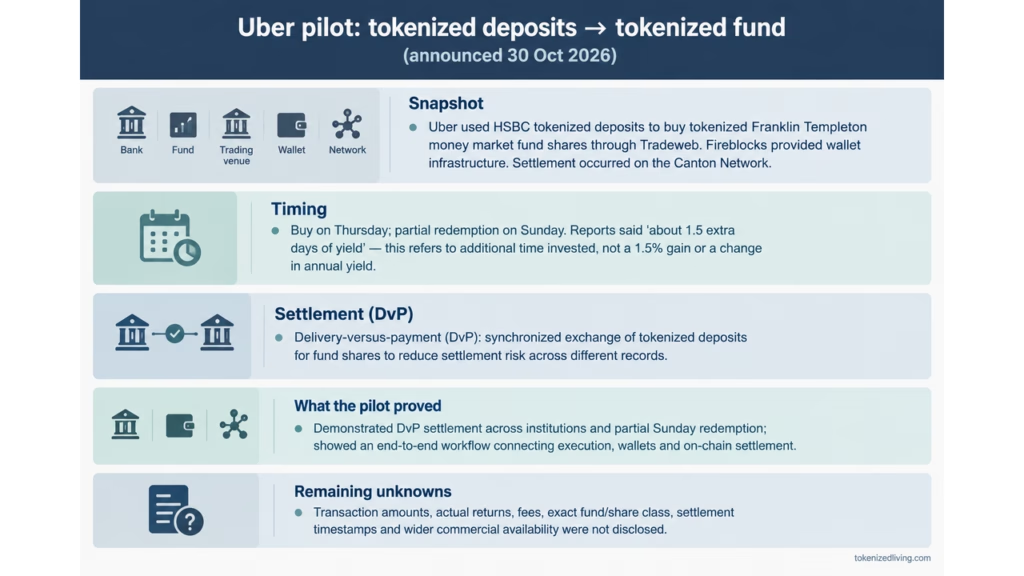
Announced on 30 October 2026, the test connected HSBC tokenized bank deposits with a Franklin Templeton tokenized money market fund. Uber bought fund shares through Tradeweb, while Fireblocks provided institutional wallet infrastructure and helped orchestrate settlement on the Canton Network.
The transaction reportedly began on a Thursday, followed by a partial redemption on Sunday. This allowed some of Uber’s cash to remain invested for longer instead of being withdrawn before the weekend as a precaution.
Key Takeaways
- Uber used HSBC tokenized deposits to buy tokenized Franklin Templeton money market fund shares through Tradeweb.
- The cash and fund shares exchanged through delivery-versus-payment settlement on the Canton Network, supported by Fireblocks wallets.
- Uber reportedly made a partial redemption on Sunday, demonstrating access outside conventional banking hours.
- “About 1.5 extra days of yield” refers to additional time invested, not a 1.5% gain or an increase in the fund’s annual yield rate.
- Transaction values, actual returns, fees, fund details and wider commercial availability were not disclosed.
What happened in the Uber pilot?
According to the HSBC announcement, Uber held HSBC Tokenized Deposits representing deposit liabilities of HSBC Bank USA, N.A.
Uber then used those deposits to purchase shares in a Franklin Templeton tokenized money market fund. Tradeweb provided the trading and execution workflow connecting the institutional buyer with the fund. Fireblocks supplied the wallet infrastructure and supported settlement orchestration, while the Canton Network provided the blockchain-based settlement environment and privacy-preserving connectivity between the regulated participants.
The transaction joined two different tokenized assets in one process: commercial bank deposits used as the payment asset and money market fund shares used as the investment asset. Readers new to the distinction can explore what tokenization means and how financial instruments fit within the wider category of tokenized real-world assets.
Independent reporting described a complete buy-and-redeem cycle. Uber bought the fund shares on Thursday and partially redeemed its holding on Sunday, receiving HSBC tokenized deposits in return. The Tradeweb statement confirms that the design supported the liquidation of part of the holding over a weekend.
The companies did not disclose how much Uber invested or redeemed.
Why weekend liquidity matters
Corporate treasurers must balance two competing objectives. They want spare cash to earn a return, but they also need funds available for wages, supplier payments and other operational obligations.
Traditional banking hours, fund dealing cutoff times and transfer-agent schedules can complicate that balance. A treasury team expecting to need cash during a weekend may have to redeem an investment earlier, potentially leaving the proceeds uninvested until they are used.
This is a cash-management use case rather than simply a faster way to trade tokens. The potential benefit comes from reducing periods when corporate money sits idle between an investment redemption and an operational payment.
That does not mean the system offers unrestricted withdrawals at any time. Availability would still depend on the fund’s legal terms, liquidity, valuation process, wallet controls, banking access and every participating system remaining operational.
What “1.5 extra days of yield” means
Several reports said the Thursday-to-Sunday transaction allowed Uber to capture “about 1.5 extra days of yield”. CoinDesk’s account of the pilot described the purchase and Sunday partial redemption, while other reports attributed the 1.5-day figure to Bloomberg.
Neither HSBC nor Tradeweb included that figure in its announcement. The original numerical claim therefore appears to come from Bloomberg reporting subsequently repeated by other publications, rather than from the public company statements.
More importantly, the claim concerns time invested. It does not mean Uber earned a 1.5% return, nor does it indicate that the fund’s annual yield increased by 1.5 percentage points.
If cash remained in a fund for about a day and a half longer, it could accrue the return associated with that additional holding period. The financial value would depend on the amount invested, the fund’s applicable yield, its expenses, the valuation method and any transaction or service fees.
None of those figures was disclosed. It is therefore impossible to calculate Uber’s actual gain or determine whether the economic benefit was material.
How Much Could an Extra 1.5 Days Be Worth?
Consider a hypothetical corporate treasury holding $10 million in a money market fund earning an annualized 4% return.
An additional 1.5 days invested would generate approximately $1,644 in gross income, assuming a constant annual rate and a simple 365-day calculation.
That figure would be considerably larger for a company managing hundreds of millions of dollars in short-term investments. However, transaction fees, settlement costs and other expenses could reduce the benefit.
These figures are illustrative. Uber did not disclose its investment amount, actual return or transaction costs.
How delivery-versus-payment worked
The pilot used delivery-versus-payment, commonly shortened to DvP. Under this arrangement, delivery of the fund shares was conditional on delivery of the tokenized payment asset.
When Uber made the purchase, its HSBC tokenized deposits and the Franklin Templeton fund shares transferred as a synchronized settlement. On redemption, the process operated in reverse: fund shares moved back while tokenized deposits moved to Uber.
This simultaneous, or atomic, exchange matters because it reduces the risk that one side completes its obligation while the other does not. Without DvP, a buyer could send payment but fail to receive the asset, or a seller could transfer the asset without receiving the corresponding funds.
DvP is particularly useful when two instruments sit on different legal or operational records. The blockchain workflow can coordinate their transfer so that both legs succeed together or neither does.
That does not remove every form of risk. Atomic settlement can reduce settlement exposure, but it does not prevent investment losses, cyber security incidents, legal disputes, incorrect wallet permissions or infrastructure outages.
The settlement process also operated within controlled banking arrangements. HSBC stated that fiat proceeds from redemptions could only settle into corporate bank accounts that had completed the required identity checks.
This is important because completing a token transfer outside banking hours does not necessarily mean the recipient can immediately send money to any external account or payment destination.
The settlement process also operated within controlled banking arrangements. HSBC stated that fiat proceeds from redemptions could only settle into corporate bank accounts that had completed the required identity checks.
This is important because completing a token transfer outside banking hours does not necessarily mean the recipient can immediately send money to any external account or payment destination.
The role of each participant
Uber acted as the corporate treasury client. It initiated the fund purchase and subsequently tested a partial weekend redemption.
HSBC Bank USA supplied the tokenized commercial bank deposits used as the payment and redemption asset. HSBC says these tokens represent liabilities of HSBC Bank USA, N.A. and are insured by the Federal Deposit Insurance Corporation up to applicable limits.
Franklin Templeton provided the tokenized money market fund shares. The specific fund, share class and prospectus were not identified publicly.
Tradeweb provided the execution venue and coordinated the trading workflow between Uber and the tokenized fund.
Fireblocks supplied institutional wallet infrastructure and supported the orchestration of on-chain settlement. Wallet controls were therefore an important part of how the participants held and transferred the tokens.
The Canton Network supported settlement and privacy-preserving communication between the institutions. The test used Canton to coordinate the cash and asset legs without requiring every transaction detail to become openly visible to all network participants.

Tokenized deposits are not tokenized fund shares
Although both instruments existed in tokenized form, they represented different legal and economic claims.
An HSBC Tokenized Deposit represents a commercial bank deposit liability. In practical terms, the depositor has a claim against HSBC Bank USA rather than a direct claim on a pool of investment securities. Any interest depends on the applicable deposit agreement. HSBC states that the deposits are FDIC-insured up to applicable limits. However, tokenization does not remove insurance caps or automatically extend protection beyond the underlying deposit terms.
A tokenized money market fund share represents ownership in a fund holding short-term financial instruments. The investor’s return comes from the fund’s underlying portfolio after expenses, subject to its legal documents and valuation rules. It is not a bank deposit and is not FDIC-insured.
Money market funds are generally designed for liquidity and capital preservation, but they are investments rather than guaranteed cash. They can experience losses and may be subject to redemption restrictions, liquidity controls or suspensions under their governing rules and stressed market conditions.
Tokenization changes how these claims can be recorded, transferred and settled. It does not make the claims legally identical or erase the risks attached to them. The Beginner’s Guide to RWA Tokenization explains this distinction between the digital token and the underlying legal asset in more detail.
What remains uncertain
As of 6 November 2026, none of the participants had publicly confirmed a general commercial rollout to other corporate customers. They had also not announced a timetable for wider availability or disclosed further completed pilots.
The public announcements describe capabilities demonstrated in a controlled institutional transaction. They should not be read as evidence that any company can now open an account and access the same service.
Several important details remain undisclosed. These include the amount invested, the amount redeemed, the actual return earned, all applicable fees, the exact Franklin Templeton fund and share class, and the precise settlement times. The participants also did not publish detailed operating limitations. Nor did they explain how the tokenized redemption process interacted with the fund’s conventional transfer-agent and valuation systems.
Future scalability is therefore an ambition rather than a demonstrated result. A wider service would require dependable integration across banks, fund managers, trading venues, wallets and blockchain infrastructure, supported by appropriate legal agreements and regulatory treatment.
Risks behind round-the-clock tokenized liquidity
The pilot’s design may reduce idle-cash periods, but it also introduces a chain of dependencies.
Wallet infrastructure creates another operational layer. Access policies, key management and transaction approvals must work correctly. A compromised credential, misconfigured permission or unavailable wallet service could prevent a transfer even if the underlying bank and fund remain sound.
Settlement also depends on HSBC, Franklin Templeton, Tradeweb, Fireblocks and Canton operating together. A failure or delay at any point could interrupt the workflow. Banking access and fund redemption rules remain relevant even when the tokens themselves can move outside normal hours.
The Uber pilot offers a concrete example of how tokenized deposits and funds could support corporate treasury management. Its most important result was not a disclosed financial windfall, but proof that a company could move between bank money and an investment fund through synchronized on-chain settlement and complete a partial redemption on a Sunday.
Whether that mechanism becomes a broadly available, cost-effective treasury service remains unanswered.