

The Depository Trust Company launched the DTCC Tokenization Service on 28 October 2026, creating a regulated route for certain US securities held at DTC to be represented on blockchain networks.
The launch is significant for institutional tokenization. DTC sits at the center of US securities infrastructure, while its parent, the Depository Trust & Clearing Corporation, provides clearing, settlement and asset-servicing functions across global markets. Bringing tokenized assets into this established framework could help connect blockchain-based finance with conventional market infrastructure.
The immediate impact is more limited than the headline numbers might suggest. The service does not give retail investors direct access to tokenized shares or place all securities held at DTC on-chain. It begins as a controlled pilot for authorized financial institutions, with restricted assets, registered wallets and limited functionality.
Key Takeaways
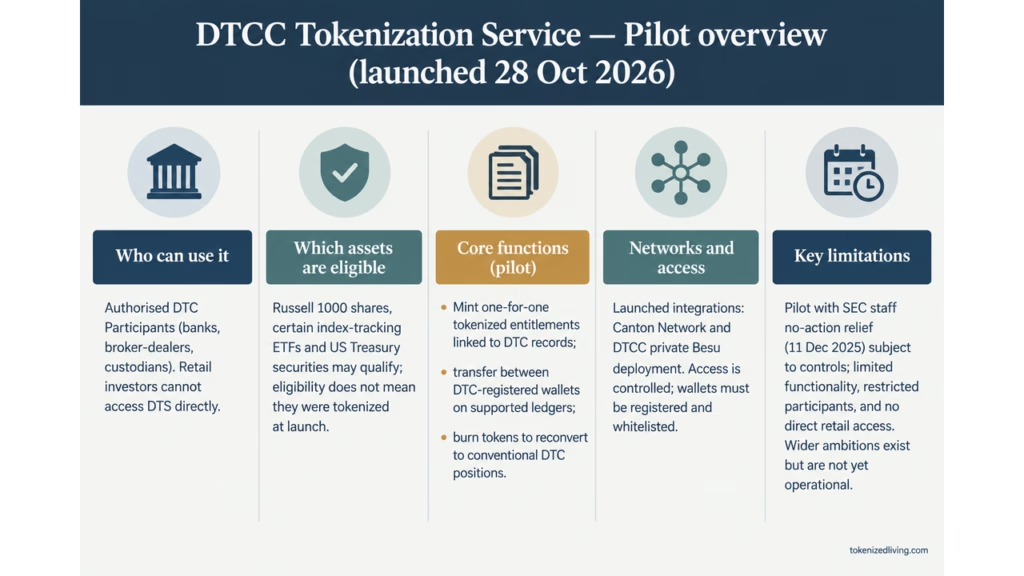
- DTS allows authorized DTC Participants to create one-for-one tokenized entitlements representing eligible securities held at DTC.
- Russell 1000 shares, certain index-tracking ETFs and US Treasury securities are eligible, but eligibility does not mean they have already been tokenized.
- The live networks are the Canton Network and DTCC’s private Besu deployment. Stellar is not a confirmed launch integration.
- Ordinary investors cannot access DTS directly and should see no immediate change to how they buy, hold or sell securities.
- DTCC’s $114 trillion-plus in assets under custody is not the value tokenized through DTS.
From Production Testing to Launch
The October launch followed an earlier milestone on July 15, 2026, when DTCC and more than 30 financial and technology firms completed limited-production transactions using tokenized DTC-held securities.
The transactions covered several use cases, including Treasury securities, equities, securities lending and collateral-related workflows. They demonstrated the service’s capabilities in a production environment before its wider introduction.
However, those earlier transactions should not be confused with ongoing trading volumes after the October launch. DTCC has not published comprehensive figures establishing how much value is currently held in tokenized form through DTS.
What is the DTCC Tokenization Service?
The DTCC announcement describes DTS as a service through which authorized DTC Participants can create tokenized representations of securities already held within DTC’s custody system.
These representations are sometimes described as “digital twins”. A token does not replace the underlying security with a separate, freely circulating cryptoasset. Instead, it represents an entitlement connected to a security position recorded by DTC.
This distinction matters. DTS is not a new stock exchange, retail investment app or public token issuance platform. It adds blockchain-based records and transfer capabilities to part of the existing securities infrastructure.
Readers new to the subject can first explore what tokenization means and how conventional assets become blockchain-linked representations. Securities such as shares and Treasury instruments fall within the broader category of real-world assets, or RWAs.
How does a DTC-held security become tokenized?
The process begins with an authorized DTC Participant. These Participants include regulated intermediaries such as banks, broker-dealers and custodians. A Participant sends DTC an instruction to tokenize an eligible security position that it holds through DTC.
Under the model presented to regulators, DTC records the underlying position in a Digital Omnibus Account or otherwise identifies the relevant entitlement in its records. DTS then mints a corresponding tokenized entitlement on a supported blockchain. The token is intended to represent the position on a one-for-one basis.
DTC continues to maintain the official books and records. The blockchain entry is linked to that conventional record rather than becoming an independent security with no connection to DTC’s systems.
Once minted, the entitlement can move between wallets registered with DTC on the same supported ledger. These are not unrestricted public wallets. They must pass DTC’s registration and approved-wallet controls, which support participant screening and compliance with anti-money laundering and sanctions requirements.
The process also works in reverse. A Participant can instruct DTC to burn the tokenized representation and convert the position back into a traditional DTC entitlement. This mint-and-burn structure is intended to let eligible assets move between conventional and tokenized forms without creating duplicate claims.
For a wider explanation of the models and parties involved, see Tokenized Living’s Beginner’s Guide to RWA Tokenization.
Do investors keep the same ownership rights?
DTCC says tokenization through DTS preserves the relevant ownership rights and investor protections attached to the conventional security. The tokenized entitlement remains backed one-for-one by the corresponding position held at DTC, while DTC continues to act as the official book-entry recordkeeper.
That structure is designed to avoid a situation in which an on-chain token becomes detached from the underlying security. DTC’s records remain central when identifying and reconciling entitlements.
The regulatory basis is a US Securities and Exchange Commission staff no-action letter dated 11 December 2025. The SEC’s Division of Trading and Markets said that it would not recommend enforcement action if DTC operated the preliminary service under the representations and conditions set out in its request.
This is limited regulatory relief, not a new SEC rule or a court judgment on every legal issue that tokenized securities might raise. The pilot lasts three years and is subject to controls including approved-wallet registration, reporting requirements and restrictions on functionality. The staff position can also be modified or withdrawn.
Existing intermediary relationships remain important. Investors generally hold securities through brokers or custodians rather than appearing directly on DTC’s books. DTS does not remove those layers or automatically make every underlying investor the direct registered holder of an on-chain token.
Which securities are eligible?
The initial scope covers Russell 1000 constituents, certain index-tracking exchange-traded funds and US Treasury securities. In practical terms, that creates a potential universe spanning major US company shares, qualifying ETFs and government debt.
It does not mean every security in those categories was tokenized at launch. An eligible asset becomes tokenized only after a participating institution submits the required instruction and DTS mints the corresponding entitlement.
At launch, DTCC’s published product information identified 34 securities available for tokenization. Reporting also placed the potential market value of eligible securities at approximately $30 trillion. These figures describe the scope of the service, not the amount already converted into tokens. DTCC has not disclosed a comprehensive total for the value of tokenized entitlements circulating through DTS as of November 5, 2026.
There are therefore three separate numbers to consider: the securities that may qualify, the securities for which Participants have issued tokenization instructions, and the value of tokenized entitlements actually circulating. Only the last two indicate real production usage.
Why the $114 trillion figure needs context
DTCC has highlighted more than $114 trillion in assets under custody. This illustrates the scale of the established infrastructure behind DTS, but it is not a measure of assets placed on blockchain.
The figure covers the wider pool of assets held at DTC. DTS applies to a restricted subset, and only positions actively converted through the service become tokenized entitlements.
The value actually tokenized at launch was not confirmed. Claims that DTCC “tokenized $114 trillion” would therefore be inaccurate. Even the potential value of eligible securities should not be presented as live tokenized volume.
Can retail investors use DTS?
DTS is not available as a direct retail service. Ordinary investors cannot open an account or register a personal wallet with DTC in the same way they might sign up for a brokerage or crypto platform.
Its primary users are DTC Participants that have completed the relevant participation or access arrangements and registered approved wallets. Their clients may benefit indirectly if a participating broker, bank or custodian develops services using DTS.
For now, most retail investors should expect no visible change. They will continue to place orders through brokers, view holdings in brokerage accounts and sell through existing market venues. DTS does not by itself change the trade execution process or give an investor the ability to withdraw a tokenized share to any blockchain wallet.
A broker or custodian would need to participate, build suitable wallet and compliance systems, and decide how to offer tokenized functionality to clients. Even then, transfers would remain subject to DTC’s controls and the pilot’s restrictions.
What do the 20 participation agreements prove?
Independent reporting, including CryptoTimes’ coverage of the launch, said that 20 DTC Participants had signed participation or access agreements.
That indicates meaningful institutional interest, but it does not establish that all 20 firms were processing production transactions. An agreement provides a route to use the service; it is not evidence of a completed mint, transfer or redemption.
Morgan Stanley was among the firms reported to have signed an agreement. No separate company statement or transaction-level disclosure had established by 5 November that Morgan Stanley was actively moving assets through DTS. Its reported participation should therefore be understood as an access commitment rather than proof of production adoption.
Transaction volumes, active wallets and the value of minted entitlements will be more useful measures of adoption than the number of signed agreements.

Which blockchains does DTS support?
DTS launched with two integrations: the Canton Network and DTCC’s private deployment of Besu, an enterprise blockchain client based on Ethereum technology.
These networks provide the ledgers on which tokenized entitlements can be recorded and transferred between approved wallets. Their presence does not make DTS an open, permissionless service. Access remains controlled by DTC, and participants must comply with the service’s registration requirements.
DTCC has said it plans to add more distributed-ledger integrations in 2027. That is a future roadmap, not live functionality.
Stellar is also part of DTCC’s confirmed expansion plans. On May 27, 2026, DTCC and the Stellar Development Foundation announced plans to support DTC-tokenized assets on the Stellar public blockchain, targeting the first half of 2027. However, Stellar was not among the two networks operating when DTS launched in October. The integration remains a future development rather than an available feature.
Nor does support for two ledgers prove seamless cross-chain movement. Transfers between different networks raise further questions about reconciliation, finality, custody and the prevention of duplicate claims. Interoperability at scale remains a prospective capability rather than an established launch feature.
What can DTS do today — and what comes later?
At launch, DTS can mint tokenized entitlements, record them on the supported ledgers, transfer them between approved wallets on the relevant network and convert them back into conventional DTC positions.
The preliminary service does not deliver every benefit commonly associated with tokenization. In particular, delivery-versus-payment settlement may take place outside DTC. On-chain delivery-versus-payment has not yet been fully incorporated into DTC’s risk-management framework under the initial pilot.
Broader ambitions include improved collateral mobility, more automated collateral management, greater interoperability and expanded settlement functions. These could eventually allow institutions to move securities more efficiently during the day or use tokenized positions in new liquidity arrangements.
However, they remain dependent on later technical development, regulatory acceptance and commercial adoption. DTS going live should not be interpreted as confirmation that atomic on-chain settlement, frictionless cross-network transfers or broad tokenized collateral markets are already operating at scale.
What are the risks and limitations?
DTC’s continued recordkeeping and wallet controls provide a familiar institutional framework, but tokenization introduces additional operational dependencies. Participants must secure private keys, manage wallet permissions and reconcile blockchain activity with existing custody systems.
Approved-wallet registration may reduce the risk of assets moving to unknown addresses, but it cannot eliminate cybersecurity, operational or counterparty failures. Institutions also need procedures for lost access credentials, disrupted networks and discrepancies between on-chain and conventional records.
Liquidity is another open question. A security can be eligible for DTS without developing an active on-chain market. Useful liquidity requires institutions willing to transact, suitable market-making arrangements and settlement processes that work reliably alongside existing systems.
Legal questions may also extend beyond the scope of the SEC staff letter. The no-action position addresses a specific service operated under stated conditions. It does not settle every issue involving state law, third-party wallet custody, insolvency or competing claims.
Why the launch matters for tokenization
DTS gives tokenization a direct connection to one of the most important institutions in US market infrastructure. Rather than creating blockchain representations outside the conventional custody system, it allows approved intermediaries to tokenize eligible DTC positions while retaining DTC’s central records and controls.
That could make institutional adoption easier. Banks and custodians may be more willing to use tokenized assets when the assets remain connected to established custody processes and a familiar regulatory framework.
It also demonstrates how tokenization may develop in regulated capital markets: not necessarily by replacing intermediaries, but by adding programmable blockchain rails to existing legal and operational structures. The potential benefits of tokenized assets must still be balanced against their technical, custody and market risks.
The launch is therefore an important infrastructure milestone, but not an overnight transformation of investing. As of 5 November 2026, the most consequential changes concern participating institutions experimenting with controlled on-chain entitlements. For ordinary investors, buying, holding and selling securities remains much the same as before.