

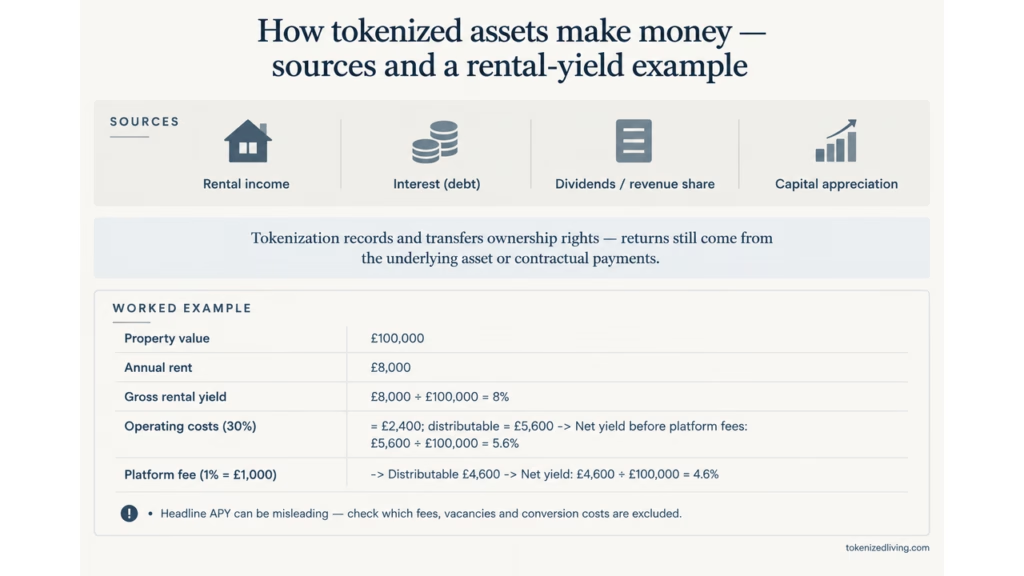
Tokenized assets can produce rental income, interest, dividends, revenue shares or capital gains. But tokenization does not create any of those returns. It changes how ownership or contractual rights are recorded, divided and transferred.
The money must still come from somewhere. A tenant pays rent. A borrower pays interest. A company declares a dividend. A business generates revenue. A buyer pays more for an asset than its previous owner did. If the underlying asset produces no income and does not rise in value, putting it on a blockchain will not make it profitable.
This distinction is essential when assessing any tokenized real-world asset, or RWA. Investors need to look beyond the token and examine the asset, legal rights, costs and payment structure behind it.
Key Takeaways
- Tokenization does not create income; returns come from assets, contractual rights or price changes.
- Tokenized assets may generate rent, interest, dividends, revenue shares or capital gains.
- Gross yield excludes important costs, while net yield provides a closer picture of what investors may receive.
- Advertised APY can be misleading if it assumes compounding or excludes fees, vacancies and conversion costs.
- Legal rights, liquidity, platform reliability and the performance of the underlying asset all affect actual returns.
Where do tokenized asset returns come from?
A token can represent many things. It might provide an interest in a company that owns property, a claim against a borrower, a share in a fund or a contractual right to part of a project’s revenue. Understanding what tokenization means helps separate the technology from the investment itself.
The return depends on what the token legally represents. Owning a token associated with a property does not automatically mean owning the property directly. The token could instead represent shares in a special-purpose vehicle, or SPV, that owns it. It might also provide only a contractual claim to certain payments.
The International Organization of Securities Commissions’ report on tokenization highlights the importance of aligning technological records with the relevant legal and regulatory framework. A blockchain entry can help record and transfer a claim, but the enforceable legal documents determine what investors are entitled to receive.
Rental income from tokenized property
Tokenized real estate can generate returns when the underlying property earns rent. A common structure involves an SPV or limited company owning the building. Investors buy tokens linked to interests in that entity, and the entity distributes part of the property’s rental cash flow.
The rent is not necessarily passed straight from the tenant to token holders. The property owner may first deduct management charges, repairs, insurance and other operating expenses. The platform or issuer may then apply its own fees before distributing the remaining amount.
Investors should also check whether the token actually includes income rights. A token linked to a property does not, by itself, guarantee a share of the rent. The offering documents must specify that entitlement.
Vacant periods, late-paying tenants and unexpected maintenance can all reduce distributions. Property prices can also fall. Tokenized ownership may make an investment easier to divide into smaller units, but it does not remove ordinary real estate risks. Our guide to the benefits and risks of tokenized real estate examines these issues in more detail.
A rental-yield example
Consider a property worth £100,000 that generates £8,000 in annual rent. Its gross rental yield is:
$8,000 ÷ $100,000 = 8%
Suppose repairs, management and insurance consume 30% of the rent, or £2,400. That leaves £5,600, producing a net yield before platform fees of:
$5,600 ÷ $100,000 = 5.6%
If the platform or manager also charges 1% of the property’s value each year, another £1,000 is deducted. Distributable cash falls to £4,600, giving token holders a net yield of:
$4,600 ÷ $100,000 = 4.6%
The difference between an 8% gross yield and a 4.6% net yield is substantial. Yet both figures could be associated with the same property.
An initial fee can reduce returns further. For example, if a 2% issuance fee is deducted from a $10,000 subscription, only $9,800 is invested in tokens. If the fee is charged separately, the investor instead pays $10,200 for a $10,000 investment. The fee structure determines the actual cost.
Interest from tokenized bonds and debt
Tokenized bonds and loans generate returns through borrower payments. A company, government or other issuer borrows money and agrees to pay interest according to the terms of the debt instrument. Token holders receive the coupon or interest if they have a legal right to those payments.
For example, a token with a face value of £1,000 and a 5% annual coupon would pay £50 in interest each year. If payments are semi-annual, that becomes two payments of £25.
The payment could travel through conventional custodians and banking systems, or the issuer could deposit stablecoins into a smart contract for distribution to eligible wallets. The method depends on the legal and operational structure.
Research from the Global Financial Markets Association on distributed ledger technology in capital markets discusses digital bond workflows involving organizations such as UBS, SDX and the World Bank. These cases demonstrate that tokenized bonds can use new digital infrastructure while retaining familiar concepts such as coupons, principal repayment, custody and issuer credit risk.
Tokenization does not make the borrower safer. If the issuer cannot meet its obligations, putting the bond on a blockchain does not prevent missed payments or losses.
Dividends and revenue sharing
Some tokens provide equity-like rights. Investors may receive dividends if the underlying company declares them, as well as potential gains if the value of their interest rises.
Dividends are not automatic unless the governing terms require a specific distribution. A company can generate revenue without paying dividends, and weak performance can cause payments to fall or stop.
Revenue-sharing tokens work differently. Their contracts may promise investors a defined percentage of revenue or another financial measure. For example, token holders might have a right to a share of net operating income from a property or revenue from a business project.
The basis of the calculation matters. A percentage of gross revenue is not the same as a percentage of profit or net revenue. Investors should identify which expenses are deducted, who calculates the amount and whether the figures are independently reported.
Smart contracts can automate the allocation of money after funds arrive. They cannot force customers to pay, make a business profitable or ensure that the issuer deposits the correct amount.
Capital appreciation
Not every tokenized asset produces regular cash flow. Investors may instead make money if the asset or token rises in value.
If an investor buys a token for £10 and later sells it for £12, the nominal capital gain is 20% before trading fees and taxes. Until the token is sold, however, the gain is unrealized.
The sale price can depend on the underlying asset’s value, but market conditions also matter. A token can trade below its estimated asset value if there are few buyers, transfer restrictions or doubts about the issuer. Conversely, speculation can push its market price above a reasonable assessment of the underlying claim.
Tokenized commodities illustrate this point. Gold does not normally produce rent, interest or dividends. A gold-backed token’s return will therefore usually depend on changes in the metal’s price, less any custody, management and trading costs.
Can You Earn Income but Still Lose Money?
Yes. Receiving regular payments does not guarantee a positive total return.
Imagine investing $1,000 in a tokenized asset that distributes $60 over one year. That represents a 6% income return before any additional costs.
However, suppose the market value of the investment falls to $900.
Your investment would then be worth $960, including the $60 received in distributions. That represents a total loss of $40, or 4%, before taxes and transaction costs.
This example shows why investors should evaluate both income and changes in asset value. A token with an attractive advertised yield can still produce a negative total return.
Gross yield versus net yield
Gross yield measures income before expenses. Net yield measures income after some or all relevant costs.
For an income-producing asset, the basic gross-yield calculation is:
Annual gross income ÷ asset value
A useful net-yield calculation is:
Income remaining after operating expenses and fees ÷ invested amount
The difficulty is that “net” does not always mean the same thing. A platform might deduct property expenses when presenting net yield but leave out trading, withdrawal or currency-conversion charges. Another might calculate the yield after platform fees but before investors’ own wallet and banking costs.
Potential deductions include asset-management fees, property expenses, custody charges, platform fees, issuance costs, blockchain transaction fees, withdrawal charges, foreign-exchange costs and the bid-ask spread when selling.
Investors should therefore look for a complete reconciliation from the asset’s gross income to the cash that reaches them. Independent analysis of gross versus net token yield also illustrates how several layers of costs can separate a headline percentage from an investor’s realised return.
Why advertised APY can mislead
APY, or annual percentage yield, usually assumes that returns are reinvested and compounded over a year. That can be useful, but only when the assumptions are clear.
A quoted APY may assume that every distribution can immediately be reinvested at the same rate. In practice, reinvestment might not be available. The rate may also change, or minimum investment sizes and fees may make frequent compounding uneconomic.
Some headline figures are based on gross income rather than net distributions. Others annualize a short period that may not represent long-term performance. A strong 30-day result, for example, does not show how the asset will perform through vacancies, defaults, repairs or changing market conditions.
Before relying on an APY, investors should determine whether it is gross or net, which fees it includes, how frequently it compounds and whether the rate is fixed or variable. They should also check whether it reflects actual past distributions, a forecast or merely a target. No projected APY removes the possibility of loss.
How investors receive distributions
Tokenized asset payments can arrive on-chain or through conventional financial systems.
In an on-chain structure, an issuer or SPV may convert distributable cash into a stablecoin such as USDC. It then deposits the stablecoins into a smart contract, which allocates payments among approved wallet addresses. Platforms may require identity checks and wallet-approved registration before an investor can receive or transfer tokens.
This process can make pro-rata allocation more efficient. However, the investor still faces network fees, wallet-security responsibilities and potential conversion costs when exchanging stablecoins for pounds or another currency. Stablecoins also introduce risks connected to their issuer and ability to maintain their intended value.
As an industry example, RealT describes weekly rental-income distributions in USDC. That is one platform model rather than a universal standard. Payment schedules and currencies vary between offerings.
Regulated digital securities may instead use established custodians, central securities depositories and banking rails. In these arrangements, coupons or principal can ultimately reach an investor’s bank or brokerage account even when the security itself is recorded using distributed ledger technology.
Hybrid structures are also possible. An SPV might maintain the legal ownership register while a platform records token transfers and distributes either fiat money or stablecoins. Some services may offer reinvestment in additional tokens rather than cash.

How asset classes differ
Anyone comparing asset class structures should first understand what qualifies as a real-world asset and what claim each token represents.
| Tokenized asset | Potential returns | Main risks |
|---|---|---|
| Real estate | Rent, price appreciation | Vacancies, maintenance, property values |
| Bonds | Interest payments | Default, interest rates |
| Equities | Dividends, capital gains | Market volatility, company performance |
| Private credit | Loan interest | Borrower defaults, illiquidity |
| Commodities | Price appreciation | Price volatility, custody costs |
| Treasury-backed funds | Portfolio income | Interest rates, fund and issuer risks |
Why actual returns may differ from expected returns
The underlying asset’s performance is the first determinant. Rental distributions fall when properties are vacant. Debt returns suffer when borrowers miss payments. Dividends depend on company performance and corporate decisions. Revenue shares decline when sales weaken.
Legal rights are equally important. Investors need to know whether they own an asset directly, hold an interest in an SPV or possess only a contractual claim against an issuer. Those distinctions can affect voting rights, distributions and the remedies available if the platform or issuer fails.
Liquidity also influences returns. A token may be technically transferable but still difficult to sell. A thin secondary market can produce wide spreads or force a seller to accept a discount. Tokenization can support fractional ownership and digital transfers, but it does not guarantee an active market.
Platform and operational risks add another layer. A platform can experience financial failure, poor administration or technical disruption. Smart-contract bugs and incorrect wallet allowlisting can delay or block payments. Investors who control their own wallets may lose access through compromised or misplaced private keys, while custodial arrangements create reliance on another party.
Returns should therefore be assessed at the level of the entire structure: the asset, issuer, legal wrapper, platform, custodian, smart contracts, payment currency and exit market.
The right question to ask
Instead of asking how a token makes money, ask what economic activity supports it.
Who pays the rent, interest or revenue? What legal right connects that payment to the token holder? Which costs are deducted? How is the distribution delivered? Can the token be sold, and is there likely to be a buyer? What happens if the asset, issuer or platform performs poorly?
A token can make an investment easier to divide, distribute and administer. It may also enable automated payments and on-chain settlement. But it cannot turn an unprofitable asset into a profitable one.
Ultimately, tokenized assets make money in the same fundamental ways as conventional assets. The underlying investment produces cash flow, appreciates or fulfils a contractual payment obligation. Tokenization changes the infrastructure—not the source of the return.
Frequently Asked Questions
Can tokenized assets provide passive income?
Yes. Some tokenized assets provide regular income through rental payments, interest, dividends or revenue-sharing agreements. For example, tokenized real estate may distribute a portion of rental cash flow, while tokenized bonds may pay interest. However, payments depend on the underlying asset, investment structure and legal rights. Income is not guaranteed, and fees can reduce the amount investors receive.
Are returns from tokenized assets guaranteed?
No. Tokenization does not guarantee profits or protect investors from losses. Rental income may fall during vacancies, borrowers can default, and companies may reduce dividends. Even investments advertising fixed yields carry risks, including issuer failure or missed payments. Investors should examine the underlying assets, contractual terms and fees before relying on projected returns.
Can you lose money even if a tokenized asset pays regular income?
Yes. An investor can receive income while losing money overall if the asset’s value declines. For example, a $1,000 investment might pay $60 in annual distributions but fall to $900 in market value. Including the distributions, the investment would be worth $960, representing a 4% total loss before fees and taxes. This is why total returns matter more than advertised income yields alone.