

Platform failure does not automatically erase an investment. However, ownership rights, access to assets, income payments, and recovery depend on the investment’s legal and operational structure.
Key Takeaways
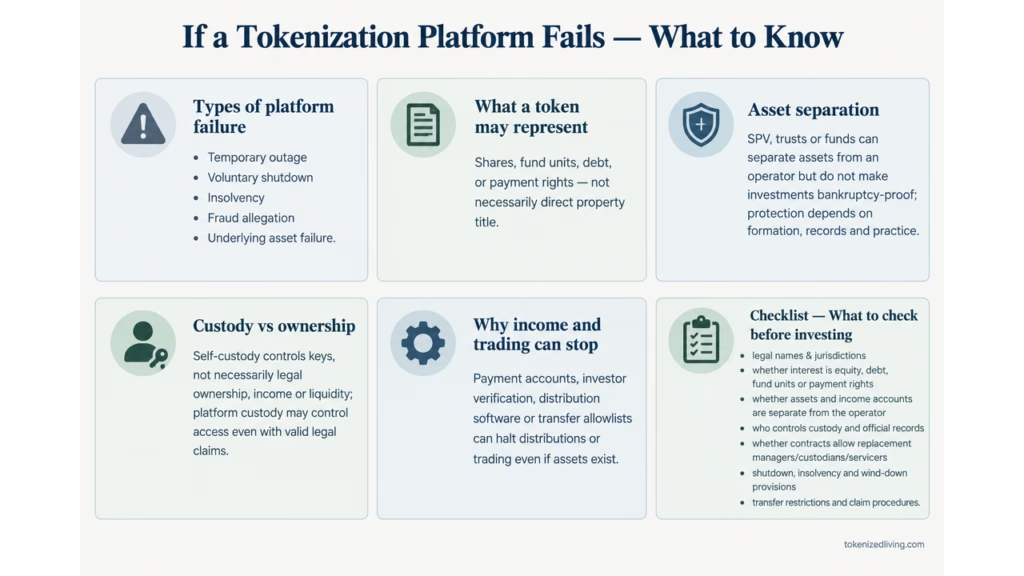
- A temporary outage, voluntary shutdown, insolvency, fraud allegation, and underlying asset failure are different events.
- A token may represent shares, fund units, debt, or payment rights—not direct ownership of an asset.
- An SPV can separate assets from a platform, but it cannot make an investment bankruptcy-proof.
- Self-custody protects control of a token, not necessarily legal ownership, income, or liquidity.
- Recovery may require ownership checks, claim forms, administrator action, and court proceedings.
Not Every Platform Failure Is the Same
A website outage may interrupt account access or trading. Meanwhile, the issuer and underlying investment may continue operating.
A voluntary shutdown is more serious. However, an orderly wind-down could allow investors to transfer tokens or receive redemption instructions.
Insolvency means an organization cannot meet its financial obligations. It may lead to bankruptcy, administration, receivership, or another process, depending on the entity and jurisdiction.
Fraud allegations can produce different results. Regulators or courts may freeze assets, appoint a receiver, or investigate ownership records. However, an allegation does not itself establish wrongdoing.
Finally, the underlying investment can fail while the platform remains open. For example, borrowers may default or a rental property may become unprofitable.
Several organizations may support one investment. The platform operator runs the interface, while an issuer creates the tokens. An asset-owning company may hold property, and a custodian safeguards assets or keys. Meanwhile, a property manager or loan servicer handles daily operations.
Therefore, the failure of one organization does not automatically mean that all the others have failed.
What Do Tokenholders Legally Own?
A token can represent company shares, fund units, debt, or a contractual right to receive payments. In limited cases, it may track direct ownership. However, holding a token does not automatically place the investor’s name on a property deed.
The distinction matters during a tokenization platform failure. An equity investor may hold an interest in an asset-owning company. By contrast, a debt investor has a claim against an issuer or borrower.
For more background, see what investors own when buying a tokenized asset and Tokenized Living’s guide to real-world assets.
Legal rights usually come from offering documents, company records, fund registers, trust documents, or contracts. The blockchain may support those records. However, it does not replace them unless applicable law and governing documents give it that role.
Asset Separation and Bankruptcy Protection
A special-purpose vehicle, or SPV, is a separate legal company formed for a specific investment. A platform might use an SPV to own one property, issue securities, and receive rental income.
Trusts and investment funds can also separate underlying assets from the platform operator’s business. This separation may prevent the operator’s creditors from claiming assets that belong to another legal entity.
However, an SPV does not make an investment bankruptcy-proof. Protection depends on several factors. They include formation documents, ownership records, separate bank accounts, title registration, jurisdiction, and how parties handled the assets.
Secured creditors, unsecured creditors, and equity investors also have different rights. Their treatment depends on contracts, liens, applicable law, and court orders rather than one universal repayment sequence. The U.S. Bankruptcy Code provides the federal framework, but each case turns on its facts.
Investors considering these structures can start with the Beginner’s Guide to RWA Tokenization.
Custody and Conflicting Ownership Records
Custody describes who controls an asset, account, or token. With self-custody, the investor controls the wallet’s private keys. Under platform-controlled custody, the platform or another custodian controls them.
Self-custody may keep a token accessible after a platform closes. Yet it does not guarantee that the investor can enforce shareholder rights or receive income. It also does not guarantee transferability or a claim to the underlying asset.
A token can remain visible in a wallet even when a property faces foreclosure or an issuer stops making payments. Likewise, a platform-controlled wallet may become inaccessible even though the investor still has a valid legal claim.
Disputes become harder when blockchain balances conflict with an issuer’s ownership register or custody records. Administrators may need account statements, transfer records, identity checks, and contractual procedures to reconcile them. Courts may decide the issue when the evidence remains contested.
The SEC’s guidance on broker-dealer bankruptcies explains similar record and custody concerns. However, securities regulation does not automatically provide deposit insurance or compensation for every tokenized investment.
Why Income and Trading Can Stop
Rental distributions, interest, or dividends can stop even if the underlying asset still produces income. The failed platform may have controlled payment accounts, investor verification, tax reporting, or distribution software.
A replacement manager, custodian, or loan servicer could restore operations. However, that transition requires usable ownership records and contractual authority. It also requires access to accounts and enough money to continue servicing the asset.
Trading may also remain frozen. Transfer allowlists, investor eligibility rules, and limited secondary markets can prevent an investor from simply moving or selling a token. The guide to tokenized asset liquidity and selling restrictions explains these limits in more detail.

Case Study: RealT’s Detroit Portfolio
In Michigan, the City of Detroit filed a nuisance-abatement action in July 2025. The action involved affiliated RealToken entities and hundreds of properties. The dispute concerned alleged property code and compliance problems.
According to Outlier Media’s account of the proceedings, a court approved a special fiduciary arrangement on April 22, 2026. Reporting said the fiduciary received broad authority over roughly 700 properties, including powers related to repairs and sales.
Investor distributions were also suspended. On July 2, 2026, a company founder reportedly announced a voluntary liquidation of U.S. structures during an investor call.
These events should not be confused with a confirmed formal bankruptcy. Public reporting did not establish completed property sales or final tokenholder recoveries. Tokenized Living’s RealT Detroit fiduciary update provides more context.
The case shows why property title, local court orders, operating funds, and fiduciary authority can be crucial. These factors may matter more than the continued visibility of tokens.
Hypothetical Example: A $2,000 Property Investment
Suppose an investor holds $2,000 in tokens representing units in a property-owning SPV. The platform operator shuts down, but the SPV still owns the property. A servicer also continues collecting rent.
The investor may retain an economic interest if the SPV’s records and legal agreements confirm that entitlement. However, distributions could stop if the platform handled payments or investor records.
A replacement manager might resume operations or arrange a sale. Still, taxes, secured debt, repairs, and administrative expenses could reduce the available value. The investor cannot assume a full or prompt recovery of the original $2,000.
What to Check Before Investing
Before investing, check the offering memorandum and core documents for key information:
- The legal names and jurisdictions of the issuer and asset-owning entity.
- Whether the investor receives equity, debt, fund units, or contractual payment rights.
- Whether assets and income accounts are separate from the platform operator.
- Who controls custody, official ownership records, and transfer approvals.
- Whether contracts allow replacement managers, custodians, or servicers.
- What shutdown, insolvency, and wind-down provisions apply.
- Which transfer restrictions and claim procedures could affect recovery.
If a platform fails, investors may need to preserve wallet transactions and account statements. They may also need to obtain offering documents, contact an administrator, and submit an investor or creditor claim. Recovery can take time, particularly when records conflict or several jurisdictions are involved.
Conclusion
A tokenization platform can fail without destroying the underlying investment. However, the token is only one part of a wider legal and operational structure.
Ultimately, enforceable ownership records, asset separation, custody, management continuity, and insolvency rules determine investors’ outcomes. These factors affect whether investors receive income, transfer their interests, or recover value.