

Some tokenized assets can be sold or redeemed. However, your exit route, timing, and final proceeds depend on the product’s legal structure and terms.
A blockchain may let you transfer a token within seconds. That does not mean another investor will buy it or that cash will reach your bank account right away.
Key Takeaways
- Tokenized asset liquidity means being able to convert an investment into usable cash at an acceptable price.
- Investors may sell to another buyer, redeem through an issuer, or wait for the underlying asset to mature or be sold.
- A marketplace or displayed price does not guarantee an executable sale.
- Identity checks, approved wallets, lockups, and investor eligibility rules may restrict transfers.
- Blockchain settlement can be fast, while redemptions and bank withdrawals still take days.
What Does Tokenized Asset Liquidity Mean?
Liquidity describes how easily you can sell an asset without accepting a large price reduction. For an investor, that requires both a viable exit route and someone willing to provide cash.
Technical transferability is different. A token may move between blockchain wallets, but the transfer function does not create buyer demand.
This distinction matters across real-world assets. A property token, fund share, and tokenized debt claim can use similar technology while giving investors very different exit rights.
Before investing, understand what you legally own when buying a tokenized asset. The token might represent shares in a property-owning company, units in a fund, or a debt claim rather than direct ownership of an asset.
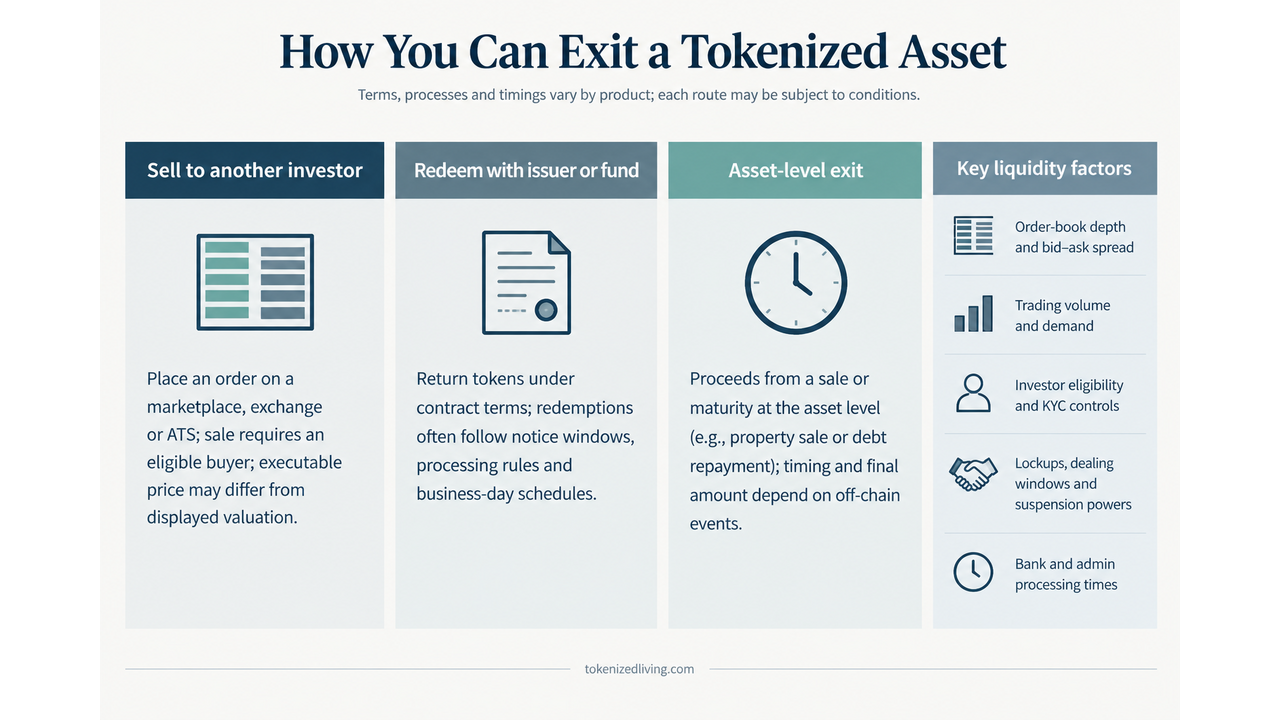
The Three Main Ways to Exit
The first route is selling to another investor. You may submit a sell order through a platform, alternative trading system, centralized exchange, or decentralized market supported by the product.
However, a sale requires an eligible buyer. If demand is weak, the order may remain open or execute below the platform’s displayed valuation.
The second route is redemption through the issuer or fund. In this case, the investor returns or cancels the tokens under a defined process and receives cash or another supported asset.
Redemption rights come from the prospectus, offering memorandum, or governing agreement. Depending on the product, requests may face dealing windows, notice periods, size limits, temporary suspensions, or bank processing delays.
The third route is an asset-level exit. For example, a property-owning company may distribute proceeds after selling a building. Likewise, a tokenized debt instrument may repay investors when it matures.
This route depends on an off-chain event. Investors may have little control over its timing, and the final amount can differ from an earlier valuation.
How Secondary Markets Affect Your Exit
Marketplaces commonly use order books. Buyers post bids, sellers post asking prices, and a trade occurs when their prices match.
Order-book depth matters as much as the top bid. A buyer might offer an attractive price for only a small number of tokens, leaving a larger seller to accept lower bids.
Low trading volume can also produce wide bid–ask spreads. The spread is the difference between the highest buyer bid and the lowest seller ask. A wide spread raises the cost of exiting quickly.
Some fungible tokens trade through automated liquidity pools instead. These pools use deposited assets and formulas to quote prices, but larger trades may experience slippage. Many regulated tokenized assets do not have access to such pools.
Therefore, the existence of a marketplace does not prove meaningful liquidity. For a broader explanation, see how tokenized asset secondary markets work.
Why a 24/7 Blockchain Does Not Mean 24/7 Cash
Blockchain networks can record transfers at any hour. Yet platforms, fund administrators, compliance teams, and banks may follow business-day schedules.
Even after an on-chain transaction settles, a platform might need to verify the transfer, process a redemption, convert assets, and send an ACH or wire payment. Your bank may then apply its own processing times.
As a result, settlement speed and cash availability are separate issues. Learning how tokenization works can help you distinguish the blockchain record from the legal and financial processes around it.

BENJI: Fund Redemption Versus Token Transfer
BENJI tokens represent shares of the Franklin OnChain U.S. Government Money Fund. They are fund shares, not direct claims on individual Treasury securities held by the fund.
Franklin Templeton has announced peer-to-peer transfer functionality. However, a permitted transfer still requires an authorized recipient and compliance with the fund’s controls.
Investors may also request redemption through the Benji app or institutional portal. According to the fund’s SEC-filed prospectus, requests are processed during normal business hours. ACH or Fedwire proceeds may take up to seven days after a properly formed request.
The prospectus also notes that shares sold soon after purchase may face delays while the original payment clears. Thus, fast on-chain settlement does not remove the fund administrator or banking steps.
RealT: Selling an Interest Connected to Property
RealT property tokens represent interests in a Series LLC that holds a property. They do not necessarily give each tokenholder direct title to part of the building.
The company’s private placement memorandum warns that tokens may not be listed immediately and that a liquid market cannot be guaranteed. Transfers also remain subject to securities rules and platform controls.
RealT provides sell-order mechanics, but their presence does not establish active demand. An investor’s exit still depends on eligible buyers, accepted pricing, transfer approval, and any processing fees.
This illustrates a core point about fractional ownership: owning a smaller interest can lower the investment amount, but it does not automatically make the interest easy to sell.
How Discounts and Fees Reduce Your Proceeds
Consider a hypothetical token investment with a stated value of $1,000. The best available buyer bid is $900, and the platform charges a 1% selling fee.
The sale produces $900 before fees. The $9 fee leaves $891 in net cash, which is $109 below the stated value—a 10.9% loss.
This example does not include network, conversion, custody, wire, or withdrawal charges. It also shows why a valuation, asking price, or fund NAV should never be treated as a guaranteed sale price.
What to Check Before Investing
First, identify the legal structure and each permitted exit route. Then read the offering documents for redemption windows, transfer restrictions, lockups, minimums, and suspension powers.
Next, examine actual bids, recent volume, spreads, and order-book depth where that information is available. Do not rely only on a platform valuation or the most recent trade.
Finally, confirm investor eligibility, identity requirements, supported wallets, and expected bank processing times. Review every potential cost, including trading, redemption, network, custody, conversion, and withdrawal fees.
FAQs
Can I sell any tokenized asset whenever I want?
No. The token must have a permitted transfer route, and secondary sales require an eligible buyer. Contractual lockups or compliance controls may also prevent a transfer.
Can tokenized fund shares always be redeemed at NAV?
No. Redemption depends on the fund’s governing documents and current procedures. Requests may be subject to business-day processing, notice rules, limits, or suspensions.
Does a quoted token price show what I will receive?
Not necessarily. It may represent an asking price, an old trade, or a bid for only a small quantity. Your actual proceeds depend on executable demand and fees.