

Cross River plans to represent loans on a blockchain from the moment they are issued, while keeping its existing regulated lending framework in place. The proposed system could give lenders and funding partners a shared record of each loan’s ownership, payments and servicing history.
For borrowers, however, the visible experience is intended to remain largely familiar. The project has completed a proof of concept, but there is no public evidence that it is commercially live.
Key Takeaways
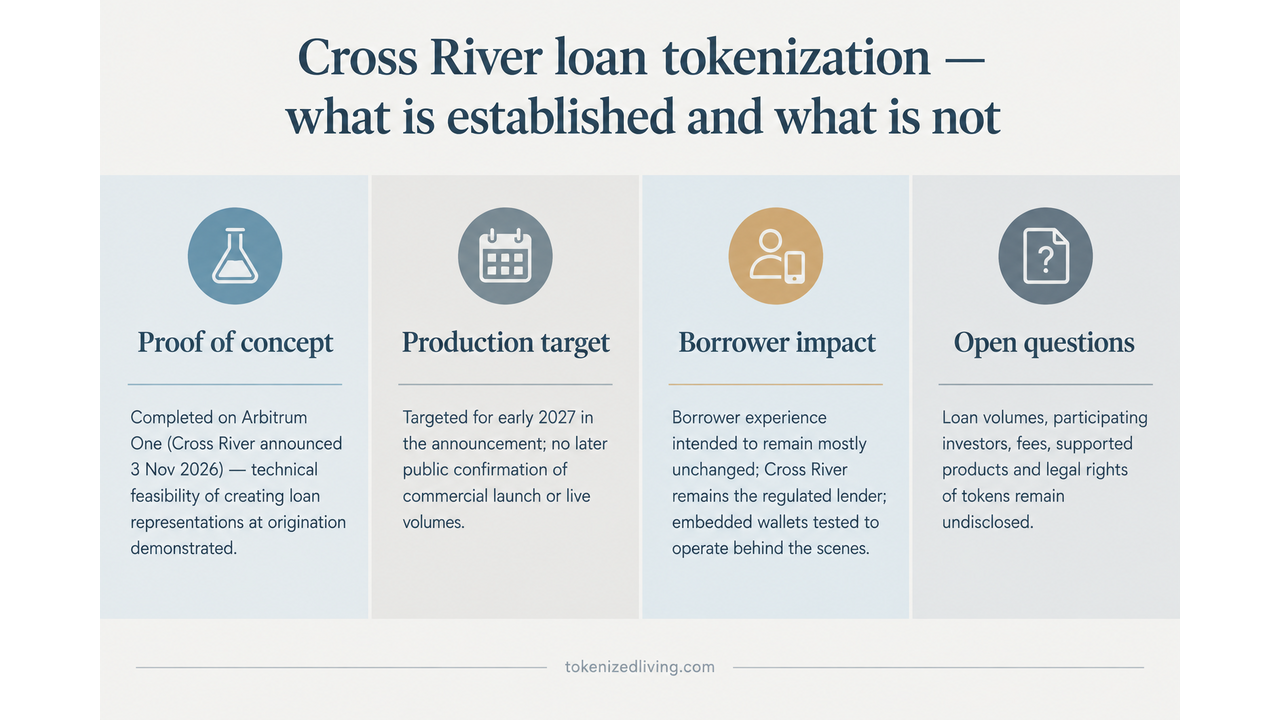
- Cross River and Offchain completed a proof of concept for tokenizing loans at origination on Arbitrum One.
- Production deployment was targeted for early 2027, with no subsequent public update confirming a launch.
- Cross River would remain the regulated bank and lender of record.
- Applications, underwriting, servicing and repayments are intended to remain mostly unchanged for borrowers.
- Loan volumes, investors, fees, supported loan types, transfer rules and token holders’ legal rights remain undisclosed.

What Cross River and Offchain announced
On November 3, 2026, Cross River announced plans to integrate loan tokenization into its lending infrastructure. The bank is working with Offchain Enterprise Services, part of the team behind Arbitrum.
According to the Cross River announcement, the companies completed a proof of concept and were working towards production deployment in early 2027. No later public announcement confirming commercial deployment, live loan volumes or a revised timetable has been identified.
The project focuses on tokenizing loans when Cross River creates them. “Loan origination” begins when a lender receives an application and assesses the borrower. The lender then approves the credit and creates the loan.
Under the proposed model, Cross River would create the digital token during loan origination. This differs from taking a portfolio of existing loans and tokenizing it later. Building the blockchain record at origination could allow funding, ownership and payment events to be recorded throughout the loan’s lifecycle, rather than added retrospectively.
Readers new to the concept can see what tokenization means and how financial claims can fit within the broader category of real-world assets.
How the proposed system would work
Arbitrum One is intended to provide the settlement and programmability layer. The shared blockchain record could track when a loan is created, which party funds or owns an interest in it, and how repayments and servicing events affect that position.
In principle, this could reduce the need for lenders, servicers and funding partners to reconcile separate databases. It could also support automated settlement or transfers when contractual and regulatory conditions are satisfied. The companies plan to offer these capabilities but have not demonstrated commercial results.
ZeroDev would provide embedded wallet infrastructure. Instead of asking borrowers to install a crypto wallet or manage private keys directly, the system could create and operate blockchain accounts behind the scenes. Arbitrum’s explanation of ZeroDev describes technology designed to simplify wallet, gas and cross-chain interactions for users.
The proof of concept demonstrated the technical feasibility of creating loan representations at origination and recording them on Arbitrum. Public information does not establish that it included live third-party investor funding, compliant secondary transfers, production-scale servicing or commercial transaction volumes.
What could change for lenders and investors
For Cross River and its funding partners, a shared record could provide a clearer view of loan ownership, repayment activity and servicing events. If implemented successfully, it may reduce operational friction and make settlement more programmable.
Investors could potentially receive more granular loan positions or transfer eligible interests more efficiently. But tokenization does not itself create liquidity. Neither company has announced market makers, secondary trading venues or liquidity commitments.
Nor does putting a loan onchain reduce the borrower’s credit risk. Investors would still face the possibility of late payment or default, while operational and legal risks would depend on the final system design.
The companies have not explained what legal rights each token would provide. These could involve loan assignments, contractual claims, securities or bookkeeping records. However, the available documents do not confirm which structure the companies will use. Therefore, the connection between blockchain records and legally enforceable ownership remains unclear.
What borrowers would experience
The companies have demonstrated loan tokenization through a proof of concept. However, Cross River has not disclosed detailed testing results for the proposed borrower experience or demonstrated the complete system operating commercially. Customers would still apply through familiar interfaces, while Cross River would continue to handle underwriting, compliance and risk decisions.
Servicing and repayment interfaces are also intended to operate as they do today. ZeroDev’s embedded wallets would support the onchain components without requiring borrowers to interact directly with blockchain tools.
The companies completed a proof of concept demonstrating loan tokenization. However, Cross River has not publicly demonstrated the complete system operating commercially. It is not yet clear whether borrower statements would identify tokenized ownership, how ownership changes would be communicated, or how disputes between conventional records and onchain data would be resolved.
Tokenization also does not necessarily mean cheaper borrowing. The companies have not published borrower pricing or shown that any operational savings would be passed through as lower interest rates or fees.
Cross River remains the regulated lender
Cross River would remain the regulated bank and lender of record. It would continue to originate the loan and retain responsibility for underwriting, compliance and credit-risk processes on its regulated platform.
Arbitrum, Offchain and ZeroDev provide technology rather than replacing the bank’s lending role. The proposed blockchain layer changes how loan-related records and positions may be represented and exchanged, not who approves the borrower.
Limitations and unanswered questions
Public materials do not disclose expected loan volumes, participating investors, funding partners, transaction fees or the specific loan products that production deployment would support. They also do not explain investor eligibility, custody arrangements, cross-border limits or token transfer restrictions.
Until commercial terms and legal documentation are published, the project is best understood as a completed technical proof of concept with a stated production target—not as an operating tokenized loan marketplace.