

When you buy a tokenized asset, it can feel deceptively simple. A token appears in your wallet, its balance is visible on a blockchain, and the platform may describe it as a fraction of a building, a share or a bond.
But what does that token legally represent?
The blockchain can show that you control a token address. It does not, by itself, prove that you own the asset associated with it. Your actual rights come from the legal structure behind the token: contracts, company records, custody arrangements, offering documents and the law governing them.
A token could represent direct ownership of a security. It could represent an interest in a company that owns a property. It might be a fund unit, a debt claim against an issuer or simply a contract designed to follow an asset’s price. These structures can produce similar-looking tokens while giving investors very different rights.
Understanding that distinction is essential before buying any tokenized real-world asset.
Key Takeaways
- A blockchain token is not automatically legal title to the underlying asset.
- Your rights depend on the issuer’s legal documents, ownership structure, custody model and governing law.
- Tokenholders may own SPV shares, fund units or debt claims rather than the asset advertised.
- Voting, income, redemption and transfer rights must be stated in enforceable documents.
- In an insolvency, your position depends on whether you are an owner, secured creditor, unsecured creditor or equity investor.
The token is only one layer of the arrangement
Tokenization uses digital tokens to represent rights or interests. The important word is “represent”. The token is a technical record, while the represented rights exist within a separate legal framework.
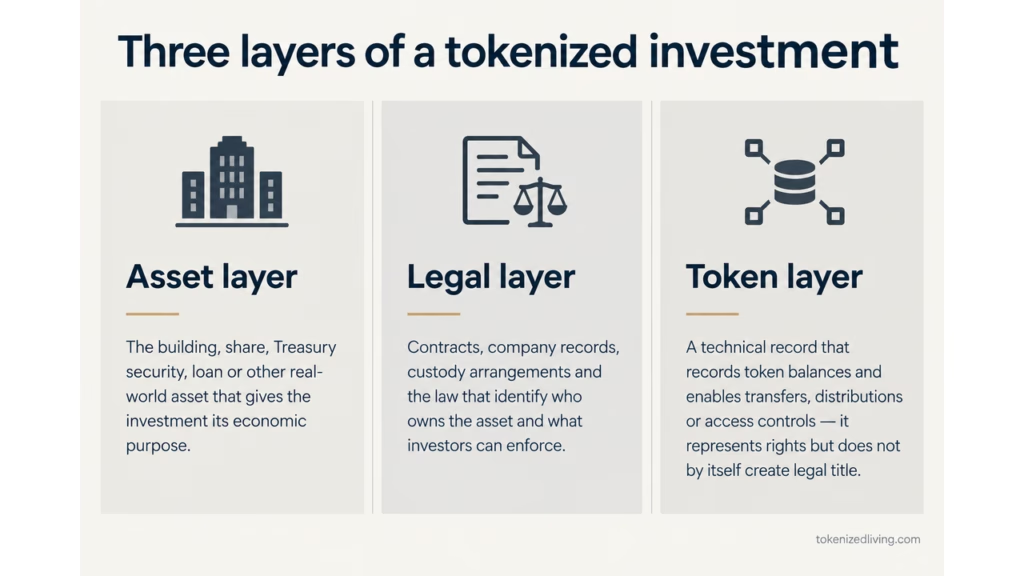
It helps to think of a tokenized investment as having three layers.
The first is the asset layer. This is the building, share, Treasury security, loan or other real-world asset that gives the investment its economic purpose.
The second is the legal layer. It identifies who owns the asset, who owes money, which contracts apply and what investors can enforce. This layer might include a company, trust, fund, custodian or special-purpose vehicle.
The third is the token layer. This records token balances and enables functions such as transfers, distributions or access controls.
These layers need to match. A smart contract might calculate a distribution perfectly, but that code does not necessarily give the tokenholder a legally enforceable right to receive the money. That right must also appear in the relevant agreement or governing document.
Seven things a token might represent
There is no single legal model for tokenized assets. The following structures can all be described as tokenization, even though their ownership consequences differ substantially.
1. Direct legal ownership
In the clearest model, the tokenholder is recorded as the legal owner of the relevant asset or security on a recognised register. For a tokenized share, for example, the issuer’s official shareholder register might recognise the investor as the registered shareholder.
This is close to conventional ownership with a different recordkeeping system. The shareholder’s rights should still come from company law, the company’s constitutional documents and the terms of the share.
Direct ownership of a physical asset through a blockchain record is less straightforward and is relatively uncommon. Land, vehicles and other registered assets usually depend on official ownership systems. Holding a token that refers to such an asset does not replace those systems unless the applicable law recognises it as doing so.
2. Beneficial ownership through a custodian or nominee
A custodian, nominee or securities depository may hold legal title while the investor receives beneficial ownership or another entitlement.
The investor might receive the economic benefits of the asset without appearing as its registered legal owner. Dividends or interest may flow through an intermediary, while voting instructions may need to pass through that intermediary as well.
This model creates additional questions. Investors need to know whether the assets are segregated, how ownership records are reconciled and what happens if the custodian fails. They should also establish whether their rights are proprietary interests in identifiable assets or merely contractual claims against the intermediary.
3. Equity or membership interests in an SPV
A special-purpose vehicle, or SPV, is often used for tokenized real estate. The SPV owns the property, while investors hold shares or membership interests in the SPV.
In this arrangement, the tokenholder does not normally appear on the property title. The token represents an interest in the entity that owns the property.
A RealToken private placement memorandum, for example, describes a structure in which an LLC holds the property and tokens represent interests in that LLC. It also sets out subscription mechanics and transfer restrictions.
This distinction matters. A tokenholder’s rights come from the LLC’s operating agreement, offering terms and applicable company law. The investor may have an indirect economic interest in rental income and sale proceeds, but that is different from directly owning a fraction of the land.
4. Fund units
Some tokens represent shares or units in a pooled investment vehicle. The fund then owns Treasuries, property interests, loans or other assets.
The investor owns an interest in the fund, not a specific proportion of every underlying asset. Redemption, distributions, fees and governance rights are determined by the fund documents.
The token may simply provide a new way to record and transfer an otherwise conventional fund share. One SEC-filed statement of additional information describes tokenized shares as a book-entry format maintained through an integrated digital transfer agent. Under that model, the relevant system must recognise the token for it to evidence ownership.
A token copied or transferred outside the recognised system would not necessarily establish a valid fund interest.
5. A debt claim
A token can represent a note, bond or other debt obligation. The investor is then a creditor rather than an owner of the underlying asset.
The issuer promises to pay interest, principal or another amount according to the note terms. The debt may be secured against assets, unsecured or structurally subordinated to other claims.
This structure is common where a wrapper company issues tokens linked to assets that it owns or holds through another party. Even if the token’s return is linked to a share, Treasury or loan, the investor may have a claim only against the wrapper.
The crucial questions are who issued the debt, whether collateral supports it and where the tokenholder sits in the payment priority.
6. Contractual rights
Some tokens provide rights created solely by contract. These might include an entitlement to specified cash flows, a licence, access to a service or the right to request delivery subject to certain conditions.
Contractual rights can be legally enforceable, but they are not the same as ownership. Their value depends on the terms of the agreement and the counterparty’s ability to perform.
A contract may also impose conditions that are not obvious from the token itself. These can include identity checks, minimum redemption amounts, waiting periods, transfer approvals or restrictions based on the investor’s location.
7. Synthetic economic exposure
A synthetic token tracks the economic performance of an asset without giving the holder ownership of that asset. It may be structured as a derivative, tracker certificate or payment promise.
A token linked to a listed company’s share price, for example, might rise and fall with that share without giving the holder voting rights, dividends or a place on the company’s shareholder register. Any dividend-equivalent payment may come from a formula in the token’s terms rather than from the company itself.
The International Organization of Securities Commissions’ 2025 report on tokenization highlights confusion around “stock tokens”. Some products may offer only a promise of monetary returns without providing shareholder rights.
Ownership is not the same as economic exposure
Two investments can produce similar returns while giving their holders different legal positions.
A direct shareholder may have rights under company law. A fund investor may have rights against a pooled vehicle. A noteholder may be owed money by an issuer. A synthetic-token holder may depend entirely on a contract with a platform or wrapper.
This difference can remain hidden while everything operates normally. Income arrives, token balances update and trades settle. It becomes much more important when payments stop, a custodian fails, an issuer becomes insolvent or an investor tries to enforce a right.
Marketing descriptions such as “own part of a building” or “buy tokenized shares” are therefore not enough. Investors need to identify the legal instrument they are purchasing and the entity responsible for honouring it.
What rights should a tokenholder check?
Ownership is a bundle of rights rather than a single feature. When you buy a tokenized asset, the token may include some rights while excluding others.
Voting rights
A tokenholder does not automatically receive a vote.
Direct shareholders may have voting rights attached to their class of shares. SPV investors may be able to vote on limited matters under an operating agreement. Fund units may offer restricted governance rights, while debt and synthetic tokens often provide no ordinary voting rights at all.
Even when voting exists, the mechanism matters. An intermediary might cast the formal vote after receiving instructions from tokenholders. The documents should explain which matters can be voted on, how votes are counted and whether the manager can act without investor consent.
Income distributions
The presence of income-producing assets does not guarantee that tokenholders have a direct right to the income.
A property SPV might receive rent, deduct costs and distribute the remainder under its operating agreement. A fund might pay distributions according to its prospectus. A debt issuer might owe fixed or variable interest. A synthetic product might calculate a payment that resembles a dividend without passing through an actual dividend.
Investors should look for the distribution formula, payment schedule, permitted deductions and the manager’s discretion to retain cash.
Redemption
Redemption means exchanging a token for cash or, less commonly, the underlying asset. It should never be assumed.
Some products allow periodic redemption at a calculated value. Others require investors to find a buyer on a secondary market. Redemption may also depend on minimum amounts, liquidity, notice periods, identity checks or approval by the issuer.
The ability to transfer a token between blockchain addresses is not the same as a legal right to redeem it.
Secondary-market transfers
A technically transferable token may still be legally restricted.
Securities laws, investor-eligibility rules and offering terms can limit who may buy the token and when it may be resold. The smart contract may enforce approved-wallet lists, but legal restrictions can apply even if the code does not prevent a transfer.
A transfer may also need to be recognised by the issuer, fund administrator or transfer agent. Sending the token to another wallet does not necessarily update the official ownership register.
For a wider introduction to how these arrangements work, see the Beginner’s Guide to RWA Tokenization.

How ownership differs by asset type
The underlying asset category can suggest a likely structure, but it does not determine the tokenholder’s rights.
Tokenized real estate
Tokenized property commonly uses an SPV. The SPV appears on the property title, and investors receive interests in the SPV.
Those interests may entitle investors to part of the SPV’s distributions and residual value. However, mortgage lenders, tax authorities and other creditors may have claims against the property or the SPV that rank ahead of equity investors.
The operating agreement should explain voting, property management, expenses, distributions and sale decisions. Investors should also check whether each property has a separate vehicle and whether the property is encumbered.
These structural risks are explored further in the guide to the benefits and risks of tokenized real estate.
Tokenized stocks
A tokenized stock can take several forms.
At one end, the token may be an officially recognised book-entry representation of a share, with ownership recorded by the issuer or its transfer agent. Another model places conventional shares with a custodian and gives tokenholders beneficial or contractual entitlements. A third uses a debt instrument or derivative that tracks the share price.
Only the first two models may provide some form of ownership interest in the underlying share, and their rights can still differ. A price-tracking note does not make the holder a shareholder merely because its value follows the stock.
Investors should check whether they appear on an official register, whether a custodian holds matching shares and whether dividends and votes are passed through.
Tokenized U.S. Treasuries
A “tokenized Treasury” often represents an interest in a fund or vehicle that holds Treasury securities. In that case, the investor owns a fund unit or vehicle interest rather than a specific Treasury security.
Another product might issue debt backed by Treasuries or promise a return linked to Treasury yields. That gives the investor a claim against the issuer, with the Treasuries acting as assets or possible collateral.
The distinction affects redemption, fees, insolvency treatment and access to the underlying securities. Investors should identify who owns the Treasuries, where they are held and whether they are segregated from the issuer’s other assets.
Tokenized private credit
Private-credit tokens may represent fund units, SPV interests or notes. The underlying borrower might owe money to a lending vehicle, while the tokenholder has a separate claim against that vehicle.
This creates a chain of relationships. The borrower pays the lender or SPV. The vehicle applies fees and expenses. It then pays tokenholders according to the token terms.
Tokenholders should not assume that they can enforce the original loan directly against the borrower. They need to check who is the lender of record, who holds any collateral and whether their own claim is secured or unsecured.
What happens if the issuer or platform becomes insolvent?
Blockchain ownership does not override insolvency law. A token can remain in a wallet while the legal claim behind it loses value or becomes difficult to enforce.
An SPV equity investor will usually sit behind the SPV’s creditors. The SPV’s assets may be sold to meet debts before anything is distributed to equity holders.
A debt-token holder is a creditor. Recovery depends on the debt terms, any security and the holder’s ranking relative to other creditors. An unsecured promise may rank alongside other unsecured liabilities.
A beneficial owner relying on a custodian needs to know whether the underlying assets are legally segregated and identifiable. Poor recordkeeping or commingling may complicate recovery.
A synthetic-token holder may have no claim to the reference asset at all. If the issuing counterparty fails, the holder may be left with a creditor claim against that counterparty.
The platform and issuer may also be different entities. If a trading platform fails, investors might retain their legal rights against an SPV, fund or issuer. In practice, however, they could lose access to records, transfer functions or distribution systems. Whether their rights survive cleanly depends on independent registers, custody arrangements and legal documentation.
How to find out what you are actually buying
Start by identifying the issuer. Its name should appear in the offering memorandum, subscription agreement or prospectus. Do not assume that the brand operating the website is the entity that owes you money or records your ownership.
Next, identify the legal instrument. Look for terms such as share, membership interest, fund unit, note, certificate, beneficial interest, derivative or contractual entitlement. These words indicate the nature of the claim more clearly than the token’s marketing name.
Then ask who owns the underlying asset. It could be the issuer, an SPV, a fund, a trust, a custodian or another intermediary. Check whether that ownership is evidenced through a property register, shareholder register, custody statement or other recognised system.
The core documents may include a private placement memorandum, prospectus, subscription agreement, operating agreement, note terms, custody agreement or statement of additional information. A SAFT or token purchase agreement may also be relevant, but it should be read alongside the documents that create the continuing rights after issuance.
Pay particular attention to the sections covering distributions, fees, voting, redemption, transfers, defaults and insolvency. Check which jurisdiction’s law governs the agreement and where disputes must be brought. A right against a foreign entity may be difficult or expensive to enforce, particularly when the underlying asset is located elsewhere.
Finally, compare the legal documents with the smart contract. The blockchain mechanics should support the stated rights, but the code should not be treated as a substitute for them.
The most important question: who owes you what?
Before you buy a tokenized asset, try to complete one clear sentence:
“I have a legally enforceable claim against [entity] for [specific right] under [document and governing law].”
If you cannot identify the entity, the right and the document, you may not yet understand the investment.
The most useful questions are often simple. Are you an owner or a creditor? Are you recorded on an official register? Who holds the underlying asset? Can you receive income, vote, redeem or transfer? What ranks ahead of you if the structure fails?
A blockchain can make ownership records and transactions more efficient. It cannot, on its own, create clear legal ownership, protect assets from insolvency or guarantee enforcement. Those outcomes still depend on the legal structure behind the token.