

Major US-listed companies are using a new regulatory mechanism to keep tokenized versions of their shares off OKXICE, a planned Tokenized Securities Venue backed by OKX and Intercontinental Exchange.
OKXICE initially proposed trading 63 stock listings. By October 23, 22 companies had reportedly filed objections, potentially reducing the venue’s available selection. However, the number of objections does not directly equal the number of proposed listings removed.
The dispute is significant, but it needs careful interpretation. These companies have objected to the offering of their tokenized shares on a particular venue under a specific US regulatory exemption. That does not necessarily mean they oppose tokenization in every form.
Key Takeaways
- Twenty-two issuers had reportedly objected to OKXICE by 23 October 2026, up from nine on 15 October.
- A timely written objection prevents OKXICE from offering that issuer’s tokenized shares under the SEC’s temporary exemption.
- The objections highlight questions about liquidity, fragmented price discovery, investor protections and issuer control. However, the filings do not explain why each company objected.
- An OKXICE objection is venue-specific, not a universal prohibition on tokenizing the company’s shares.
- The episode shows that issuer participation may be as important as technology and regulation in determining the future of tokenized equities.
How the objections developed
OKXICE set out its proposed Tokenized Securities Venue in a public notice dated 4 October 2026. The document described the venue’s intended operations, participant access, automated market maker design and obligations under what it called the SEC’s TSV Exemption.
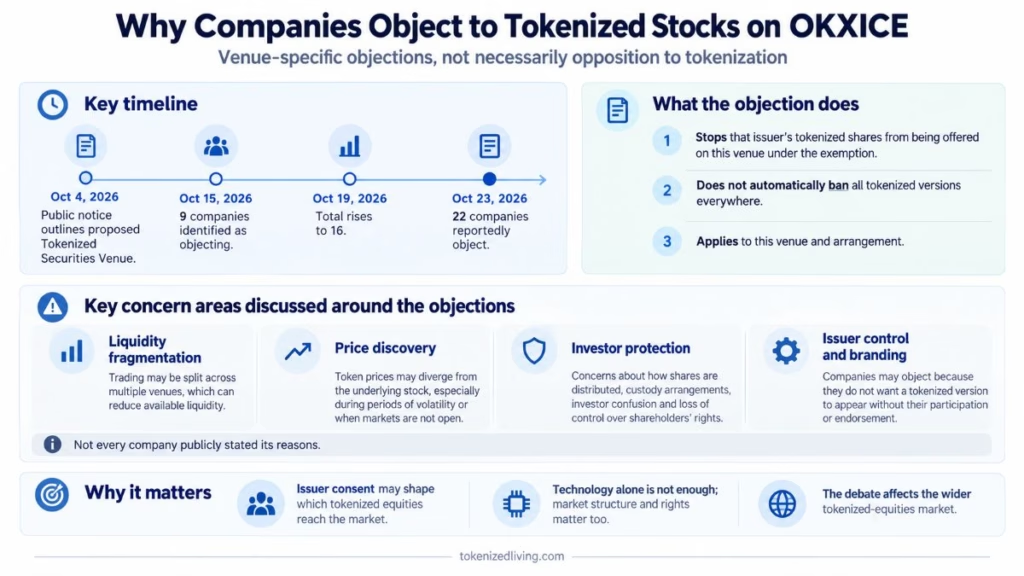
A revised notice published on 15 October identified an initial group of nine companies that had objected to tokenized versions of their shares appearing on OKXICE. Reporting on a subsequent update put the number at 16 by 19 October.
The total then reached 22 on 23 October. CoinDesk reported on 24 October that Cisco, Wells Fargo, Marvell, Arm, Intuit and Moderna were among the latest additions.
The rising total matters because OKXICE reportedly intended to begin with 63 stocks. Each successful objection removes an issuer’s shares from the venue’s available universe under this particular exemption, reducing the breadth of its prospective product.
What is the SEC innovation exemption?
The mechanism is described as a temporary, conditional exemption for a Tokenized Securities Venue, or TSV. It is intended to allow experimentation with tokenized US-listed securities without simply removing the obligations associated with regulated securities markets.
Under the framework described in OKXICE’s notices, the venue must notify an issuer before offering a tokenized version of its listed shares. The issuer then has an opportunity to respond within the stipulated period.
If the issuer submits a timely written objection, OKXICE cannot offer that company’s tokenized shares under the exemption. The venue’s notices also describe an obligation to publish revisions within five business days when issuers object or planned listings are halted.
This is not the same as requiring every company to become an active participant in the tokenization process. An issuer does not have to create the token, manage its blockchain infrastructure or operate the market. However, the objection mechanism gives it meaningful control over whether its shares appear on this venue.
For readers new to the underlying concept, tokenization converts rights or interests in an asset into blockchain-based tokens. Public shares are a form of real-world asset, although tokenized equities carry market-structure and securities-law considerations that differ from many other tokenized RWAs.
Under the SEC framework, issuers have 30 calendar days to object after receiving the required notice about an unaffiliated third party’s tokenized stock. If a timely objection is submitted, the venue cannot make that stock available for trading under the exemption. The restriction applies to that particular venue and arrangement rather than automatically banning all tokenized versions of the company’s shares.
What rights do issuers actually have?
The right provided through this framework is narrower than a general right to prohibit all tokenization of a company’s shares.
A company’s objection stops OKXICE from offering its tokenized stock under the TSV Exemption. It does not, on the available evidence, create a worldwide ban covering every platform, structure or jurisdiction. Whether another venue could offer an economically linked token would depend on that venue’s structure and the laws that apply to it.
That distinction is central to the dispute. An issuer can reject a particular venue because it dislikes the operating model, custody arrangements or investor disclosures without rejecting tokenization as a technology.
Companies may also prefer to retain control over when and how a tokenized version of their equity reaches investors. A third-party token could create the impression that the issuer developed, approved or endorsed the product, even if the company had no operational role.
Issuer control extends beyond branding. Public companies have established systems for shareholder records, voting, dividends and other corporate actions. A tokenized structure must explain how token holders connect to those systems and whether they receive rights equivalent to conventional shareholders.
Why liquidity and price discovery are major concerns
Tokenization can make assets programmable and potentially expand how and when they trade. It does not automatically create deep liquidity.
A tokenized version of a stock may trade in a separate liquidity pool from the conventional shares listed on an established exchange. If trading activity splits between multiple venues, no single market necessarily contains the full picture of supply and demand.
This fragmentation could affect price discovery. The token’s price might diverge from the underlying stock, particularly during periods of volatility or when one market is open and another is not. Arbitrage may narrow differences in ordinary conditions, but its effectiveness depends on market access, settlement arrangements and available liquidity.
Applied Optoelectronics: A Real-World Example
Applied Optoelectronics was among the first companies to object to having its shares tokenized on OKXICE. Unlike most of the other issuers, the fiber-optic equipment manufacturer publicly explained its decision.
A company spokesperson told The Wall Street Journal that Applied Optoelectronics was uncertain how tokenization might affect its share price, trading liquidity and volatility. The company also worried that investors could mistake an independently issued token for a product it had approved or endorsed.
These concerns show why issuer objections are about more than adopting new technology. Even when a token tracks an existing stock, the company may have limited control over how it trades or how investors interpret its relationship with the issuer.
For Applied Optoelectronics, the potential benefits did not appear sufficient to justify those uncertainties.
OKXICE’s documentation describes an automated market maker model. AMMs use liquidity pools and algorithmic pricing rather than relying solely on the order books and market makers common in established equity markets. That model is well known in digital-asset markets, but it does not guarantee the same depth or execution quality as a heavily traded listed share.
Liquidity can also become more fragile under stress. A pool that appears adequate in calm markets may produce larger price movements when investors try to enter or exit quickly. There is not yet enough empirical evidence to determine how fragmentation would affect tokenized US equities across different market conditions.
These are reasons for caution, rather than proof that tokenized equity markets cannot work. Better links between the token and underlying shares, stronger market-making arrangements and clear redemption mechanisms could reduce some risks. Issuers still need to understand those arrangements before allowing their names and securities to appear on a new venue.
The investor-protection questions
Investor protection begins with clarity about what the token represents. A product described as a tokenized stock could represent direct ownership, beneficial ownership held through an intermediary or only an economic exposure linked to the share price. Those structures do not necessarily give investors identical legal rights.
Investors therefore need to know who holds any underlying shares, how assets are segregated and what happens if the platform or custodian fails. They also need clear information about voting rights, dividends, stock splits, mergers and other corporate actions.
Investor confusion is a particular concern when the issuer has not participated in creating the product. A familiar company name and ticker may suggest that the token is an official digital version of the company’s shares. An issuer may object because it does not want investors to infer that endorsement.
Trading hours add another complication. If tokenized shares trade when the main equity market is closed, token prices may react to news without the same level of underlying-market liquidity. That can provide useful price signals, but it can also increase volatility and produce temporary gaps when the conventional market reopens.
None of these questions proves that OKXICE lacks adequate protections. They explain why issuers may want more control and assurance before permitting tokenized versions of their shares to trade there.
This is not necessarily opposition to tokenization
The 22 objections should not be treated as a referendum on tokenization itself.
Companies can support blockchain-based market infrastructure while opposing a specific venue, product design or distribution model. They may prefer issuer-led tokenization, a different custody structure or a system that integrates more directly with existing transfer agents and shareholder records.
Some may also want tokenized shares to provide demonstrable benefits before accepting the operational and reputational risks. Those benefits could include broader access, improved settlement or more efficient corporate actions, but the value depends on the legal and technical design. Tokenization alone does not resolve questions about ownership, liquidity or investor rights.
The more accurate conclusion is that major issuers want a say in how their publicly listed securities enter tokenized markets. The SEC exemption, as described by OKXICE, gives them that say.
What it means for the wider tokenized-equities market
OKXICE’s experience shows that regulatory permission is only one part of launching a tokenized-equities venue. A platform may have the technology and an applicable exemption yet still struggle to build a compelling selection of shares if large issuers decline to participate.
That could lead to a divided market. Regulated, exchange-affiliated venues may offer a narrower selection of securities from companies that consent or choose not to object. Other platforms may attempt third-party tokenization where local rules permit it, potentially creating greater uncertainty around title, custody and issuer involvement.
The objections may also encourage platforms to work with companies from the outset rather than treating listed shares as assets that can be placed on-chain without issuer participation. An issuer-led approach could make it easier to align token ownership with voting, dividends and other shareholder rights.
For the wider RWA tokenization market, the lesson extends beyond public equities. Technology can represent an asset on a blockchain, but it cannot remove the rights and interests of the asset’s owner, issuer or existing market participants. Questions about legal title, control and fragmented liquidity also arise in areas such as tokenized property, private credit and funds.
Issuer consent may shape the market
The objections do not end the case for tokenized equities. They show where some of the hardest work lies.
Tokenized stock platforms must do more than prove that tokens can track shares or trade through blockchain infrastructure. They need to show how investors acquire enforceable rights, how liquidity connects with established markets and how corporate actions reach token holders. They must also convince issuers that tokenization will not confuse investors or weaken control over their securities.
OKXICE’s proposed launch brought those tensions into public view. With 22 companies objecting by 23 October, the immediate effect was a smaller prospective stock roster. The longer-term implication is more important: the tokenized-equities market is unlikely to develop through technology and regulatory exemptions alone. Issuer participation will help determine which assets reach these venues and under what conditions.