

A smart contract is software deployed on a blockchain. It runs programmed instructions when a user, institution, or supported service submits a transaction.
In tokenization, a smart contract might check whether an authorized investor can transfer a token. It approves the transaction only if the wallet, balance, and transfer meet its programmed rules.
Key Takeaways
- Smart contracts can manage token balances, issuance, transfer checks, and distributions.
- Identity checks, asset management, legal rights, and many payment processes remain off-chain.
- Contracts need transactions or authorized services to trigger actions. They don’t act just because a date arrives.
- Investors should examine administrative powers, audit scope, external dependencies, and the token’s legal rights.
What Is a Smart Contract?
The Ethereum smart contract documentation describes a smart contract as a program that runs on the Ethereum blockchain. Other programmable blockchains use similar concepts.
Despite its name, a smart contract is not automatically a legally enforceable agreement. The software contains programmed rules, while offering documents, company agreements, and other legal records establish investor rights.
This distinction matters for understanding what tokenization means. A blockchain token may represent an interest in a company, a contractual claim, or another right. It does not necessarily represent direct legal ownership of the underlying asset.
What Smart Contracts Do in Tokenization
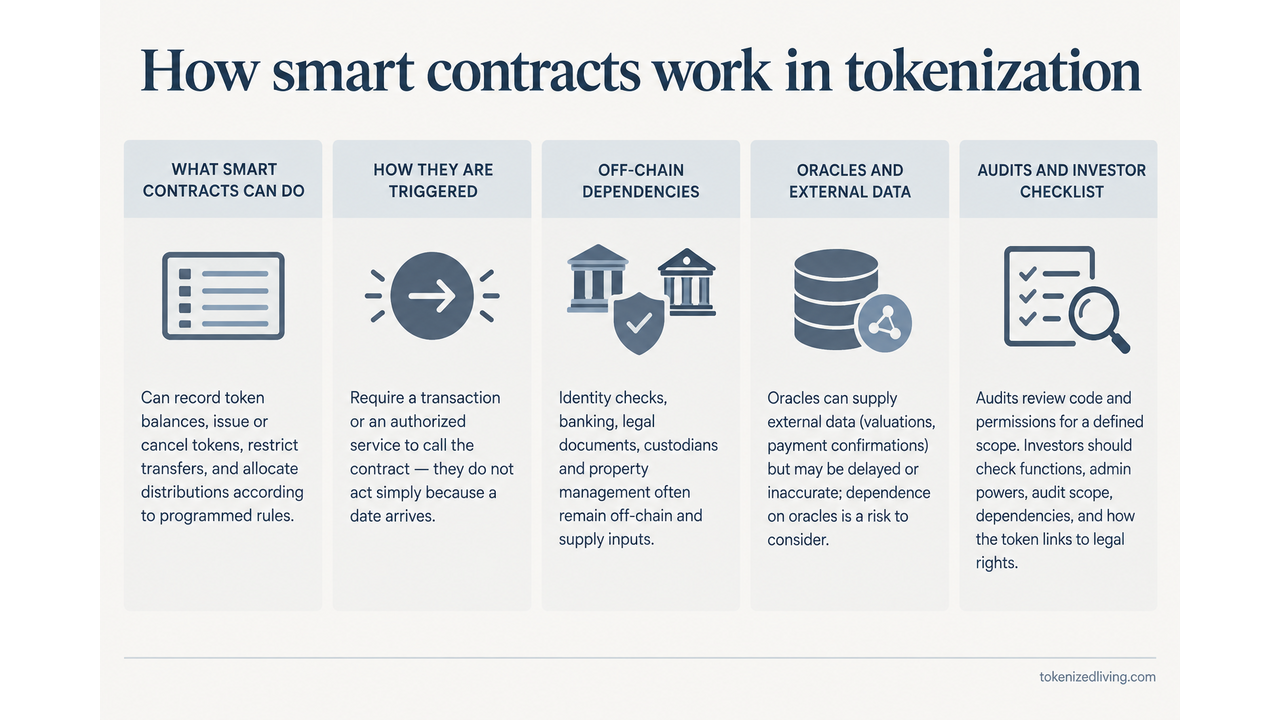
Smart contracts in tokenization can record balances and other ownership-related information on a blockchain. They may also issue new tokens, cancel existing ones, restrict transfers, and allocate available funds among eligible holders.
However, one contract rarely handles every task. An issuer might use separate contracts for tokens, investor permissions, distributions, and administrative controls. Off-chain systems may handle identity checks, banking, and legal records.
The blockchain balance also may not serve as the legally recognized ownership register. That depends on the investment structure and relevant documents. Our guide to RWA tokenization for beginners explains how real-world assets connect with blockchain systems.
How a Smart Contract Executes a Transaction
A smart contract generally needs someone or something to call it. An investor can submit a transfer, an issuer can authorize token issuance, or an automated service can trigger a scheduled process.
The contract does not independently monitor bank accounts or wake up when a payment date arrives. For example, an authorized automation service can submit a distribution transaction after the issuer confirms that funds are available.
Some contracts also need outside information. An oracle is a system that supplies external data, such as a property valuation, interest rate, or payment confirmation.
Yet an oracle cannot guarantee that its information is correct. Delayed, inaccurate, or manipulated data may cause the software to act on a faulty input. In addition, not every tokenized investment needs an oracle; some rely on authorized administrators instead.
Identity Checks and Transfer Restrictions
Know-your-customer checks usually take place outside the blockchain. Once the platform confirms an investor’s identity and eligibility, an authorized service may approve that investor’s wallet.
The contract can then check the approved-wallet registry before processing a transfer. OpenZeppelin’s tokenization guidance discusses identity integration, access controls, and transfer restrictions for regulated assets.
Blockchain transfer capability does not mean a security can trade freely. Offering terms, securities rules, investor eligibility, and market availability may still restrict a sale.
Hypothetical Example: Maple Street Property Token
The following example shows one possible structure. Tokenization platforms may divide these responsibilities differently.
Stage 1: Buying the Investment
Jane completes identity checks and buys tokens representing an interest in Maple Street Real Estate LLC. The company owns a rental property, while the token does not place Jane directly on the property deed.
The issuer approves Jane’s wallet after reviewing her eligibility. A custodian may control the wallet for her, or Jane may use an approved personal wallet.
Next, an authorized party instructs the token contract to issue or transfer the correct number of tokens. The contract records Jane’s balance, but the operating agreement and offering documents establish her legal rights.
Stage 2: Receiving Rental Distributions
The property manager collects rent, pays operating expenses, and calculates the cash available for investors. The responsible business then supplies those funds through its payment or custody arrangements.
An authorized operator or automation service submits the distribution transaction. The smart contract allocates the available amount according to its programmed rules, such as each eligible holder’s token balance.
However, the software cannot inspect the building, force tenants to pay, or independently determine every expense. It also cannot guarantee that enough cash will exist for a distribution. The property manager, issuer, custodian, and other service providers remain responsible for those off-chain tasks.
For more context, see how tokenized assets generate returns.
Stage 3: Transferring the Tokens
Jane later requests a transfer to another wallet. The contract checks her balance, the recipient’s approval status, and any applicable limits.
If the conditions are satisfied, it processes the transfer. Otherwise, it rejects the transaction.
Even an approved transfer requires an eligible recipient and, in a sale, a willing buyer. On-chain transfer functionality cannot create market demand, as our guide to tokenized asset liquidity explains.
Administrative Controls and Upgrades
Tokenization contracts often give authorized parties administrative powers. Depending on the design, an administrator may pause transfers, freeze balances, approve wallets, issue or cancel tokens, or upgrade contract logic.
Control may rest with one administrator, several signers, or a formal governance process. Investors should understand this structure because compromised credentials, unauthorized upgrades, or misuse of permissions can change how a token operates.
Therefore, it is inaccurate to assume every smart contract is immutable or fully decentralized. The actual powers depend on the deployed code and its access settings.
What a Security Audit Covers
Independent security specialists may review contract code, access permissions, vulnerabilities, and whether selected functions work as intended. However, an audit covers a defined scope and software version.
It does not guarantee bug-free code. Nor does it assess property quality, expected returns, legal enforceability, or the competence of an asset manager. Later upgrades and configuration changes may also fall outside the original review.
Documented Example: WisdomTree’s Tokenized Funds
WisdomTree publishes developer information for institutions interacting with tokenized funds through WisdomTree Connect. Its documented model combines smart-contract interaction with a transfer-agent structure rather than treating blockchain software as a replacement for regulated operational roles.
That design matters because the token layer and the legal fund administration remain connected but distinct. Investors should still confirm which contracts, functions, networks, and code versions apply to a particular product.
What Smart Contracts Cannot Do
Smart contracts cannot independently collect unpaid rent, enforce off-chain payment duties, or verify every real-world fact. They also cannot guarantee returns, preserve asset values, or create buyers for an illiquid investment.
Most importantly, software cannot establish every legal right by itself. Tokenized investments may still require issuers, custodians, transfer agents, property managers, administrators, banks, and enforceable agreements.
What Investors Should Check
Before investing, look for clear answers to these questions:
- What functions does the smart contract actually perform?
- Who controls administrative and upgrade permissions?
- Can an administrator pause, freeze, issue, cancel, or restrict tokens?
- Has an independent audit examined the contract?
- Which software version and functions did the audit cover?
- Does the system depend on oracles, custodians, or automation services?
- How does the token connect to legally enforceable investment rights?
Offering documents should explain the investment structure and legal rights. Platform disclosures, developer documentation, contract repositories, and audit reports can provide further technical detail.
Conclusion
Smart contracts can automate issuance, bookkeeping, transfer checks, and distributions. However, their effectiveness depends on secure code, accurate inputs, responsible operators, and enforceable legal structures.
They change how certain investment tasks are performed. They do not replace the underlying asset or the people and institutions responsible for it.