

Ocree announced the next phase of Project Bedrock on November 17, 2026. Its partners are the Canadian Securities Exchange (CSE), Apex Group through Tokeny, and Tetra Digital Group. The pilot will explore whether tokenized private real estate securities can work alongside established Canadian financial infrastructure.
For investors, the potential benefit is a more familiar way to buy and hold digital securities through existing financial channels. However, the announcement does not establish that investors have completed transactions or that a resale market is operating.
Key Takeaways
- Project Bedrock is a pilot exploring infrastructure for private real estate-based securities.
- An investment token and the proposed CADD payment token would perform different functions.
- The initial audience includes accredited investors, family offices, and institutions, according to a CSE interview.
- Future secondary trading could offer another exit route, but it would not guarantee liquidity.
What Project Bedrock is testing
The Ocree announcement describes a proposed digital ecosystem for private markets. It brings together tokenization technology, disclosure tools, and a proposed payment method with dealer, exchange, and custody infrastructure.
Tokenization uses digital tokens to represent assets or investment rights. For an introduction to the technology and its uses, see our guide to what tokenization means.
Bedrock’s proposed contribution is the connection between those digital tools and established financial channels. Rather than building a separate system, the project aims to explore how intermediaries can support tokenized private securities.
The announcement does not identify a confirmed first offering or establish a commercial launch date. Specific Bedrock securities, properties, investment amounts, and completed investor transactions also remain unconfirmed.

How the proposed system would work
Ocree is organizing the project and bringing its approach to private-market disclosure. The CSE is participating as an exchange and market-infrastructure provider. Apex Group, through Tokeny, would provide the technology to represent securities digitally.
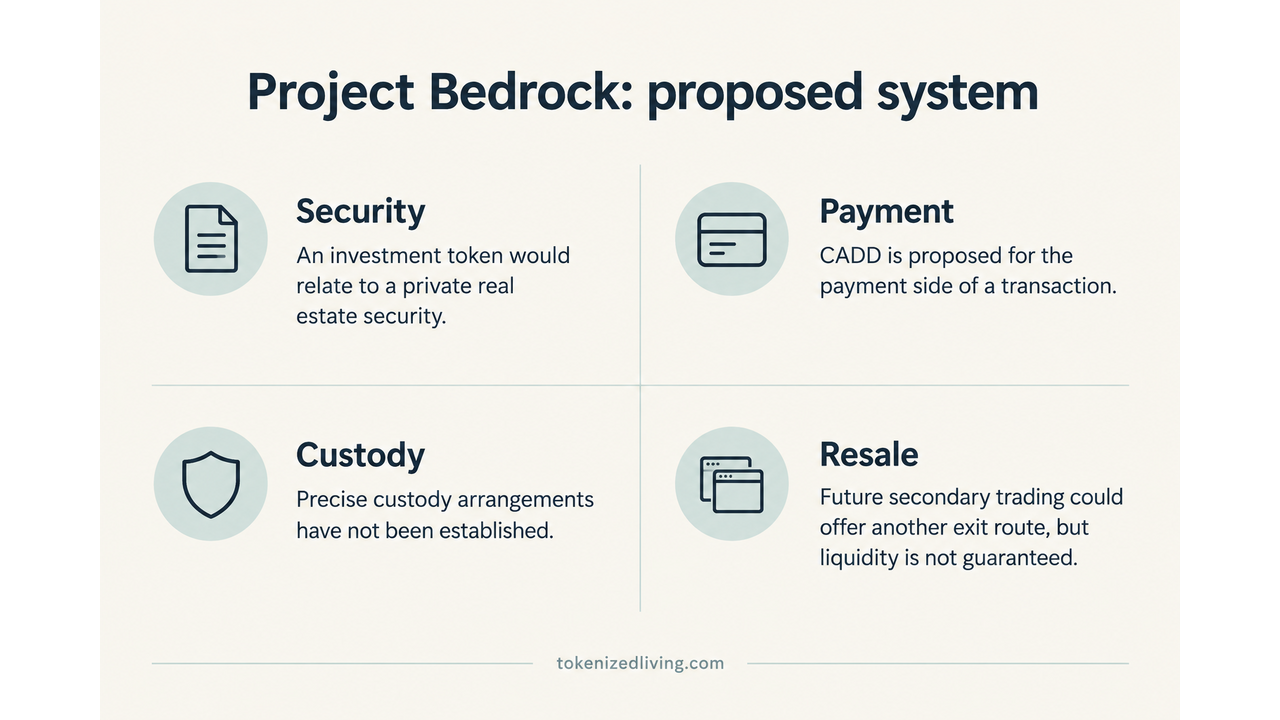
Tetra Digital Group is associated with the Canadian-dollar CADD stablecoin and proposed settlement process. The precise custody arrangements have not been established.
In principle, the system would connect several steps. These include preparing a private security, distributing it through dealers, representing it digitally, holding it in custody, and completing payment. Custody refers to the safekeeping and administration of assets.
Familiar intermediaries could make digital securities easier for eligible participants to use within existing accounts and processes. More consistent records and distribution could also reduce administrative friction, although the project has not demonstrated measurable savings.
Ocree’s Asset Rating and Disclosure System, or OARDS, is intended to standardize investment information and support disclosure and compliance processes. Consistent information could help investors and intermediaries evaluate an offering. It would not guarantee a valuation or replace due diligence.
What investors would own
Project Bedrock concerns private securities linked to real estate, not direct purchases of property deeds. An investment token would represent or relate to a security; the offering documents would establish the rights attached to it.
Those rights could vary by offering. Investors should not assume that a token gives them direct ownership of a property or any particular claim.
In a CSE interview with Ocree CEO Ted Davis, the exchange identifies the pilot’s initial focus. It includes accredited investors, family offices, and institutions. Individual offerings would still determine eligibility and could require identity checks or impose transfer restrictions.
For broader context, our guide to tokenized real estate explains how property-linked investments can take different forms.
CADD and the settlement question
The proposed investment token and CADD would have different jobs. The investment token would relate to a security. CADD is a Canadian-dollar stablecoin proposed for the payment side of a transaction.
Settlement means completing a transaction so the buyer receives the security and the seller receives payment. A stablecoin could support that exchange, but completed CADD settlement within Project Bedrock has not been confirmed.
That distinction matters because a technology’s availability does not prove it has worked in this pilot. Investors would also need clarity on custody, stablecoin redemption, and what happens if a transaction fails.
Could investors eventually sell?
Project Bedrock has a later-phase ambition to support secondary trading, meaning sales after the initial issuance. A secondary market could give eligible investors another potential exit route.
However, resale would still depend on trading permissions, willing buyers and sellers, and acceptable prices. As our tokenized asset liquidity guide explains, a token’s technical ability to transfer does not guarantee that someone will buy it.
Regulation and unanswered questions
Canadian securities requirements for offerings, settlement arrangements, and secondary trading are distinct. An announced partnership or discussions with regulators do not by themselves establish approval for those activities.
The immediate questions include whether specific securities have been issued and purchased and whether actual settlement has occurred. It also remains unclear whether the system delivers measurable benefits. Fees, transfer restrictions, and future demand are important unknowns.
Project Bedrock proposes a practical connection between digital private securities and existing financial infrastructure. Whether that connection improves how eligible investors buy, hold, and eventually sell these investments remains to be demonstrated.