
Last updated: August 18, 2026
The United Kingdom has moved its tokenized-deposit project beyond theoretical demonstrations.
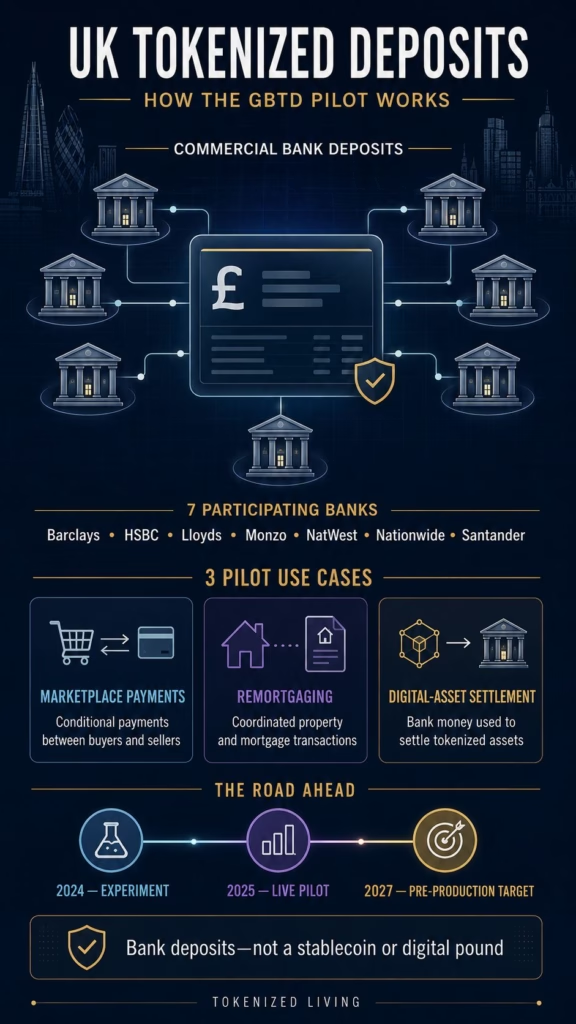
Seven banks and building societies now participate in the Great British Tokenised Deposits initiative, known as GBTD. The project uses real sterling deposits to test programmable payments across retail and wholesale transactions.
However, GBTD is still a pilot.
It is not a new national payment system, retail cryptocurrency or digital pound. UK consumers also cannot download a GBTD wallet and start using it independently.
Instead, the project explores how existing commercial bank deposits could gain programmable features while remaining inside the regulated banking system.
The distinction matters.
A tokenized deposit remains a claim against a commercial bank. By contrast, a stablecoin normally represents a claim against a separate issuer and reserve structure.
GBTD could eventually provide the digital cash needed to settle tokenized securities and other real-world assets. First, though, participating banks must prove that the system can operate safely and efficiently at scale.
UK Tokenized Deposits: Quick Overview
| Question | Answer |
|---|---|
| Project name | Great British Tokenised Deposits |
| Abbreviation | GBTD |
| Project organizer | UK Finance |
| Technology partner | Quant |
| Other supporting firms | EY and Linklaters |
| Participating institutions | Barclays, HSBC, Lloyds Banking Group, Monzo, NatWest, Nationwide and Santander |
| Previous project | UK Regulated Liability Network |
| Live pilot launched | September 2025 |
| Main use cases | Marketplace payments, remortgaging and digital-asset settlement |
| Is real money involved? | Yes, according to the project’s technology partner |
| Is it a stablecoin? | No |
| Is it a digital pound? | No |
| Can the public use it? | Not as a generally available service |
| Current status | Live pilot with a 2027 pre-production target |
| Main unresolved issue | Adoption and interoperability across banks and payment systems |
What Is a Tokenized Sterling Deposit?
A tokenized deposit is a bank deposit represented on a programmable digital ledger.
The token does not sit outside the banking system.
Instead, it represents an existing deposit liability on the issuing bank’s balance sheet. Therefore, £100 in tokenized deposits should still represent a £100 claim against that bank.
The Bank of England defines tokenized deposits as deposit claims represented on programmable platforms.
This format can support:
- Conditional payments
- Smart contracts
- Near-instant settlement
- Automated fund locking
- Delivery-versus-payment transactions
- Connections with tokenized assets
However, the technology does not turn the deposit into a permissionless cryptocurrency.
The bank remains responsible for the deposit. Existing identity, compliance and account requirements also remain relevant.
How Tokenized Deposits Differ From Normal Bank Transfers
Most bank money already exists digitally.
When someone checks a mobile-banking app, they see a digital record rather than physical notes stored under their name.
Therefore, tokenization is not simply the process of making money digital.
The important change is programmability.
A normal payment usually requires separate messages and ledger updates. Several institutions may need to confirm the transaction, reconcile their records and release the funds.
A tokenized system can connect the payment to predefined conditions.
For example, money could remain locked until:
- A buyer confirms collection of an item
- A property transaction reaches legal completion
- A digital security transfers to its new owner
- Several banks confirm the same settlement instruction
- A corporate account falls below a predetermined balance
The payment can then execute automatically when the required conditions occur.
This is similar to a smart contract. Nevertheless, regulated institutions still control the accounts, rules and participation.
From the Regulated Liability Network to GBTD
The existing version of this article describes the Regulated Liability Network as though its results were still pending.
That phase ended in 2024.
The 2024 RLN experiment
UK Finance began the Regulated Liability Network Experimentation Phase in April 2024.
Eleven financial organizations participated:
- Barclays
- Citi UK
- HSBC UK
- Lloyds Banking Group
- Mastercard
- NatWest
- Nationwide
- Santander UK
- Standard Chartered
- Virgin Money
- Visa
R3, Quant, DXC and Coadjute provided technology support. EY and Linklaters also contributed.
The project explored whether a shared platform could support different regulated forms of money and financial assets.
In September 2024, UK Finance published the RLN experimentation results.
The experiment demonstrated several potential capabilities:
- Programmable payments
- Automatic locking and unlocking of funds
- Reduced payment errors
- Better fraud controls
- More efficient home-buying transactions
- A shared access point for banks and technology companies
The legal analysis also concluded that the UK framework could support this type of platform. However, the project still needed further regulatory engagement, governance and a sustainable funding model.
In other words, the technology worked in a controlled experiment.
That did not prove commercial viability.
The 2025 GBTD live pilot
UK Finance launched the next phase in September 2025.
The organization renamed the initiative Great British Tokenised Deposits and shifted the focus toward live transactions involving sterling deposits.
Barclays, HSBC, Lloyds Banking Group, NatWest, Nationwide and Santander joined the initial pilot. Monzo later became the seventh participant.
Quant became the technology partner. Meanwhile, EY and Linklaters continued providing professional and legal support.
The official GBTD project page says the platform can also provide tokenization as a service. Therefore, institutions without their own tokenized-deposit technology could potentially participate.
The 2026 position
The live pilot continued into 2026.
A June UK Finance document described the project as concluding its live pilot phase. However, UK Finance still referred to GBTD as a live pilot during its July 2026 Digital Innovation Summit.
Quant reported that the system was working with real customers and real money. The company also identified 2027 as a pre-production target.
That is progress, but it is not a nationwide commercial launch.
As of August 18, 2026, UK Finance had not announced that GBTD was generally available to bank customers.
Which Banks Participate in GBTD?
The current project includes seven major UK institutions.
| Participant | Institution type |
|---|---|
| Barclays | Bank |
| HSBC | Bank |
| Lloyds Banking Group | Banking group |
| Monzo | Digital bank |
| NatWest | Banking group |
| Nationwide | Building society |
| Santander | Bank |
This combination matters because a single-bank tokenized deposit solves only part of the problem.
A bank can create programmable deposits for its own customers. However, those tokens must still interact with other banks when the recipient holds an account elsewhere.
The real challenge is multibank interoperability.
GBTD attempts to create a shared coordination layer rather than requiring every institution to build an isolated network.
How Does GBTD Work?
GBTD is not presented as a single public blockchain where every bank issues freely traded tokens.
Instead, it connects participating institutions and coordinates their tokenized-deposit systems.
1. A bank records the customer’s deposit
The customer’s money remains a liability of their bank.
The bank still records the legal deposit balance and remains responsible for meeting regulatory requirements.
2. The system represents the deposit programmatically
The bank or GBTD platform creates a programmable representation of the deposit.
This allows software to lock, release or transfer value according to approved conditions.
Institutions that already possess tokenization systems can connect them to GBTD. Others may use the project’s tokenization-as-a-service capability.
3. The payment conditions are established
The parties define what must happen before the payment completes.
For example, an online marketplace transaction might require the buyer to confirm that the goods have been collected.
The platform can then lock the required funds without transferring them immediately.
4. The external event is confirmed
An approved source confirms that the transaction conditions have been met.
This could involve:
- Buyer confirmation
- A property-completion instruction
- Transfer of a digital security
- Confirmation from another financial institution
- An automated corporate treasury rule
The quality of this information is critical.
A smart contract can execute incorrect instructions perfectly. Therefore, banks still need reliable data and dispute procedures.
5. Value moves between participating banks
A tokenized deposit remains tied to its issuing bank.
Consequently, a Barclays deposit token cannot simply become a NatWest liability without changes to both banks’ records.
According to Quant’s July 2026 explanation, GBTD transfers the value rather than moving the same token.
The sending bank removes, or burns, the relevant tokenized deposit from its system. Meanwhile, the receiving bank creates the equivalent deposit on its own ledger.
This preserves the relationship between each bank and its customer.
6. The underlying settlement is coordinated
The participating banks still need to settle their obligations.
GBTD connects with existing settlement infrastructure, including the Bank of England’s Real-Time Gross Settlement system.
Therefore, the project adds a programmable coordination layer without pretending traditional settlement infrastructure has disappeared.
The Three GBTD Use Cases
GBTD focuses on three practical applications rather than vague promises about “the future of money.”
1. Safer online marketplace payments
Peer-to-peer marketplace transactions create a difficult trust problem.
A buyer may not want to pay before receiving an item. Meanwhile, the seller may not want to hand over the item without confirmed payment.
Fraudsters exploit this uncertainty through fake transfer screenshots, payment reversals and false delivery claims.
Under the GBTD model, the buyer can lock money inside their bank account.
The funds only transfer when the agreed collection or delivery condition occurs.
This could give both parties greater confidence without requiring an unregulated escrow provider.
However, programmability cannot eliminate every dispute.
The parties may still disagree over an item’s condition, delivery or authenticity. Therefore, the final service would need clear consumer-protection and dispute-resolution procedures.
2. Faster remortgage completion
A remortgage involves several parties.
These can include the borrower, old lender, new lender, solicitor, land registry and payment providers.
Money may pass through a solicitor’s client account before reaching the previous lender. Every additional transfer introduces delay and operational risk.
GBTD can lock the new mortgage funds until all parties confirm they are ready.
The system can then release the money when the transaction completes.
This could reduce unnecessary transfers through intermediary accounts. It may also lower exposure to conveyancing fraud.
Nevertheless, tokenized payments cannot solve every property bottleneck.
Legal checks, valuations, documentation and land-registration processes will still exist.

3. Digital-asset settlement
Tokenizing a bond or investment fund solves only the asset side of a transaction.
The buyer also needs compatible money to complete the purchase.
If the tokenized asset moves immediately but the cash arrives later, one party remains exposed to settlement risk.
GBTD aims to support delivery versus payment.
Under this structure, the digital asset and payment move together. Either both sides complete or neither side completes.
Quant reported that the GBTD pilot tested digital-bond settlement involving HSBC’s Orion platform.
This cash-leg problem also appears in international projects such as BIS Project Agorá and Hong Kong’s Project Ensemble.
GBTD and the Bank of England Synchronisation Lab
GBTD has joined the Bank of England’s Synchronisation Lab.
The lab explores how transactions on external ledgers can coordinate with payments in central bank money.
Imagine a digital bond moving on one ledger.
At the same moment, the corresponding payment must move through the Bank of England’s settlement infrastructure.
Synchronisation can make one transfer conditional on the other.
This reduces the risk that one party delivers an asset but does not receive payment.
The Bank of England continues to prefer central bank money for significant wholesale settlement. Nevertheless, it also recognizes that tokenized deposits can support some on-chain transactions.
Its 2025–2026 Financial Market Infrastructure report confirmed that tokenized deposits can already serve as payment assets inside the Digital Securities Sandbox.
This gives GBTD a possible role in the UK’s wider tokenized-market infrastructure.
Tokenized Deposits vs Stablecoins and a Digital Pound
These forms of digital money are not interchangeable.
| Feature | Tokenized deposit | Stablecoin | Digital pound |
|---|---|---|---|
| Issuer | Commercial bank | Private stablecoin issuer | Bank of England |
| Legal claim | Deposit claim against the bank | Claim determined by issuer and reserve structure | Direct claim on the central bank |
| Main backing | Bank’s balance sheet and regulatory framework | Reserve assets | Central bank money |
| Deposit protection | Can apply to eligible deposits | No FSCS deposit protection | Would not depend on commercial-bank deposit insurance |
| Main purpose | Programmable banking and settlement | Digital payments and blockchain liquidity | Potential public digital central-bank money |
| Current UK status | Live pilots | Regulatory framework developing | Design phase; no launch decision |
| Credit exposure | Issuing bank | Stablecoin issuer and reserve structure | Central bank |
| Public availability | Limited | Some products already available | Not available |
Tokenized deposits
A tokenized deposit remains commercial bank money.
The bank can use deposits to support lending and other normal banking activities. Furthermore, prudential regulation governs the bank’s capital, liquidity and risk management.
Stablecoins
A stablecoin is normally issued against a pool of reserve assets.
It may move freely across supported blockchains. However, holding a stablecoin does not make someone a bank depositor.
Stablecoins do not receive FSCS deposit protection.
The Bank of England’s May 2026 guidance also expects banking groups to issue retail stablecoins through separate, insolvency-remote entities with distinct branding.
Digital pound
A digital pound would be issued by the Bank of England.
Therefore, it would represent central bank money rather than a claim against a commercial bank.
The UK has not decided to launch one.
If introduced, a digital pound would coexist with cash and commercial bank deposits rather than automatically replace them.
Are Tokenized Deposits Protected by the FSCS?
The Prudential Regulation Authority expects retail tokenized deposits to meet the same depositor-protection rules as conventional deposits.
Its May 2026 guidance states that banks should structure retail tokenized-deposit claims to satisfy FSCS requirements and associated operational rules.
From December 1, 2025, the FSCS protects eligible deposits up to £120,000 per eligible person, per authorized firm.
However, people should not assume every digital token carrying a bank’s name receives protection.
Coverage depends on:
- Whether the product legally qualifies as a deposit
- Whether the bank has UK authorization
- Whether the customer and deposit meet FSCS eligibility rules
- How different banking brands share an authorization
- Whether the institution can identify the customer and balance
- Whether third-party wallets preserve the direct deposit relationship
A genuine tokenized deposit should remain a bank liability.
A stablecoin, e-money token or synthetic bank-branded asset may have different protections.
The Potential Benefits of UK Tokenized Deposits
GBTD could deliver several credible improvements.
Programmable payments
Banks can attach approved conditions to payments.
This could reduce manual instructions and allow money to respond automatically to business events.
Lower fraud exposure
Locking funds until both sides meet agreed conditions could reduce some marketplace and conveyancing fraud.
However, the system still needs reliable evidence and dispute handling.
Atomic settlement
Money and digital assets can move together.
This reduces principal risk during securities transactions.
Faster reconciliation
A coordinated system can give participating institutions a shared view of transaction status.
Consequently, banks may spend less time comparing separate records.
Continued use of commercial bank money
Tokenized deposits preserve the role of regulated banks and deposit funding.
This differs from a large shift toward stablecoins, which could move money away from commercial-bank balance sheets.
Access for smaller institutions
Tokenization as a service could let banks participate without building an entire blockchain operation internally.
Nevertheless, this benefit depends on pricing, governance and whether the service avoids excessive dependence on one technology provider.
The Risks and Unresolved Questions
The current project has not answered every important question.
GBTD remains a pilot
Live transactions provide stronger evidence than a laboratory demonstration.
However, they do not prove that millions of consumers and businesses will use the system reliably.
Interoperability remains difficult
Every bank maintains separate customer records, technology and regulatory responsibilities.
Connecting two banks once is not the same as creating an open network that can add dozens of participants efficiently.
Programmability creates new failure points
A coding error could lock money incorrectly or release it too early.
Banks also need procedures for correcting mistakes without undermining settlement certainty.
Fraud will change rather than disappear
Conditional payments can block some scams.
Nevertheless, criminals may target customer accounts, identity systems, data sources or the conditions used to trigger payment.
Bank credit risk remains
A tokenized deposit is still a liability of its issuing bank.
Tokenization does not transform commercial bank money into risk-free central bank money.
FSCS protection also has eligibility rules and limits.
Faster movement can increase liquidity pressure
Always-available digital money may leave a bank more quickly during periods of stress.
The PRA has told banks to account for the liquidity risks created by innovative deposit products.
Privacy requires careful design
Programmable payments may involve more data sharing between banks, platforms and service providers.
The project must limit who can see transaction details and how that information can be used.
Governance could become a bottleneck
Participants must agree on:
- Technical standards
- Membership rules
- Liability for errors
- Dispute resolution
- Transaction reversals
- Cybersecurity
- Platform funding
- Future ownership
A technically successful system can still fail if institutions cannot agree on governance.
The economic case remains unproven
The project may reduce fraud and operational work.
However, banks must compare those savings with the cost of new technology, integration, compliance and maintaining legacy systems.
Real savings will only appear if the new infrastructure replaces inefficient processes rather than running permanently beside them.
Will GBTD Replace Faster Payments?
Probably not.
The UK already has functioning payment systems for everyday bank transfers.
GBTD targets transactions that need more complex conditions, coordination or simultaneous asset settlement.
Sending £20 to a friend does not require a blockchain-based smart contract.
Buying a high-value item from a stranger, completing a mortgage or settling a tokenized bond may justify the additional infrastructure.
Therefore, the strongest case for GBTD lies in payments where existing systems require several parties, manual checks or separate settlement processes.
What Happens Next?
Quant identified 2027 as the project’s pre-production target.
Before then, the participating institutions need to establish:
- A durable governance structure
- Commercial pricing
- Regulatory approval
- Technical standards
- Operational-resilience arrangements
- Consumer protections
- Dispute procedures
- Connections with more banks and asset platforms
The Bank of England’s Synchronisation Lab may also provide important evidence about linking tokenized deposits with central bank settlement.
Still, a target is not a launch guarantee.
GBTD will only matter at scale if banks outside the original consortium join and customers receive products that solve real problems.
Final Verdict
GBTD represents one of the more credible tokenized-deposit projects.
It involves seven established UK institutions, real sterling and specific payment problems. Moreover, it builds on an earlier experiment rather than starting with an unsupported promise.
The project also keeps commercial bank money at its center.
That matters because people already trust bank deposits, understand their value and benefit from an established regulatory framework.
However, claims that GBTD has already transformed UK payments are premature.
It remains a pilot. No generally available consumer service exists, and UK Finance has not yet published complete evidence covering transaction volumes, fraud reduction, costs or operational performance.
The technology has moved beyond theory.
The commercial case still needs proving.
Frequently Asked Questions
What is GBTD?
GBTD stands for Great British Tokenised Deposits. It is a UK Finance-led pilot connecting tokenized sterling deposits across participating banks and building societies.
Which banks participate in GBTD?
The current participants are Barclays, HSBC, Lloyds Banking Group, Monzo, NatWest, Nationwide and Santander.
Is GBTD a cryptocurrency?
No. GBTD represents regulated commercial bank deposits through programmable ledger technology.
Is a tokenized deposit the same as a stablecoin?
No. A tokenized deposit remains a liability of a regulated bank. A stablecoin has a separate issuer and reserve structure.
Is GBTD the digital pound?
No. A digital pound would be issued by the Bank of England. GBTD uses commercial bank money.
Can UK consumers use GBTD today?
GBTD has conducted live pilot transactions. However, it is not currently a generally available payment service for the public.
Are tokenized deposits protected by the FSCS?
Eligible retail tokenized deposits should receive the same FSCS treatment as other qualifying bank deposits. The current limit is £120,000 per eligible person, per authorized firm. Product structure and customer eligibility still matter.
What are GBTD’s three use cases?
The pilot tests online marketplace payments, remortgage completion and settlement involving tokenized digital assets.
Does GBTD use a public blockchain?
GBTD operates as regulated multibank infrastructure rather than a freely accessible public cryptocurrency network. It connects bank systems, programmable ledgers and existing settlement infrastructure.
When will GBTD launch commercially?
Quant has identified 2027 as a pre-production target. However, UK Finance has not announced a guaranteed nationwide commercial-launch date.
This article provides general information and does not constitute financial or legal advice. Regulations, deposit-protection rules and project details can change.