
Updated, 30th August 2026
Tokensoft has supported blockchain projects since 2017. During that time, the company has helped launch token sales, distribute tokens and automate investor verification.
However, Tokensoft is sometimes described too broadly as a complete asset tokenization platform. Its current services focus more heavily on compliance, fundraising, token distribution and community management.
Therefore, businesses considering Tokensoft need to understand what the platform provides—and what it does not.
This Tokensoft review examines its current features, compliance tools, security claims, real-world asset history and limitations. It also explains who should consider using the platform.
Last updated: August 2026.
Tokensoft Review: The Short Version
Tokensoft is primarily a business-to-business platform for blockchain projects, token issuers and Web3 foundations.
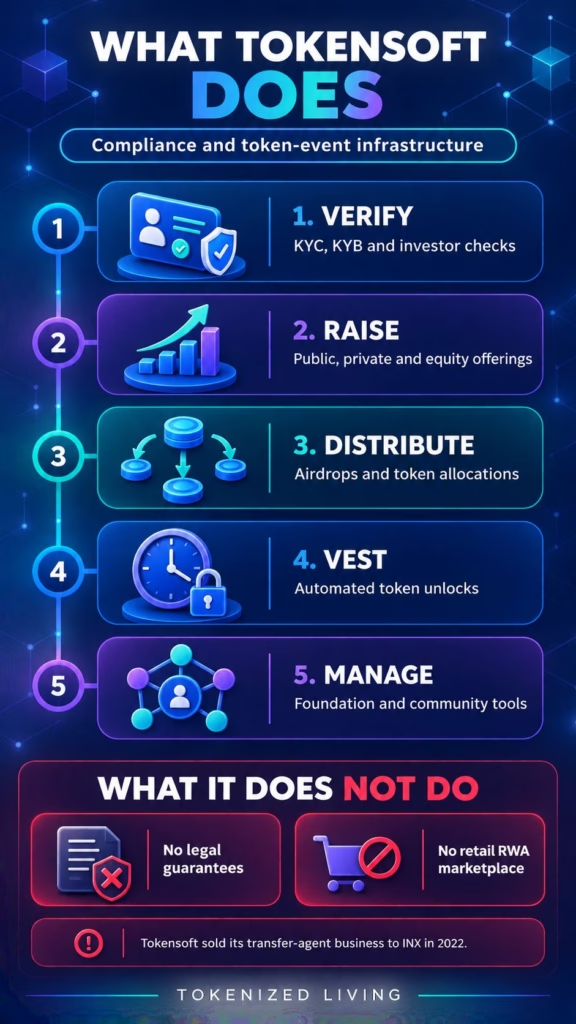
Its main services include:
- KYC and KYB verification
- Accredited-investor checks
- Public and private token sales
- Equity fundraising
- Token distributions and airdrops
- Automated vesting schedules
- Foundation setup and administration
- Community campaigns
- Document signing and personal-data hosting
According to Tokensoft, its customers have raised more than $1 billion across approximately 100 projects since 2017. The company has worked with projects including Avalanche, Arbitrum, Tezos, The Graph and Synthetix.
However, these figures come from Tokensoft itself. They should be treated as company-reported information rather than independently audited performance data.
Tokensoft also does not operate like a retail investment marketplace. Investors cannot browse a catalogue of tokenized properties, bonds or funds on its main website.
Instead, Tokensoft supplies infrastructure that projects can use to conduct their own token events.
| Area | Assessment |
|---|---|
| Compliance infrastructure | Strong |
| Fundraising tools | Strong |
| Token distribution and vesting | Strong |
| RWA lifecycle management | Limited compared with specialist platforms |
| Public pricing transparency | Weak |
| Retail investment access | Not its primary purpose |
| Independent security information | Limited |
| Best suited to | Token projects, issuers and foundations |
What Is Tokensoft?
Mason Borda and James Poole founded Tokensoft in Palo Alto in 2017. The company initially concentrated on compliant token launches and secure digital asset infrastructure.
Today, Tokensoft describes itself as a chain-agnostic compliance platform. It helps projects manage identity checks, fundraising, token distributions and community events.
Tokensoft is not a blockchain. It is also not an exchange, broker or general-purpose investment marketplace.
Instead, it provides configurable infrastructure for organisations launching or managing tokens.
This distinction matters. A company could use Tokensoft to verify participants and distribute tokens. However, the underlying legal structure, asset ownership and investor rights remain the issuer’s responsibility.
Readers unfamiliar with the complete process should first read our guide explaining how to tokenize an asset.
What Does Tokensoft Offer in 2026?
Tokensoft divides its current services into several connected areas.
Identity and Investor Verification
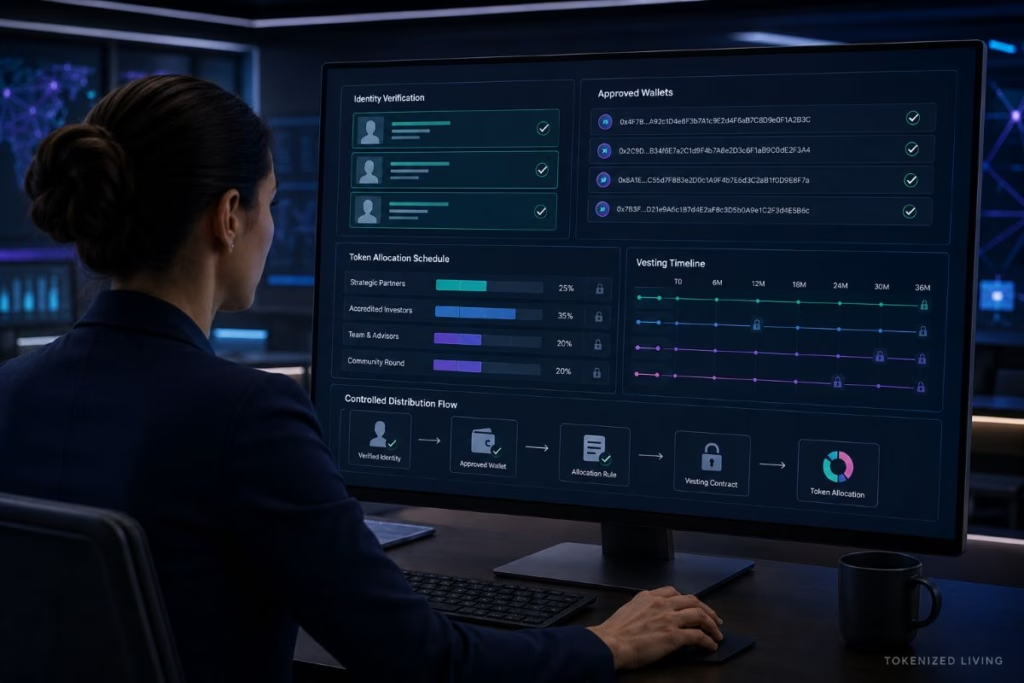
Projects can connect user identities with blockchain wallets. Tokensoft also offers integrated KYC, KYB and accredited-investor checks.
KYC, or Know Your Customer, verifies an individual’s identity. Meanwhile, KYB, or Know Your Business, examines companies and other legal entities.
Accredited-investor checks help issuers determine whether participants meet the requirements for certain restricted offerings. However, the exact criteria depend on the relevant jurisdiction and offering structure.
Tokensoft also provides manual-review support through an in-platform ticketing system. This feature may help when automated verification cannot approve an applicant.
Nevertheless, completing a KYC check does not make an investment safe. It simply helps the issuer follow its identity and eligibility procedures.
Public and Private Token Sales
Tokensoft supports public sales, private placements and equity raises.
Issuers can configure:
- Participant eligibility
- Compliance requirements
- Sale dates
- Allocation limits
- Payment processes
- Required documents
- Geographic restrictions
- Investor onboarding
Tokensoft says its platform can support offerings structured under Regulation D, Regulation A, S-1 registrations and certain non-US arrangements.
However, Tokensoft provides the technology rather than legal approval. Securities lawyers must still determine which regulations apply.
The company’s own frequently asked questions make this limitation clear. Tokensoft cannot decide whether a particular token should legally be treated as a security. The issuer must obtain that determination from its legal counsel.
Token Distribution, Airdrops and Vesting
Tokensoft allows projects to distribute tokens after a sale or community event.
For example, an issuer can use the platform for:
- Investor allocations
- Team and adviser tokens
- Developer rewards
- Community airdrops
- Grant programmes
- Token claims
- Vesting schedules
Vesting prevents recipients from accessing their entire allocation immediately. Instead, tokens unlock according to predetermined conditions.
Tokensoft supports immediate and time-based releases. It also advertises price-based unlocking options.
These features can reduce manual administration. Moreover, automated distribution can help projects apply the same rules consistently across many recipients.
Still, automation does not fix poor token economics. A badly designed allocation remains badly designed, even when software executes it perfectly.
Foundation Setup and Management
Tokensoft also assists selected projects with foundation formation and administration.
Its services can include governance planning, legal templates, ongoing administration and support for over-the-counter transactions. However, the company describes its foundation service as invite-only.
This option may interest established blockchain projects that need a legal entity to coordinate development, grants and governance.
Nevertheless, creating a foundation does not automatically decentralise a project. The actual governance structure still determines who controls funding and decision-making.
Community Campaigns
Tokensoft offers tools for airdrops, ambassador programmes, hackathons and grant campaigns.
Projects can use custom invitation links, social-profile verification, notifications and analytics. These functions connect token distribution with community-building activities.
However, Tokensoft does not guarantee demand. Its FAQ states that issuers must build their own communities and cannot assume Tokensoft users will participate.
That warning is refreshingly honest. Technology can manage an offering, but it cannot manufacture investor interest.
Tokensoft’s Real-World Asset History
Tokensoft has genuine historical connections with real-world asset tokenization. However, its current role needs careful explanation.
In 2018, the company developed ERC-1404. This Ethereum token standard introduced transfer restrictions for tokens with compliance requirements.
For example, a smart contract could prevent an unapproved wallet from receiving a token. It could also allow an authorised party to freeze, revoke or reassign tokens under defined circumstances.
According to Tokensoft’s company history, ERC-1404 was designed partly for tokens backed by real-world assets.
The company later established Tokensoft Transfer Agent. That business helped administer blockchain-based securities, including Arca’s ArCoin and the INX Token.
Tokensoft also worked with SEBA Bank on tokenization services and its Series B equity. In addition, its technology supported the INX digital security offering.
These projects demonstrate legitimate experience with regulated digital assets. However, an important corporate change occurred in 2022.
Tokensoft Sold Its Transfer-Agent Business to INX
INX acquired Tokensoft Transfer Agent in January 2022.
The acquired company was an SEC-registered transfer agent. It had supported some of the earliest regulated digital securities using Tokensoft technology.
The transaction is documented in an INX announcement filed with the US Securities and Exchange Commission.
Therefore, Tokensoft’s earlier transfer-agent achievements should not be confused with its current corporate services. The former Tokensoft Transfer Agent became part of INX.
Tokensoft subsequently developed its second-generation platform. Its current website places greater emphasis on Web3 compliance, fundraising, distributions, foundations and community campaigns.
This does not eliminate Tokensoft’s RWA experience. However, it does mean the company should not be presented as though it still provides every regulated service from issuance through transfer agency and secondary trading.
How Does Tokensoft Work?
The exact process varies between projects. Nevertheless, a typical token event would follow these stages.
1. Define the Offering
The issuer establishes the token’s purpose, target participants, legal structure and fundraising terms.
At this stage, qualified legal advisers should determine whether the token represents a security, utility, governance right or another legal interest.
2. Configure Eligibility Requirements
The project sets its KYC, KYB, jurisdiction and investor-qualification rules.
Tokensoft then uses those requirements to guide participant onboarding.
3. Create the Investor Experience
The issuer can use a white-labelled interface instead of sending participants to a generic third-party marketplace.
As a result, the token event can retain the project’s branding.
4. Verify Participants
Applicants provide the requested identity and eligibility information.
Some participants may pass automatically. Others may require manual review or additional documents.
5. Complete the Sale or Allocation
Approved users complete the required transaction or qualify for a distribution.
Tokensoft describes its fundraising platform as non-custodial. Therefore, projects should confirm which entity handles funds, payment processing and token custody in their particular arrangement.
6. Distribute and Unlock Tokens
Finally, the project distributes tokens according to its allocation and vesting rules.
However, projects must also plan for ongoing administration. Token issuance represents the beginning of the asset lifecycle—not the end.
For another approach to ongoing token management, our guide to Hadron’s tokenization platform examines its issuance, transfer controls and monitoring tools, alongside the responsibilities that remain with issuers.
Does Tokensoft Guarantee Regulatory Compliance?
No platform can guarantee universal regulatory compliance.
Tokensoft helps automate an issuer’s chosen compliance programme. It can verify identities, restrict participants, collect documents and apply configured eligibility rules.
However, it does not determine the law.
A token may fall under securities, payments, commodities, consumer-protection, privacy or anti-money-laundering regulations. In addition, different countries may classify the same structure differently.
Therefore, issuers still need qualified legal advice in every important jurisdiction.
Tokensoft’s FAQ also confirms that the company cannot determine whether a token is legally a security. That decision remains with the customer and its counsel.
Consequently, “compliance platform” should not be interpreted as “automatic regulatory approval.”
How Secure Is Tokensoft?
Tokensoft promotes a non-custodial, compliance-focused platform. It also reports completing hundreds of token events without a hack or regulatory enforcement action.
However, that remains a company-reported claim.
The public website does not provide enough detailed information to conduct a complete independent security assessment. For example, it does not prominently publish a current penetration-testing report, smart-contract audit library or detailed security certification page.
That absence does not prove the platform is insecure. Nevertheless, serious issuers should request more evidence during due diligence.
Questions should include:
- Which security certifications does Tokensoft currently hold?
- Who audits its smart contracts?
- How often does it conduct penetration testing?
- How does it encrypt personal information?
- Where does it store KYC and KYB data?
- Which third parties process identity information?
- What happens after a data breach?
- Who controls administrative smart-contract functions?
- How are lost or compromised keys handled?
- Does the project receive an incident-response plan?
Security also extends beyond the platform itself. Issuers must examine their legal partners, payment providers, smart contracts and blockchain networks.
Our guide to choosing a blockchain for a tokenization project explains several of these infrastructure decisions.
Which Blockchains Does Tokensoft Support?
Tokensoft describes its system as chain-agnostic. Its distribution tools can operate across different blockchain networks.
Historically, the company has supported projects connected with Ethereum and several major blockchain ecosystems. Its named customers include Avalanche, Tezos, Arbitrum and The Graph.
However, “chain-agnostic” does not mean every feature works identically on every network.
Before signing a contract, issuers should confirm:
- Whether Tokensoft supports their chosen network
- Which wallet types participants can use
- How transfer restrictions work
- Whether vesting contracts have been audited
- Who pays blockchain transaction fees
- How Tokensoft handles network upgrades
- Whether tokens can move between networks
- Which exchanges or secondary venues support the token standard
Businesses that need complete asset-lifecycle management may also want to compare Tokensoft with a specialist platform such as Zoniqx.
Tokensoft Pricing
Tokensoft does not publish a standard pricing table on its main website.
Therefore, potential customers need to contact the company for a tailored quotation. The final cost will probably depend on the service package, number of participants, compliance complexity and development requirements.
Tokensoft’s FAQ states that the company does not take a percentage of token sales. However, issuers may still face platform, setup, verification, legal and integration costs.
Businesses should request a detailed breakdown covering:
- Initial platform setup
- KYC and KYB checks
- Manual compliance reviews
- Smart-contract deployment
- Token distribution
- Vesting management
- Custom development
- Foundation administration
- Technical support
- Data storage
- Failed or repeated verification attempts
The lack of public pricing makes early comparison difficult. It is one of the platform’s clearest weaknesses.
Tokensoft Advantages and Disadvantages
Advantages
- Operating history dating back to 2017
- Experience with large blockchain projects
- Integrated KYC and KYB processes
- Support for accredited-investor checks
- Public and private fundraising tools
- Automated token distributions and vesting
- White-labelled participant interfaces
- Foundation and community-management services
- Multi-chain positioning
- Historical experience with regulated digital securities
Disadvantages
- No public pricing table
- Limited independent security information on its website
- Not a retail RWA investment marketplace
- Does not provide secondary-market liquidity
- Cannot determine whether a token is legally a security
- Current RWA services appear less comprehensive than specialist lifecycle platforms
- Historical transfer-agent achievements can create confusion
- Issuers still require external lawyers and other regulated partners
- Success depends heavily on the project’s existing community
Who Should Consider Tokensoft?
Tokensoft may suit:
- Established blockchain projects
- Web3 foundations
- Companies planning a compliant token sale
- Projects distributing tokens to large communities
- Issuers requiring KYC or KYB workflows
- Teams managing complex vesting schedules
- Businesses wanting a white-labelled token event
However, it may not suit:
- Retail investors looking for tokenized assets
- Small businesses wanting transparent fixed pricing
- Property owners seeking a simple DIY tokenization service
- Issuers requiring a built-in secondary marketplace
- Projects expecting the platform to provide legal approval
- Teams without an existing audience or fundraising strategy
Retail investors should also understand that Tokensoft’s involvement does not endorse a project. Every token still requires separate investigation.
Tokensoft Versus a Complete RWA Platform
Tokensoft provides several components that an RWA project could use. These include identity verification, participant eligibility, fundraising and token distribution.
However, a complete RWA platform may also cover:
- Asset due diligence
- Legal entity creation
- Asset valuation
- Ownership documentation
- Token-holder rights
- Income distributions
- Asset servicing
- Corporate actions
- Transfer agency
- Regulated custody
- Secondary trading
- Investor reporting
- Redemption or asset disposal
Tokensoft does not publicly present all these services as one complete package.
Therefore, calling it an asset tokenization platform is not entirely wrong. However, calling it a complete end-to-end RWA marketplace would be misleading.
Tokensoft is better understood as a configurable compliance and token-event platform with genuine roots in regulated tokenization.
For another infrastructure-focused approach, see our analysis of Consensys and asset tokenization.
Final Verdict: Is Tokensoft Worth Considering?
Tokensoft has a credible operating history and has supported several important blockchain projects. Its compliance workflows, fundraising tools and distribution features address genuine problems for token issuers.
Moreover, its experience with ERC-1404, ArCoin, INX and SEBA gives it authentic connections with regulated digital assets.
However, the platform has limitations.
Pricing lacks transparency. Public security information remains limited. In addition, Tokensoft no longer owns the transfer-agent business connected with several of its best-known security-token achievements.
Most importantly, Tokensoft is not a substitute for securities lawyers, regulated intermediaries or a complete asset-management system.
For established Web3 projects, it may offer a powerful combination of compliance and distribution tools. For companies tokenizing real estate or other physical assets, it may form one part of a much larger technology and legal structure.
That distinction is the key to evaluating Tokensoft honestly.
Frequently Asked Questions
Is Tokensoft a legitimate company?
Tokensoft has operated since 2017 and has worked with recognised blockchain projects. However, customers should still conduct legal, technical and commercial due diligence before signing an agreement.
Can I buy tokenized real estate through Tokensoft?
Tokensoft does not operate as a general retail marketplace for tokenized property. Individual issuers may use its infrastructure, but Tokensoft’s main website does not offer a browsable property catalogue.
Does Tokensoft guarantee that a token is compliant?
No. Tokensoft can apply the issuer’s compliance rules, but it cannot determine every token’s legal classification. Issuers need qualified legal advice.
Is Tokensoft an SEC-registered transfer agent?
Tokensoft previously owned Tokensoft Transfer Agent. INX acquired that business in January 2022, and it later operated under the INX name.
Does Tokensoft publish its prices?
No standard pricing table appears on its public website. Prospective customers must contact Tokensoft for a customised quotation.
Does Tokensoft provide investors for a token sale?
Tokensoft supplies technology and compliance infrastructure. Its FAQ warns issuers that they remain responsible for building their own communities and generating interest.
Is Tokensoft custodial?
Tokensoft describes its current fundraising platform as non-custodial. However, every issuer should confirm how funds and tokens move within its specific offering structure.
This article is for educational purposes only. It does not constitute investment, financial or legal advice. Platform features and regulatory requirements can change.