

Updated: August 28, 2026
Zoniqx is not a simple website where a retail investor chooses a property token and clicks “buy.” It provides infrastructure for institutions that want to create, manage or distribute tokenized assets.
That distinction matters.
Zoniqx offers tools for asset structuring, token issuance, compliance rules, investor onboarding and lifecycle management. It also connects tokenized products with licensed distribution channels. However, Zoniqx does not claim to be a broker, transfer agent or investment adviser. Furthermore, its zConnect product is neither a marketplace nor a source of guaranteed liquidity.
This Zoniqx review examines what the company offers in 2026. It also separates supported facts from figures and outcomes reported by Zoniqx itself.
Independent review note: Tokenized Living did not receive payment for this article. We have not used Zoniqx as a paying institutional client. Our assessment relies on public product information, technical documentation and corroborating announcements checked on August 28, 2026.
TL;DR
- Zoniqx provides institutional technology for tokenized real-world assets.
- Its z360 product covers issuance, compliance settings and ongoing asset management.
- zConnect supports asset discovery, data and access through licensed channels.
- zConnect is non-custodial and does not itself provide market liquidity.
- Zoniqx reports $5.1 billion in assets on its infrastructure and more than 20 live issuances. These figures are company-reported.
- Its DyCIST framework uses ERC-7518, which remained under peer review when checked.
- Public pricing is limited, so prospective clients need to request a quote or demonstration.
- Zoniqx looks most relevant to asset managers, fund managers, credit issuers and institutional platforms. It is not designed as a beginner-friendly retail marketplace.
Zoniqx review: quick verdict
| Question | Answer |
|---|---|
| What is Zoniqx? | Institutional issuance, lifecycle and distribution infrastructure for tokenized assets |
| Main products | z360 and zConnect |
| Best suited to | Fund managers, asset issuers, private-credit firms, real estate operators, banks and institutional platforms |
| Is it a retail investment marketplace? | No |
| Does it custody assets? | zConnect is non-custodial; other custody arrangements depend on the issuer and service providers |
| Does it guarantee liquidity? | No |
| Is pricing public? | No complete public fee schedule was available when checked |
| Main strength | Broad institutional workflow covering issuance and ongoing management |
| Main limitation | Pricing and many project results are difficult to assess independently |
Our verdict: Zoniqx has developed a serious institutional tokenization stack with useful compliance and multi-chain capabilities. Nevertheless, prospective clients must conduct detailed technical, legal and commercial due diligence. The website’s scale figures and several case studies come from Zoniqx or its partners rather than independent audits.
What is Zoniqx?
Zoniqx is a technology company serving tokenized private markets. Its infrastructure connects asset issuers, distribution networks and eligible investors.
An issuer might use Zoniqx to configure a tokenized fund, private-credit product or real estate structure. The platform can then support investor rules, token deployment, records, distributions and other events throughout the asset’s life.
In contrast, Zoniqx is not the legal asset itself. Nor does its technology decide what rights an investor receives. Those rights still depend on contracts, offering documents, company law and the structure behind the token.
Readers new to this distinction should start with our plain-English guide to what tokenization means. A blockchain token can represent equity, debt, fund units or contractual claims. It does not automatically equal direct ownership of an underlying asset.
Zoniqx previously described its offering through terms such as Tokenization Platform as a Service, or TPaaS, and Tokenized Asset Lifecycle Management, or TALM. Those descriptions still appear across parts of its website. However, the company’s current public positioning centres on two products: z360 and zConnect.
How Zoniqx works
A tokenization project usually needs far more than a smart contract. The issuer must establish a legal entity, define investor rights, choose jurisdictions, arrange compliance checks and plan how payments or redemptions will work.
Zoniqx attempts to bring those stages into one operating system.
A typical institutional workflow may include:
- Structuring the asset, offering and investor terms.
- Configuring eligibility rules and transfer restrictions.
- Completing KYC or KYB checks for participants.
- Deploying the token on a suitable blockchain.
- Connecting the offering with permitted distribution channels.
- Managing payouts, notices, redemptions and investor records.
- Producing operational and compliance reports.
The technology can automate parts of this process. Still, automation does not replace legal advice, licensed intermediaries or regulatory approval. Our guide to tokenizing an asset explains why the legal structure must come before token issuance.
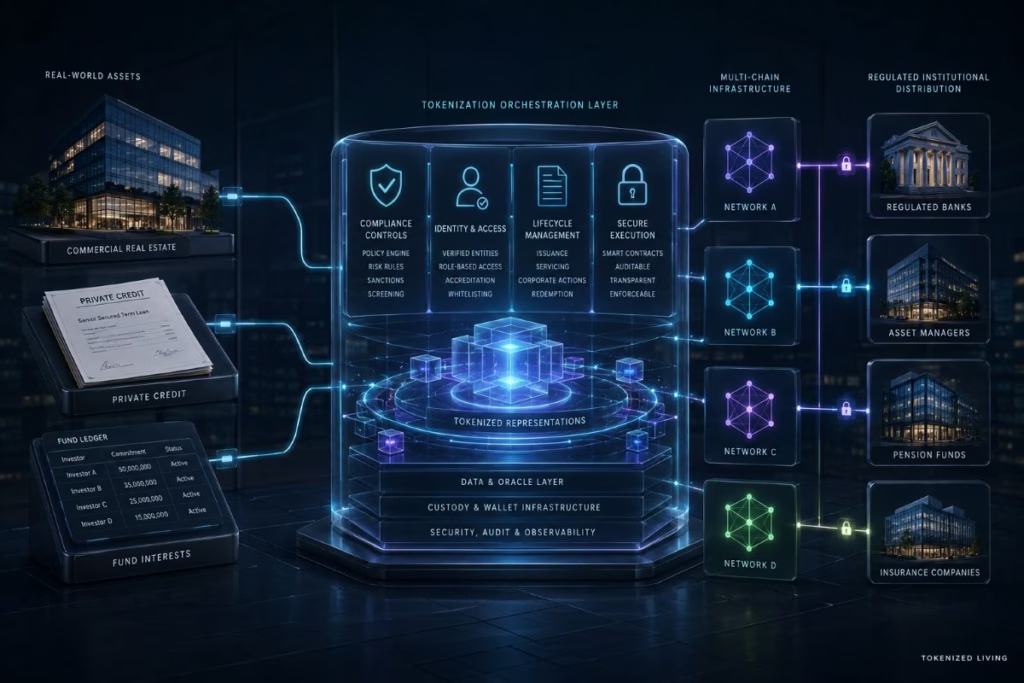
z360: issuance and lifecycle management
Zoniqx describes z360 as its issuer-facing orchestration suite. It provides one interface for configuring, deploying and managing tokenized real-world assets.
Its advertised functions include:
- asset structuring and token configuration
- investor eligibility and transfer controls
- smart-contract deployment across multiple blockchains
- KYC and KYB workflows
- distributions and corporate actions
- investor and transaction records
- dashboards and operational reporting
- integration with zConnect
This breadth is one of Zoniqx’s strongest features. Issuing a token is only the beginning. Funds and securities may require years of payments, record updates, reports, redemptions and compliance checks.
However, buyers should test how much of the process is truly automated. They should also identify where third-party administrators, custodians, lawyers or licensed firms remain necessary.
The choice of network also affects cost, privacy, interoperability and available tools. Issuers comparing networks can use our guide to choosing a blockchain for tokenization.
zConnect: access infrastructure, not a marketplace
zConnect is the part of Zoniqx most likely to be misunderstood.
According to the current zConnect product page, it combines tokenized-asset discovery, cross-chain data and policy-controlled access. Eligible participants can connect through licensed platforms and complete checks required for a particular asset.
Yet Zoniqx is unusually direct about what zConnect does not do.
The company says zConnect:
- is not a marketplace
- does not provide liquidity
- does not match buyers and sellers
- does not intermediate transactions
- does not take custody of user assets
Instead, it routes compliant access between participants and licensed channels. Transactions can then occur directly between participant-controlled wallets.
This correction is essential. Zoniqx’s older marketing often connected tokenization with improved liquidity. Nevertheless, technical transferability and actual market liquidity are different.
A token may move between wallets quickly. The owner can still struggle to find a qualified buyer at a fair price. Our analysis of tokenized asset secondary markets explains why a trading function cannot manufacture demand.
DyCIST and ERC-7518
Zoniqx uses the name DyCIST for its Dynamic Compliant Interoperable Security Token framework. It is associated with ERC-7518, a proposal authored by members of the Zoniqx team.
ERC-7518 extends ERC-1155 and introduces partitions for semi-fungible assets. Different partitions can carry separate rights, restrictions or investor conditions within one token contract.
The proposal also includes functions for:
- token locking
- address freezing
- forced transfers and recovery
- payouts
- transfer-permission checks
- different investor or share classes
- wrapping and cross-chain interoperability
Those features address genuine problems in regulated tokenization. For example, a security may have different holding periods for US and non-US investors. An issuer may also need to stop an ineligible transfer or recover assets after a key is lost.
However, ERC-7518 was marked Review when checked on August 28, 2026. The Ethereum EIP page states that it remains in the peer-review process. Therefore, it should be described as a proposed standard, not a universally adopted or final Ethereum standard.
Moreover, programmable compliance cannot guarantee legal compliance by itself. Someone still needs to translate laws, investor status and offering terms into accurate rules. Incorrect inputs can produce incorrect automated decisions.
Supported assets and networks
Zoniqx presents its infrastructure as asset-agnostic. Its current materials focus on areas such as:
- private credit and debt
- investment funds
- tokenized Treasuries
- real estate and infrastructure
- private equity
- commodities
- carbon credits and environmental assets
- institutional yield products
The company says its infrastructure supports more than 14 live blockchain networks. Public evidence confirms activity or ecosystem relationships involving several major networks.
For instance, Ripple’s Q1 2024 XRP Markets Report recorded Zoniqx’s plans to streamline RWA tokenization through an XRP Ledger integration. Hedera also publishes a Zoniqx case study describing chain-agnostic tokenization and integration with its network.
In March 2025, Midnight announced that Zoniqx would deploy its RWA tokenization framework on Midnight. The collaboration focused on privacy, compliance and interoperability for institutional applications.
More recently, the ADI Foundation announced a March 2026 partnership with Zoniqx. Its announcement described plans involving sovereign and institutional tokenization programs on ADI Chain.
These announcements demonstrate ecosystem activity. Still, a partnership does not prove that every announced pipeline project has reached production.
Zoniqx adoption and reported projects
When checked in August 2026, Zoniqx reported:
- $5.1 billion in assets on its infrastructure
- more than 20 live issuances
- more than 14 live blockchains
- operations involving seven jurisdictions
Those numbers appear on the Zoniqx website. They show a much larger claimed footprint than the old Tokenized Living article described.
Zoniqx also publishes case studies involving commercial real estate, private equity, bank deposits and environmental projects. Its customer page references projects valued at $3.2 billion, $500 million and other amounts.
However, readers should treat these figures carefully.
Several case studies provide limited public information about the client, legal entity, token contract, amount actually issued or amount purchased by investors. In addition, the phrase “assets on infrastructure” may not mean that investors bought $5.1 billion of tokens. It could include assets configured, represented, managed or connected through the platform.
Therefore, this review does not add all announced project values together. Nor do we treat pipeline value as completed issuance.
Prospective institutional clients should request evidence covering:
- live token contracts or ledger records
- the distinction between announced, configured and funded projects
- current client references
- issuance and redemption volumes
- active investor numbers
- distribution partners for their jurisdictions
- security assessments and incident history
Security, compliance and custody
Zoniqx states that it has completed SOC 2 Type II and that its operations support GDPR and CPRA requirements. Nevertheless, prospective clients should request the relevant reports, confirm their scope and check the covered period.
The company also states that it is not a registered broker-dealer, investment adviser or transfer agent. It does not make investment recommendations or execute securities transactions as those regulated entities.
That is not automatically a weakness. Infrastructure providers often work with regulated partners instead of holding every licence themselves. Yet clients must identify which legal entity performs each regulated activity.
Questions should include:
- Who verifies investors?
- Who maintains the official ownership register?
- Which party handles custody or wallet infrastructure?
- Who executes securities transactions?
- Which venue supports secondary transfers?
- Who is responsible for sanctions and AML monitoring?
- What happens if Zoniqx or another service provider stops operating?
Although zConnect is non-custodial, a particular tokenization project may still use an external custodian or managed wallet provider. Consequently, users must examine the complete arrangement rather than applying one custody label to every project.
Our Hadron by Tether review explores a similar distinction between control of token keys, custody of the underlying assets and the issuer’s legal responsibilities.
Zoniqx pricing and minimum requirements
Zoniqx does not publish a complete standard fee schedule for all deployments. Its website directs prospective users to request a demonstration or pricing information.
That approach is common in enterprise software. Projects vary by asset type, jurisdiction, number of investors, integrations and blockchain network.
Even so, the lack of public pricing makes early comparisons harder. A prospective client should request a breakdown of:
- setup and implementation fees
- annual software or support costs
- token issuance charges
- investor onboarding fees
- blockchain and smart-contract costs
- integration and customization charges
- distribution or transaction-related fees
- costs for reporting, corporate actions and redemptions
- termination and data-export costs
The cheapest platform is not necessarily the best option. However, unclear pricing can hide long-term operational expenses.
Zoniqx strengths
End-to-end institutional workflow
Zoniqx covers more than token creation. Its platform addresses structuring, onboarding, compliance controls, lifecycle events and distribution connectivity.
Multi-chain approach
The company works across EVM and non-EVM networks. This gives issuers more flexibility than a single-chain platform. It may also reduce dependence on one ecosystem.
Compliance-focused token design
ERC-7518 addresses partitions, transfer controls, recovery and payouts. These functions reflect the practical needs of regulated assets.
Non-custodial access model
zConnect says transactions occur directly between participant-controlled wallets. That structure can reduce pooled-custody risk within the access layer.
Evidence of ecosystem participation
Ripple, Hedera, Midnight and ADI Foundation have publicly discussed Zoniqx integrations or partnerships. These references provide more support than company announcements alone.
Zoniqx limitations and risks

It is not built for casual retail investors
Zoniqx mainly serves issuers, institutions and licensed distribution channels. Someone looking for a simple property-investing application will probably find the platform unsuitable.
Liquidity is not guaranteed
zConnect can improve discovery and compliant access. However, it cannot create buyers, market depth or fair pricing for an illiquid asset.
Pricing lacks transparency
Institutions must contact the company for meaningful cost information. This makes comparison difficult before a sales discussion.
Much of the performance evidence is self-reported
Zoniqx publishes substantial project values and infrastructure totals. Yet several public case studies lack enough detail for complete independent verification.
ERC-7518 is still under review
The proposal contains useful ideas, but it was not a final ERC when checked. Buyers should assess implementation quality, audits and compatibility rather than relying on the ERC number alone.
Product names have changed
Zoniqx materials use z360 and zConnect alongside older labels such as TALM, TPaaS, DyCIST and SecureConnect. The underlying evolution may be reasonable, but the terminology can confuse prospective clients.
Legal responsibility remains fragmented
Tokenization platforms do not remove the need for lawyers, administrators, brokers, custodians or transfer agents. Clients must understand which partner handles every regulated function.
Who should consider Zoniqx?
Zoniqx may suit:
- asset and fund managers planning tokenized offerings
- private-credit and debt issuers
- real estate or infrastructure sponsors
- banks and licensed distribution platforms
- governments exploring digital registries or financial instruments
- institutions requiring multi-chain deployment
- teams needing ongoing token lifecycle management
It may not suit:
- beginners seeking a simple retail investment application
- small issuers wanting instant self-service token creation
- projects that need transparent fixed pricing before contact
- investors expecting Zoniqx itself to guarantee liquidity
- issuers without a clear legal and compliance structure
Zoniqx review verdict
Zoniqx deserves more serious consideration than the old “leading the revolution” description suggested. It has evolved into a broad institutional infrastructure provider with issuance, lifecycle, compliance and distribution tools.
Its strongest feature is the connection between z360 and zConnect. One side helps issuers create and manage tokenized products. The other supports discovery and compliant access through institutional channels.
Nevertheless, the limitations are equally important.
Zoniqx does not provide automatic liquidity. It is not a retail marketplace. Its ERC-7518 proposal remained under review, and many project figures require further verification. Pricing also remains difficult to assess without speaking to the company.
For a well-funded institution with legal advisers and a defined tokenization strategy, Zoniqx may offer valuable infrastructure. For a casual investor or small asset owner seeking an instant solution, it is probably the wrong starting point.
You can compare its role with the other companies in our guide to the top tokenization platforms. That comparison is being updated as the sector changes.
Frequently asked questions
Is Zoniqx legitimate?
Zoniqx is an active tokenization-infrastructure company with publicly documented relationships involving networks such as XRPL, Hedera, Midnight and ADI Chain. However, that does not eliminate project, technical or counterparty risk. Prospective clients should verify contracts, security reports, regulated partners and live deployments.
Is Zoniqx a regulated broker or investment adviser?
No. Zoniqx states that it is not a registered broker-dealer, investment adviser or transfer agent. Its role is technology infrastructure. Regulated activities must pass through appropriately licensed entities.
Can retail investors use Zoniqx?
Zoniqx is primarily designed for institutions, issuers and qualified distribution networks. zConnect may provide eligible participants with access through licensed channels, but it is not a conventional open retail marketplace.
Does Zoniqx provide liquidity?
No. Zoniqx explicitly states that zConnect does not provide liquidity or match buyers with sellers. It can support discovery and compliant access, but real liquidity still requires active buyers and sellers.
Does Zoniqx custody investor assets?
zConnect is described as non-custodial, and participants retain control of their assets. However, individual offerings may involve external custodians, embedded wallets or other service providers. Check each project’s complete custody structure.
What is ERC-7518?
ERC-7518 is a proposed security-token framework associated with Zoniqx’s DyCIST architecture. It extends ERC-1155 with partitions, transfer restrictions, payouts, recovery tools and compliance functions. It remained under peer review when checked in August 2026.
How much does Zoniqx cost?
Zoniqx does not publish a complete fee schedule covering every deployment. Pricing depends on the project, integrations, jurisdictions and required services. Prospective clients need to request detailed pricing directly.
Is Zoniqx suitable for real estate tokenization?
It may suit institutional real estate sponsors that need token issuance, investor controls and lifecycle management. However, the platform cannot replace the property’s legal structure, valuation, management or buyer demand.