
Rumors of Wall Street Treasury tokenization are circulating again.
TL;DR
Financial rumors rarely move markets on their own. Yet sometimes they reveal something deeper about where the system may be heading.
Recently, speculation has resurfaced in financial and crypto circles about what might happen if a major Wall Street leader gained significant influence within the U.S. Department of the Treasury.
For advocates of blockchain-based finance, the implications are enormous.
Because if Wall Street’s largest institutions begin shaping Treasury policy more directly, tokenization could move from experimental technology to core financial infrastructure much faster than many expect.
“The next generation for markets will be tokenization of securities.”
— Larry Fink, CEO of BlackRock
Some links in this article may be affiliate links. If you choose to invest through them, we may earn a small commission at no extra cost to you.
Always do your own research before making any investment decisions.
Why Tokenization Is Suddenly in the Spotlight
Tokenization refers to the process of representing real-world assets as blockchain-based digital tokens.
Instead of traditional ownership structures, assets can be divided, traded, and settled through distributed ledgers.
Major institutions are already exploring this model.
For example:
- BlackRock launched the BlackRock USD Institutional Digital Liquidity Fund (BUIDL)
- Franklin Templeton introduced an on-chain money market fund
- Ondo Finance created tokenized Treasury exposure products
These early steps suggest that tokenized securities could become a new financial layer for institutional markets.
The Treasury Market Is the Real Prize
The United States Treasury market is the largest bond market in the world.
It underpins:
- global banking liquidity
- collateral markets
- government financing
- risk-free benchmark interest rates
Traditionally, these bonds settle through financial infrastructure coordinated with entities such as the Federal Reserve and Depository Trust & Clearing Corporation.
However, blockchain technology introduces an alternative.
Tokenized settlement could allow:
- T+0 instant settlement
- 24/7 trading
- programmable compliance
- global fractional access
For institutions managing trillions of dollars, those efficiencies are extremely attractive.
📊 Market Insight
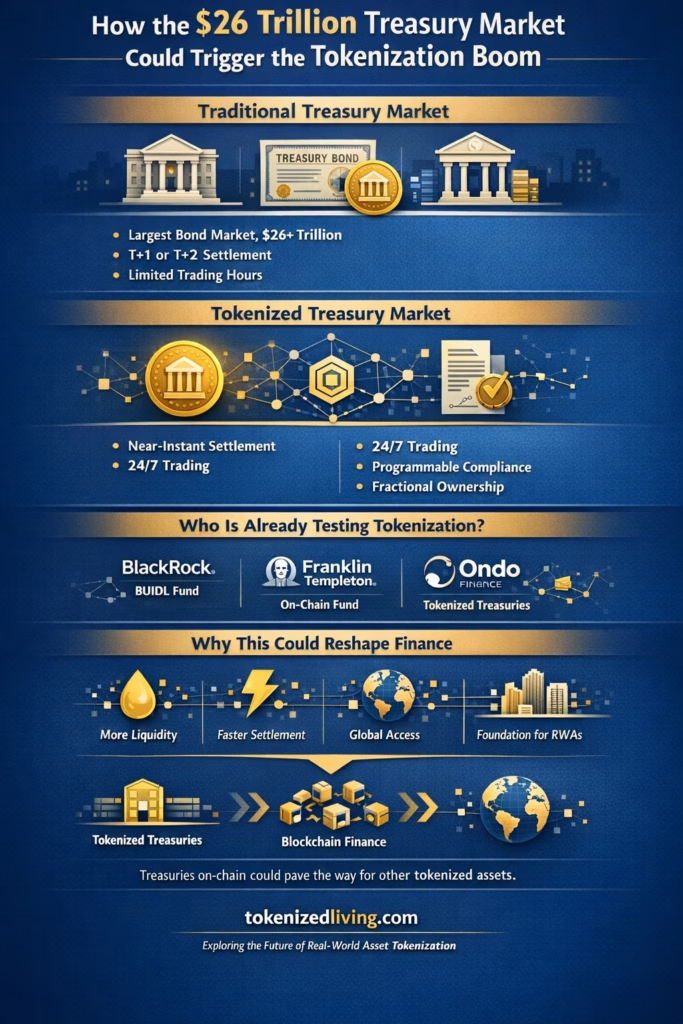
Why the Treasury Market Could Trigger the Tokenization Boom
One reason analysts watch the U.S. Treasury market so closely is its sheer scale. The market for U.S. government bonds exceeds $26 trillion, making it the largest and most liquid bond market in the world. Because Treasuries act as the global “risk-free” benchmark, they sit at the center of everything from bank collateral to money market funds.
If even a small portion of that market moves onto blockchain rails, the effects could ripple across the entire financial system.
Why Institutions Are Interested in Wall Street Treasury Tokenization
Large financial institutions see several advantages in tokenized Treasuries:
1️⃣ Faster settlement
Traditional bond settlement still relies on clearing systems that operate in fixed windows. Blockchain infrastructure could allow near-instant settlement, reducing counterparty risk.
2️⃣ 24/7 markets
Bond markets typically close overnight and on weekends. Tokenized securities could potentially trade around the clock, similar to digital asset markets.
3️⃣ Programmable collateral
Tokenized bonds can be integrated into smart contracts, allowing them to function as automated collateral in lending, derivatives, and liquidity pools.
4️⃣ Global fractional access
Blockchain systems allow assets to be divided into smaller units. In theory, this could allow investors worldwide to access Treasury exposure more easily.
Early Signals Already Exist
Institutional pilots suggest that tokenized Treasuries are not just theoretical.
Several financial firms are already experimenting with blockchain-based versions of government bond exposure, including BlackRock, Franklin Templeton, and Ondo Finance.
These products remain small compared with the full Treasury market, but they demonstrate something important:
The infrastructure for tokenized government bonds is already being tested.
Why This Matters for Real-World Asset Tokenization
If tokenized Treasuries gain wider acceptance, they could provide a trusted yield-bearing base layer for blockchain finance.
That base layer could support other tokenized markets, including:
- real estate
- private credit
- infrastructure projects
- commodities
In other words, Treasuries could act as the gateway asset that brings institutional capital into the broader tokenized economy.
For platforms exploring fractional ownership of real-world assets, this shift could dramatically increase liquidity and investor participation.

📈 Watch This Trend
Tokenized Treasuries Are One of the Fastest-Growing Segments of Crypto Finance
While tokenization once focused heavily on NFTs and experimental assets, institutional attention has shifted toward something much more traditional: U.S. government bonds.
In fact, tokenized Treasury products have quietly become one of the fastest-growing sectors within real-world asset (RWA) tokenization.
Several large financial firms now offer blockchain-based exposure to short-term U.S. Treasuries, including:
- BlackRock through the BlackRock USD Institutional Digital Liquidity Fund (BUIDL)
- Franklin Templeton via its on-chain money market fund
- Ondo Finance through tokenized Treasury yield products
These instruments allow investors to access government bond yields while holding a blockchain-based token representing the underlying exposure.
Why Investors Are Paying Attention
Tokenized Treasuries offer a combination rarely seen in crypto markets:
- Stable government-backed yield
- Blockchain liquidity
- On-chain collateral compatibility
This combination is particularly attractive for decentralized finance platforms seeking low-risk yield-bearing collateral.
The Bigger Signal
The rise of tokenized Treasuries suggests something larger is happening.
Institutional investors are no longer experimenting only with speculative digital assets. Instead, they are exploring how blockchain infrastructure can improve traditional financial markets.
If this trend continues, Treasuries may become the first major global asset class widely integrated into blockchain-based financial systems.
And once that happens, the path becomes much clearer for other tokenized assets, including real estate, infrastructure, and private credit markets.
📊 Quick Comparison
Traditional Treasuries vs Tokenized Treasuries
| Feature | Traditional U.S. Treasuries | Tokenized Treasuries |
|---|---|---|
| Settlement Speed | Typically T+1 or T+2 settlement through clearing systems | Potential near-instant (T+0) settlement on blockchain |
| Market Hours | Fixed trading hours, closed nights and weekends | Potential 24/7 trading on digital platforms |
| Accessibility | Primarily institutional investors and large financial intermediaries | Potential global access through digital tokens |
| Minimum Investment | Often large institutional allocations | Can be fractionalized into smaller units |
| Collateral Use | Used as collateral in traditional banking and repo markets | Can function as programmable collateral in smart contracts |
| Infrastructure | Clearing through entities such as the Depository Trust & Clearing Corporation | Recorded and transferred via blockchain infrastructure |
| Transparency | Reporting through financial institutions and regulators | On-chain transparency depending on the platform |
| Examples | Conventional U.S. Treasury bonds and bills issued by the U.S. Department of the Treasury | Products developed by firms such as BlackRock, Franklin Templeton, and Ondo Finance |
Key Takeaway of Wall Street Treasury Tokenization
Traditional Treasuries already play a central role in global finance. Tokenized versions aim to keep the underlying government-backed asset while modernizing how ownership, settlement, and access work.
For the broader tokenization ecosystem, this could provide the stable financial foundation that many blockchain markets have lacked.
The shift toward tokenized Treasuries becomes easier to understand when viewed visually.
Why Leadership Matters
Financial infrastructure rarely changes without policy support.
That is why speculation about Wall Street leadership influencing Treasury policy sparks so much interest.
Asset managers understand the practical challenges of modern markets:
- slow settlement systems
- fragmented infrastructure
- capital inefficiencies
Many believe blockchain systems could improve these problems.
If policymakers with direct experience in asset management begin to support these reforms, the regulatory barriers to tokenization could fall quickly.
Wall Street Is Already Building the Rails
Even without political changes, the industry is moving forward.
Large banks and financial institutions are quietly developing blockchain-based settlement infrastructure.
For example:
- JPMorgan created Onyx by JPMorgan for blockchain-based financial transactions
- Goldman Sachs has developed digital asset platforms for institutional clients
- Citi has experimented with tokenized securities settlement
In other words, the rails for a tokenized financial system are already being built.
Policy support could simply accelerate the transition.
What This Means for Tokenized Real Estate
If tokenized Treasuries become widely accepted, they could provide a trusted yield-bearing base layer for blockchain finance.
That would benefit other tokenized markets, including:
- fractional real estate
- infrastructure investments
- private credit
- commodities
For investors exploring tokenized property, this shift could bring:
- deeper liquidity
- institutional capital
- stronger regulatory frameworks
In many ways, government bonds may act as the gateway that legitimizes the broader tokenization ecosystem.
The Concerns Critics Raise
Not everyone sees this possibility as positive.
Some critics argue that stronger ties between Wall Street and government policy could create new risks.
Common concerns include:
- concentration of financial power
- regulatory capture
- institutional dominance of tokenized markets
In that scenario, blockchain might modernize financial infrastructure but still leave control in the hands of large financial players.
The outcome will depend on how regulatory frameworks evolve.
⚠️ Key Risks to Watch
While tokenization promises faster settlement and broader access to financial assets, several risks remain. These factors could influence how quickly tokenized Treasuries and other real-world assets gain mainstream adoption.
1️⃣ Regulatory Uncertainty
Tokenized securities still sit in a gray area in many jurisdictions. Regulators such as the U.S. Securities and Exchange Commission continue to evaluate how blockchain-based financial products should be classified and supervised.
New rules could shape how tokenized bonds, funds, and real estate assets operate.
2️⃣ Institutional Concentration
Large financial institutions are currently leading the development of tokenized securities. Firms such as BlackRock, Franklin Templeton, and JPMorgan already operate pilot programs.
While institutional adoption brings credibility, critics worry that tokenization could reinforce existing financial power structures rather than decentralize them.
3️⃣ Technology and Infrastructure Risks
Blockchain settlement systems must prove they can handle large-scale financial markets.
The U.S. Treasury market alone processes trillions of dollars in daily transactions, meaning tokenized infrastructure must demonstrate reliability, security, and scalability before wider adoption.
4️⃣ Liquidity Fragmentation
If multiple platforms issue tokenized securities using different standards, liquidity could become fragmented.
Without common interoperability standards, investors may face barriers moving assets between platforms.
5️⃣ Political and Policy Shifts
Government priorities can change quickly. Even if tokenization gains momentum under one regulatory approach, new administrations or policy shifts could slow development.
For that reason, the pace of tokenized financial markets will likely depend as much on policy stability as technological innovation.
Conclusion
Rumors about Wall Street influence within the U.S. Treasury highlight an important reality.
Tokenization is no longer a fringe experiment.
Major financial institutions are actively preparing for a future where assets, bonds, and funds exist on blockchain-based infrastructure.
If policymakers begin supporting these systems more directly, adoption could accelerate dramatically.
For investors watching the rise of real-world asset tokenization, rumors of Wall Street Treasury tokenization may prove to be the catalyst that pushes blockchain finance into the global mainstream.
Legal Risk Box
⚠️ Legal & Policy Risk
Tokenized financial markets remain subject to evolving regulations. Governments may impose new requirements on digital securities, settlement infrastructure, and blockchain-based ownership structures. Investors should monitor regulatory developments closely.
FAQ about Wall Street Treasury tokenization
Could the U.S. Treasury actually adopt blockchain infrastructure?
It is possible over time. Many institutions are already testing blockchain settlement systems for bonds and funds.
Why are tokenized Treasuries important?
Treasuries are considered the safest asset in global finance. Tokenizing them could create a trusted yield-bearing asset for blockchain markets.
Are tokenized government bonds already available?
Yes. Several financial firms offer blockchain-based exposure to short-term U.S. Treasuries through tokenized funds.
Would this help tokenized real estate?
Yes. If tokenized bonds become widely used, they could bring liquidity, infrastructure, and investor confidence to other tokenized asset classes.
We use AI tools to enhance research and drafting, always under human supervision.