
The latest RealT Detroit update is not a normal platform announcement.
It is a major stress test for tokenized real estate.
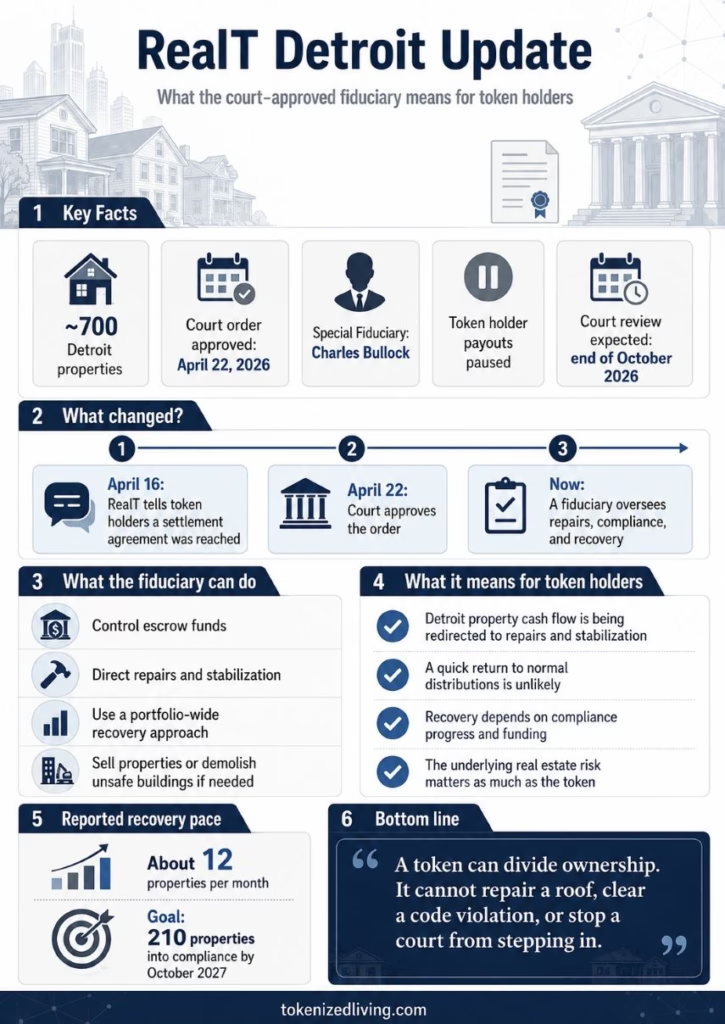
RealT told token holders on April 16 that it had reached a settlement agreement with the City of Detroit. The company said the agreement had been fully executed and was expected to be approved by the court soon. It also confirmed that Charles Bullock, Esq., would serve as Special Fiduciary and take control of the escrow account.
That sounded like progress.
But the public update that followed was much sharper.
A judge approved the order on April 22, 2026. The agreement puts an outside fiduciary in charge of RealT’s roughly 700 Detroit properties until at least the end of October.
That is the real story.
RealT’s Detroit portfolio is no longer operating under normal platform control. A court-approved fiduciary now has broad authority over repairs, property decisions, and the path back to compliance.
For token holders, this is not just a temporary pause in property cash flow. It is a warning about what happens when tokenized property ownership meets local housing law, deferred maintenance, unpaid bills, tenant complaints, and court oversight.
Some links in this article may be affiliate links. If you choose to invest through them, we may earn a small commission at no extra cost to you.
Always do your own research before making any investment decisions.
TL;DR
RealT’s Detroit portfolio is now under a court-approved fiduciary.
Charles Bullock has been appointed to oversee the properties, manage repairs, and report back to the court.
RealT’s April 16 email framed the agreement as a shift toward cooperation with Detroit. However, later public reporting shows the arrangement gives the fiduciary broad control over roughly 700 properties.
Normal token holder payouts from Detroit properties are not expected to resume quickly. RealT has said proceeds will be directed toward repairs, stabilization, and portfolio recovery.
The court review expected around the end of October 2026 is a key date. But it is not a guaranteed return to normal.
For tokenized real estate investors, the lesson is clear: the token is only one layer. The property, tenants, legal structure, reserves, compliance, and local government risk still matter.
What RealT Told Token Holders
RealT’s April 16 email said the company had reached a settlement agreement with the City of Detroit after their long-running case.
The email described the agreement as a move away from conflict and toward structured cooperation. RealT also said Charles Bullock would immediately assume control of the escrow account.
That point matters.
Since the Temporary Restraining Order, RealT said the City had retained 100% of property cash flow from affected Detroit assets and approved only limited disbursements. According to RealT, only around $30,000 had been approved for repairs, while contractor invoices selected by the City exceeded $120,000.
RealT also told token holders that proceeds would not flow directly back to them yet. Instead, money would go first toward repairs, property stabilization, and portfolio recovery.
That was already a major shift.
Many token holders originally bought into a model where each property had its own financial profile. But the April 16 update suggested a more portfolio-wide approach, at least during the recovery period.
RealT also said Detroit property proceeds could continue to be reinvested into the portfolio until at least October 31, 2026.
That is not a small footnote.
It means token holders may be waiting far longer than some expected before Detroit-related property cash flow returns to anything close to normal.
What Happened After the Email
The key public update came after RealT’s April 16 message.
The court order was approved on April 22, 2026. The agreement places an outside fiduciary in control of RealT’s roughly 700 Detroit properties.
The full agreement has not been made public. That matters.
Investors can read RealT’s version. They can read media summaries. They can read comments from Detroit officials. But they still cannot review the full agreement themselves.
That creates an information gap.
And in tokenized real estate, information gaps are dangerous.
Investors are not just buying a token on a dashboard. They are gaining exposure to real properties, local rules, maintenance costs, tenant conditions, taxes, utilities, contractors, and legal process.
When the full agreement is not public, investors need to avoid overconfidence.
What Power Does the Fiduciary Have?
This is where the story becomes more serious.
Public reporting says Charles Bullock can use escrowed funds to renovate properties. He can also sell properties to raise cash. In some cases, he may demolish buildings considered dangerous and beyond saving.
That is not normal property management.
That is court-supervised intervention.
The fiduciary is expected to prioritize occupied homes and apartment buildings with emergency issues. That makes sense from a tenant safety perspective. But it also means investor recovery may not follow the clean property-by-property logic that token holders expected when they bought specific tokens.
RealT’s own email said the fiduciary would manage assets using a portfolio-wide approach, despite the individual ownership structure of the properties.
That line deserves attention.
Tokenized real estate often markets itself around transparency, fractional access, and property-level ownership exposure. But when a distressed portfolio enters court-supervised recovery, the operational reality can become much less tidy.
The Repair Timeline Looks Slow
The reported repair timeline is another uncomfortable point.
Public reporting says the agreement outlines a pace of around a dozen properties per month. It also includes a goal of bringing 210 properties into compliance by October 2027.
That timeline is not quick.
It also raises an obvious question: what happens to the rest of the portfolio?
If the portfolio has roughly 700 properties and the stated compliance goal covers 210 by October 2027, investors should not assume the whole Detroit problem gets solved in a few months.
This is why the October 2026 review date should not be treated as a finish line.
It is a checkpoint.
The court can assess progress. The fiduciary can report back. The judge can decide whether to extend the arrangement.
But nothing in the public reporting suggests a fast return to the original RealT model across the full Detroit portfolio.
Market Insight: This Is Bigger Than RealT
This RealT Detroit update matters because it exposes a weakness in how people discuss tokenized real estate.
The blockchain part is often the easy part.
The harder part is everything underneath it.
A token can represent an ownership interest. A smart contract can help automate transfers. A platform can show investors dashboards, distributions, and property data.
But none of that fixes a leaking roof.
None of it pays a water bill automatically if reserves are too thin.
None of it satisfies local housing inspectors if the property is not compliant.
And none of it protects investors if a city decides the homes have become a public nuisance.
That is the hard lesson.
Tokenized real estate is not just a financial technology product. It is still real estate. Real buildings age. Tenants complain. Repairs cost money. Local governments can intervene.
If the structure is weak, tokenization does not remove the risk. It can spread that risk across more people.
Why Token Holders Should Care
For token holders, the obvious concern is cash flow.
RealT already told investors that proceeds from Detroit properties would not return directly to token holders yet. Instead, funds would be directed toward repairs and stabilization.
That may be necessary. But it still changes the investment case.
Investors may have bought RealT tokens expecting regular property-backed distributions. Now, at least for affected Detroit properties, those proceeds are tied to a broader recovery plan.
There are several risks here.
First, repair costs may be higher than expected.
Second, the pace of compliance may be slower than token holders want.
Third, some properties may be sold to raise cash.
Fourth, some properties may be demolished if they are considered beyond saving.
Fifth, the fiduciary arrangement could last longer than expected.
That does not mean every Detroit token becomes worthless. That would be an overstatement.
But it does mean investors need to stop treating these assets like simple yield products.
They are exposed to distressed property recovery.
That is a very different risk profile.
Legal Risk Box: The Token Is Not the Whole Asset
This case shows why tokenized real estate investors need to understand the legal structure behind each token.
In many tokenized real estate models, the token does not mean the investor personally owns the deed. Instead, the token may represent an interest in an entity connected to the property.
That distinction matters when things go wrong.
If a court, city, fiduciary, receiver, tax authority, or utility department becomes involved, the token does not sit above the real-world legal system. The property still has to comply with local law.
RealT’s April 16 email also mentioned possible structural changes to its model. These may include an Assets Under Management fee and larger reserve funds at acquisition. It also said the company was addressing structural limits that made it difficult to use proceeds for essential expenses, including insurance.
That is a major admission.
If a tokenized real estate model does not have enough reserve capacity, it can look efficient during good times and fragile during stress.
Investors should ask one blunt question before buying any property token:
What happens when the property needs money before it produces money?
If the answer is vague, walk away.
The Reserve Fund Problem
RealT’s mention of larger reserve funds may be one of the most important parts of the April 16 update.
Many real estate investors underestimate reserves.
That mistake becomes worse in tokenized real estate because the pitch often focuses on access, automation, and distribution frequency. Investors look at projected payouts. They do not always look hard enough at roofs, boilers, taxes, insurance, vacancies, legal costs, and repairs.
That is amateur behavior.
Real estate needs cash buffers.
Distressed real estate needs even larger buffers.
And scattered single-family rental portfolios can become expensive to manage if properties need repairs across different neighborhoods, tenants, contractors, and compliance categories.
If a platform buys older or cheaper housing stock, the headline acquisition price is only part of the story.
The real question is whether the platform has enough capital to keep the properties legally compliant and livable.
If not, investors may get yield for a while. Then the repair bill arrives.
What This Means for RealT’s Model
RealT’s April 16 email said the company is considering changes to the original tokenization model. These may include an AUM fee and larger reserve funds.
That could make the model more durable.
But it also changes the investor equation.
Higher reserves mean more money held back.
AUM fees mean more ongoing platform costs.
More conservative repair planning may reduce headline yields.
That is not necessarily bad. In fact, it may be necessary.
But investors should understand the trade-off.
If tokenized real estate platforms want to survive long term, they cannot market fragile structures as passive property income machines. They need boring, disciplined real estate controls.
That means reserves.
It means compliance monitoring.
It means property-level reporting.
It means real audits.
It means clear investor updates when things go wrong.
It also means admitting that some properties should never have been tokenized in the first place.
The Bigger Tokenized Real Estate Lesson
This case should become required reading for anyone interested in tokenized real estate.
Not because RealT is the only platform with risk.
Because RealT is one of the most visible examples of what happens when the real-world asset part becomes harder than the blockchain part.
The industry loves to talk about liquidity.
But what is liquidity worth if the underlying property is under court supervision?
The industry talks about fractional ownership.
But what does fractional ownership mean when a fiduciary has to decide whether to repair, sell, or demolish assets?
The industry talks about access.
But access to what?
A clean, compliant, well-managed property?
Or a distressed asset with thin reserves and a long recovery timeline?
That is the line investors need to understand.
Tokenized real estate can still be useful. It can make property investing more accessible. It can improve reporting. It can reduce some friction. It can help investors access markets that were previously hard to enter.
But it does not remove basic real estate risk.
It makes that risk easier to buy.
That is not the same thing.
Explore RealT Properties
If you want to see how this works in practice, you can browse available properties on RealT.
You can see real properties, how they are structured, and what they generate.
View Properties on RealTThis is an affiliate link. If you use it, we may earn a commission at no extra cost to you.
What Investors Should Watch Next
The first thing to watch is whether the full agreement becomes public.
Without the actual agreement, investors are relying on summaries from RealT, Detroit officials, and journalists.
The second thing to watch is the fiduciary’s October report.
That report may show how many properties have been repaired, how much money has been spent, whether more funding is needed, and whether the court arrangement should continue.
The third thing to watch is property-level recovery.
Investors should look for certificates of compliance, actual repair progress, occupancy status, tax issues, utility issues, and whether any properties are sold or demolished.
The fourth thing to watch is RealT’s model changes.
If RealT introduces higher reserves, AUM fees, or new expense rules, investors need to examine how those changes affect future returns.
The fifth thing to watch is platform communication.
RealT’s April 16 email gave token holders more detail than silence. That is positive. But investors still need consistent, property-level clarity.
In this situation, vague optimism is not enough.
Conclusion
The RealT Detroit update is bigger than one lawsuit.
It is a warning shot for the whole tokenized real estate sector.
RealT’s April 16 email framed the Detroit agreement as a move toward cooperation and portfolio recovery. Later reporting showed a harder reality: a court-approved fiduciary now has control over roughly 700 Detroit properties until at least the end of October, with authority over repairs and broader asset decisions.
For tenants, that may bring overdue repairs.
For token holders, it creates uncertainty.
For the tokenized real estate industry, it exposes the truth many promoters avoid: real-world assets come with real-world problems.
A token can make ownership easier to divide.
It cannot make a distressed property easy to fix.
That is the lesson investors should take from Detroit.
FAQs
What is the latest RealT Detroit update?
The latest public update is that a judge approved an agreement on April 22, 2026, placing an outside fiduciary in control of RealT’s roughly 700 Detroit properties until at least the end of October.
Who is the RealT Detroit fiduciary?
The fiduciary is Charles Bullock, Esq. RealT told token holders that his appointment was official, and later public reporting confirmed his role in overseeing the Detroit portfolio.
Will RealT token holders receive Detroit property payouts again soon?
RealT told token holders that proceeds from Detroit properties would not yet flow directly to them. The company said funds would be directed first toward repairs, stabilization, and portfolio recovery.
Does this mean RealT has lost all control of the Detroit properties?
Public reporting says the fiduciary has control of the roughly 700-property Detroit portfolio until at least the end of October. Properties that receive certificates of compliance may return to RealT’s control.
Can the fiduciary sell RealT properties?
Public reporting says the fiduciary can sell properties to raise cash. He may also demolish buildings considered dangerous and beyond saving.
What does this mean for tokenized real estate investors?
It shows that tokenized real estate still depends on property quality, reserves, compliance, management, and local law. A blockchain token does not remove the risks attached to the underlying asset.