
Updated 13 September 2026
Tokenized real estate lets investors buy digital tokens linked to property investment rights. Depending on the arrangement, those rights may involve company ownership, loan repayments, fund units, or a registered property interest.
That difference shapes everything that follows: your income, voting power, costs, and ability to leave the investment.
A small starting amount can make property exposure easier to access. However, you still need to understand the building, the people managing it, and the contract behind the token.
This guide explains how the process works and how to assess an offering before committing money.
TL;DR
- A property token can represent several legal arrangements. Establish exactly which rights you receive.
- Rental distributions depend on collected income, expenses, reserves, debt payments, and the investment agreement.
- Blockchain can support ownership records and automate selected tasks. Property management still happens in the physical world.
- Selling tokens requires an allowed transfer route and sufficient buyer demand. A marketplace does not guarantee an exit.
- Compare total costs and risks with listed REITs, conventional fractional investments, and direct property ownership.
- Check the failure plan: who controls the asset, maintains records, and continues operations if the platform closes?
This guide provides general education. Investment, legal, and tax outcomes depend on the offering and your circumstances.
What Is Tokenized Real Estate?
Tokenized real estate uses blockchain tokens to represent rights connected with a property investment.
For example, a company might own an apartment building and issue tokens representing membership interests in that company. Investors could then receive distributions under its operating agreement.
Another issuer might raise money through a tokenized loan. In that case, investors hold repayment rights against the borrower.
Both arrangements involve real estate, but they give investors different claims.
For the broader concept, our beginner’s guide to tokenization explains how digital tokens can represent other assets too.
Tokenization and Fractional Ownership
Fractional ownership divides an ownership interest among several people. Tokenization provides a digital way to record or represent an interest.
The two can work together, but neither requires the other. A property company can divide its shares without blockchain. Equally, a tokenized investment can have a large minimum purchase.
Therefore, check the actual investment terms before assuming that tokenization means affordable entry, shared property title, or easy trading.
What Do You Actually Own?
Start with the legal claim. The platform’s brand name and the token’s appearance cannot answer this question.
| Structure | What you may hold | Main question |
|---|---|---|
| Property company | Shares or LLC membership interests | Does this entity own the property, and what liabilities does it have? |
| Property debt | A loan, note, or other repayment claim | Is the claim secured, and which creditors rank ahead of you? |
| Fund or trust | Units or beneficial interests | Who controls the portfolio and decides distributions? |
| Registered property interest | A legally recognised fraction of the property | Which official record establishes your rights? |
| Contractual income rights | A claim to specified payments | Who owes the payments, and how can you enforce the contract? |
Company Ownership Is Different From Property Title
If you buy an interest in a property-owning company, the company generally holds the building’s title. Your rights arise through the company documents.
Those rights may include income, votes, information, and a share of remaining sale proceeds. However, each agreement can limit them differently.
Owning 1% of a company’s equity also does not guarantee 1% of a property’s gross sale price. Debt, expenses, and any priority claims may reduce what remains for that equity.
A Property-Linked Loan May Be Unsecured
Marketing can describe a loan as linked to real estate without giving investors a mortgage over the property.
Ask for evidence of any security, its registration, and creditor priority. A repayment promise and an enforceable claim over the building are different protections.
Our fractional ownership agreement guide explains the clauses covering ownership, fees, voting, defaults, and exits.
The value of a property token depends on the rights it represents and the asset supporting those rights.
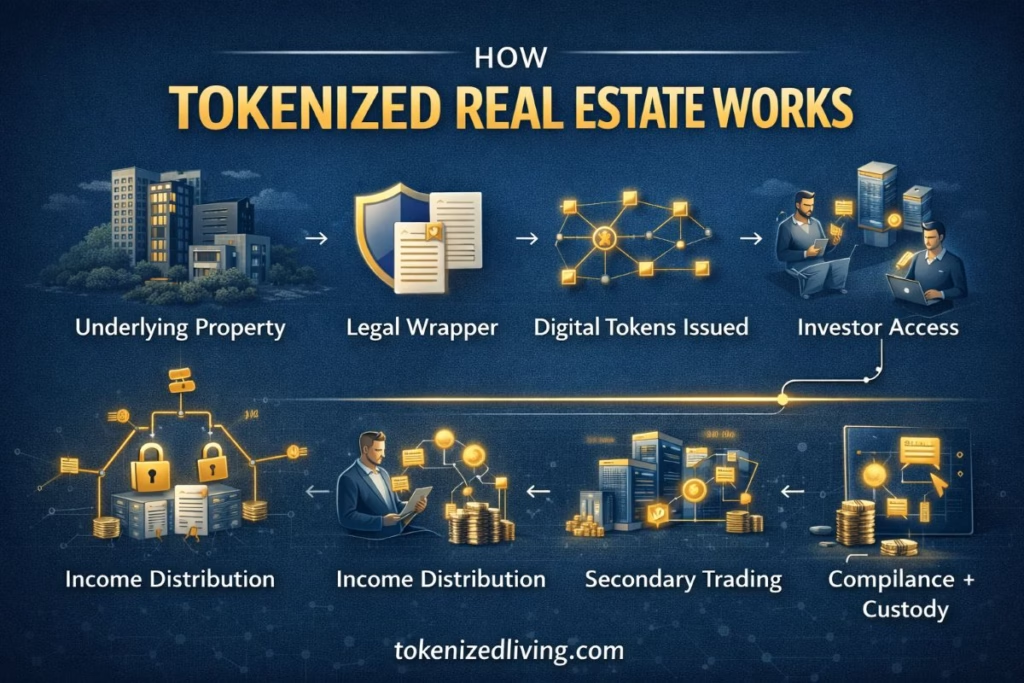
How Tokenized Real Estate Works
The details vary, but a property-company offering commonly follows these stages.
1. The Sponsor Selects a Property
The sponsor assesses the location, price, rental demand, condition, and expected costs. For a development project, permits, construction budgets, and the completion plan also matter.
Investors should see evidence behind the assessment. Attractive photographs cannot establish occupancy, title, or the cost of replacing a roof.
2. The Issuer Defines the Investment
A legal entity holds or acquires the property, or enters the relevant financing arrangement. The offering documents explain how investor money will be used.
Check whether the property purchase has already completed. If fundraising comes first, establish who holds the money and what happens if the target is missed.
3. Investors Complete Onboarding
Platforms commonly request identity documents and information about residence or investor status. Eligibility can differ between offerings on the same website.
Successful registration does not prove that every product is available to you. Confirm acceptance before transferring funds.
4. Tokens and Ownership Records Are Issued
After the purchase completes, investors receive tokens or a platform record of their holdings. The documents should explain how that record connects with the legally recognised investor register.
Also check whether you control a wallet or rely on the platform’s custody service.
5. The Property Operates and Investors Receive Reports
Managers collect rent, organise maintenance, pay bills, and handle tenants. The issuer calculates any distributions under the agreement.
Meanwhile, investors need regular information about cash flow, vacancies, repairs, borrowing, and material disputes.
6. Investors Exit Through an Available Route
Possible routes include selling tokens, a permitted redemption, loan repayment, or a sale of the underlying property.
Each route has different conditions. An expected project end date is not a promise that money will arrive on that date.
How Do Investors Make Money?
Returns usually come from rental operations, financing payments, or changes in investment value. The source depends on what you bought.
Rental Distributions
For a rental property investment, tenants’ payments help fund the property’s expenses. The manager may then distribute some of the remaining cash.
Payment frequency describes timing. Daily distributions do not automatically produce a higher annual return than monthly payments.
Also establish whether payments come from operating income, reserves, borrowing, or returned investor capital. A payment alone does not establish a profit.
Loan Interest or Project Returns
A debt investment may pay fixed interest, a variable amount, or returns linked to project performance. Some projects retain payments until completion.
Check the repayment source and maturity terms. Development delays can affect both the timing and amount received.
Gains or Losses on Exit
Investors may realise a gain by selling their interest or receiving proceeds after the property sells. However, falling prices, selling costs, and outstanding liabilities can produce a loss.
A dashboard valuation is an estimate or reference price. It does not establish what a buyer will pay for your holding.
A Hypothetical Rental Example
Imagine a debt-free property company with $200,000 of investor equity. Assume all equity interests share distributions equally in proportion to ownership.
The following figures are illustrative, not a forecast or an actual platform offering.
| Annual cash-flow item | Amount |
|---|---|
| Potential rent at full collection | $24,000 |
| Vacancy and unpaid rent | −$2,000 |
| Property management | −$2,000 |
| Property taxes and insurance | −$4,000 |
| Repairs and reserve allocation | −$3,000 |
| Administration and other fees | −$1,000 |
| Cash available for distribution | $12,000 |
Suppose you invest $1,000 for 0.5% of the equity, with no separate purchase fee in this example. Your share of a full distribution would be $60 for the year.
That equals a 6% cash yield on your investment before personal taxes. It also assumes the manager distributes all available cash.
Now imagine an additional $8,000 repair bill, with no extra funds available from existing reserves or insurance. Available cash would fall to $4,000. Your share would drop to $20, or 2%.
The property still exists and your token still works. Nevertheless, the income changes because the building needs money.
Why Rental Yield Is Not Total Return
Using the same example, assume you receive $60 and then sell your holding for $900. A hypothetical 3% selling charge leaves $873 from that sale.
Total receipts would be $933 against the original $1,000 investment. You would lose $67 before tax, despite receiving income during the year.
Therefore, compare distributions, purchase costs, sale proceeds, and exit charges together.
What Fees and Costs Should You Check?
Separate the platform’s charges from the expenses of owning the property. Both affect what investors receive.
Acquisition costs may include sourcing, legal work, valuations, company formation, and a platform commission. During ownership, management, accounting, insurance, taxes, repairs, and borrowing can reduce cash flow.
Selling can add brokerage costs, platform charges, payment fees, or a discount needed to attract a buyer.
Ask which amount each percentage applies to. A fee based on property value differs from one charged against collected rent or investment profit.
Also check for capital calls. Some agreements allow requests for additional money, with consequences if an investor refuses.
Finally, compare the fundraising target with the purchase price and full budget. Any difference should have a clear explanation.
Can You Sell Tokenized Real Estate Whenever You Want?
The ability to submit a sell order is only the first step. Completing a sale requires a permitted transaction and enough demand at an acceptable price.
Selling Your Tokens
A secondary market connects existing holders with buyers. Restrictions may include holding periods, identity checks, investor eligibility, manager approval, or permitted pricing ranges.
Review completed trades and available bids where the platform provides them. A displayed asking price shows what a seller wants, not what someone has paid.
Redeeming or Selling the Underlying Investment
A redemption depends on the issuer’s rules and available funds. Requests may face limits, queues, delays, or suspension.
Selling the whole property follows another process. Investors may need a vote, while the manager handles marketing, legal work, and settlement.
For debt offerings, repayment instead depends on the borrower meeting its obligations. A missed maturity date creates a credit problem, even if token transfers remain technically possible.
Borrowing Against Tokens
Some services offer loans secured by tokens. That produces cash alongside a new debt obligation.
It also introduces interest costs and possible liquidation if collateral values fall. Borrowing should therefore be assessed separately from selling the investment.
Our guide to tokenized asset secondary markets explains trading, settlement, and liquidity in more detail.
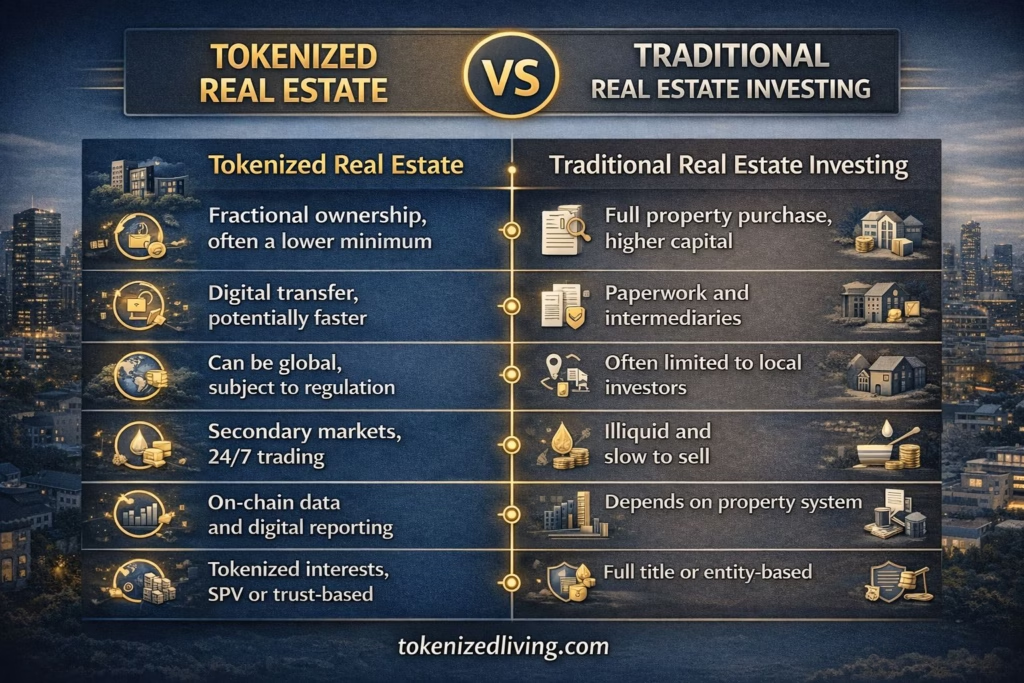
Tokenized Real Estate vs REITs and Other Property Investments
The useful comparison includes more than buying an entire building. Investors can already access property through listed securities and conventional fractional arrangements.
| Investment route | Typical exposure | Exit and control |
|---|---|---|
| Direct property ownership | A building you own, alone or jointly | Greater operational control; a sale involves a property transaction |
| Listed equity REIT | Shares in a company owning a property portfolio | Exchange trading; little control over individual buildings |
| Conventional fractional investment | A company interest, fund unit, or shared title | Rights and resale depend on the agreement |
| Tokenized property investment | Digital tokens linked to specified investment rights | Transfer route, demand, and legal terms determine the exit |
A listed REIT can provide property exposure without selecting and overseeing each building yourself. Its share price can fluctuate, and selling still depends on market conditions.
The distinction between listed and non-traded REITs matters. Non-traded REITs can have serious liquidity restrictions, as Investor.gov’s REIT explanation describes.
Tokenized offerings may appeal to people who want to choose specific properties or access a particular investment structure. However, that choice also creates more research work.
Evaluate whether the extra selection, administration, and technology risk serve your actual goal.
What Can Tokenization Improve?
Smaller investment units can make it easier to spread a budget across several assets. Digital records may also simplify tracking holdings and transferring interests between approved investors.
Smart contracts can automate selected rules, such as transfer permissions or payment allocation. A smart contract is software that executes specified instructions on a blockchain.
However, automation depends on accurate information and suitable controls. Someone must still verify rent collection, approve expenses, and connect physical events with digital records.
Blockchain transaction visibility also has limits. A public transfer history does not independently establish a building’s condition or prove the manager’s financial statements.
What Are the Main Risks?
Property and Tenant Risk
Vacancy, unpaid rent, structural problems, insurance costs, and local market conditions can reduce returns. Development projects add construction delays, budget overruns, and completion risk.
Review the inspection evidence and reserve policy. Tenant welfare and legal housing standards are central to responsible property management and sustainable income.
Borrowing and Refinancing Risk
Debt increases the claims against a property’s cash flow and value. Higher interest costs or a failed refinancing can create pressure even when tenants keep paying rent.
Check loan balances, repayment dates, security, and the assumptions behind any planned refinancing.
Management and Platform Risk
A manager may underperform, misreport results, or face conflicts of interest. Meanwhile, the platform can lose funding, suffer an outage, or close.
A separate property company can help distinguish assets and obligations. However, investors still need someone to collect rent, maintain records, and arrange distributions.
Ask who can appoint a replacement manager and how the transition would be funded.
Technology and Custody Risk
Smart-contract defects, stolen credentials, lost keys, and compromised administrator accounts can disrupt access or transactions.
Check who can freeze, replace, or upgrade tokens. Also establish how the issuer handles a lost wallet and reconciles conflicting records.
If payments use stablecoins, examine conversion costs, redemption access, and the risk of losing the intended currency peg.
Concentration and Currency Risk
Ten tokens do not necessarily mean ten independent risks. Holdings may share one city, manager, lender, platform, or property type.
Cross-border investments also expose investors to exchange-rate changes. A gain in the property’s currency can shrink when converted into your spending currency.
For a fuller assessment, read our benefits and risks of tokenized real estate.
RealT: A Case Study in Physical Property Risk
RealT illustrates why operating conditions belong in any discussion of tokenized ownership.
In July 2026, Outlier Media reported that co-founder Jean-Marc Jacobson announced plans for voluntary liquidation during a July 2 investor call. The report also described property-management failures and the role of a special fiduciary controlling its Detroit portfolio.
The proposed liquidation’s scope and process remained unclear in that reporting. An announcement should not be treated as proof of completed bankruptcy proceedings or a particular investor recovery. Read Outlier Media’s report.
Our RealT review and risk analysis examines the background and unresolved questions. RealT appears here as a distressed-platform case study.
The lesson is practical: digital ownership records cannot replace repairs, insurance, sound finances, or accountable management.
Is Tokenized Real Estate Legal?
Tokenized property investments can operate legally, but the answer depends on their structure and the applicable jurisdictions.
Property, company, securities, and tax rules may all matter. The asset’s location, issuer’s location, and investor’s residence can introduce different requirements.
Tokenized Securities Still Face Securities Laws
In its January 28, 2026 statement, SEC staff explained that tokenized securities can use different structures and confer different rights.
The statement also explains that recording a security on or off a blockchain does not change the application of federal securities laws. Offers and sales require registration unless an exemption is available.
This is a staff statement with no legal force. It does not approve individual property offerings or create a new tokenization law. Read the SEC staff statement on tokenized securities.
What Investors Should Verify
Identify the issuer and check the offering’s stated legal basis. Then establish your eligibility and any resale restrictions.
Identity checks alone do not prove that an investment complies with every applicable rule. Likewise, registration of a company does not establish approval of its investment products.
Before investing: Establish the title holder, your contractual rights, the governing law, and the process for enforcing a claim. Regulation cannot guarantee returns or prevent every loss.
How Are Tokenized Property Investments Taxed?
Tax treatment follows the investment structure and relevant laws. The label on the token cannot determine the answer by itself.
Payments may represent distributions, interest, or another form of income. Selling the holding can create a separate reporting question.
Cross-border investments may involve withholding and obligations in more than one country. Crypto payments can add record-keeping requirements too.
Before investing, ask which statements the issuer provides and whether you need local tax registration. Keep purchase records, distributions, fees, exchange rates, and sale confirmations.
Our tokenized real estate tax guide explores these issues. A qualified adviser can assess the rules for your specific holding and residence.
Which Platforms Should You Research?
Compare the investment structures before comparing advertised yields.
For example, Lofty’s published model uses interests in property-specific LLCs. Our Lofty review explains its ownership, payments, fees, and trading arrangements.
Reental describes different structures for Spain and the United States, including participatory loans and property-company interests. The Reental review explains why the selected project agreement matters.
These examples illustrate different models, rather than a universal recommendation. Eligibility, fees, and individual offering terms can change.
Use our tokenized real estate platform comparison to compare ownership rights, costs, access, and exit conditions across the platforms reviewed.
Explore Lofty Properties
To see how Lofty works in practice, you can browse the properties currently available on its marketplace.
Review each property’s ownership structure, projected income, expenses, fees and supporting documents before investing.
This is an affiliate link. If you use it, we may earn a commission at no extra cost to you.
A Checklist Before Your First Investment
- Identify the claim. Write down the issuer, property owner, and exact right you receive.
- Read the complete documents. Obtain the offering, subscription, ownership, custody, and management terms that apply.
- Verify the asset. Examine title evidence, valuation, inspections, occupancy, and any development permissions.
- Check liabilities. Find existing debt, overdue bills, creditor priority, and possible capital calls.
- Calculate realistic cash flow. Include vacancies, maintenance, reserves, borrowing, taxes at property level, and fees.
- Assess the manager. Review experience, reporting quality, related-party arrangements, and replacement rights.
- Price the exit. Check restrictions, buyer demand, charges, and a scenario requiring a discounted sale.
- Understand custody and failure plans. Establish how access, records, and property operations continue after disruption.
- Confirm eligibility and tax administration. Resolve these questions before funding the account.
- Keep independent records. Save agreements, transaction confirmations, statements, and ownership evidence outside the platform.
If the issuer cannot explain a material part of the arrangement, leave the investment uncommitted while you investigate.
Does It Fit Your Financial Goals?
Begin with the purpose of the money and when you may need it.
Funds reserved for an emergency or a near-term home purchase need dependable access. A restricted property investment may be difficult to reconcile with that requirement.
A longer horizon can make a holding period more manageable. However, it does not remove the risk of poor management, permanent loss, or an unclear contract.
Retirement planning adds another question: could your spending plan withstand interrupted distributions and delayed sales? Our guide to tokenized real estate in retirement portfolios explores that issue.
Judge suitability by the specific investment and your capacity to absorb its risks. A low minimum alone cannot settle the decision.
Frequently Asked Questions
How Much Money Do You Need to Start?
Minimum purchases vary by platform, property, and payment route. Some offerings allow small commitments, but purchase fees can increase the amount needed. Check the complete transaction cost before funding.
Does a Token Give Me the Right to Stay in the Property?
Usually, an investment interest provides financial rights under an agreement. Personal use requires an explicit occupancy or usage right. Never assume that buying a rental-property token includes accommodation.
Do I Need a Crypto Wallet?
It depends on the platform. Some provide custody or an embedded wallet, while others require an external wallet. Check who controls access and what happens if credentials are lost.
Are Rental Payments Guaranteed?
No. Payments can change or stop because of vacancies, expenses, reserves, debt obligations, or management problems. A target yield describes an expectation, not a guaranteed result.
Can I Lose My Entire Investment?
Yes. Property losses, excessive debt, fraud, or failures in the legal and operating structure can leave investors with no recovery. Review any additional funding obligations as well.
What Happens if the Platform Closes?
The outcome depends on asset ownership, custody, records, and replacement arrangements. A surviving property company still needs management and funding. Preserve evidence of your interest and know who handles continuity.
Is Tokenized Real Estate Better Than a REIT?
Neither is automatically better. Listed REITs offer exchange-traded property-company exposure, while individual tokenized offerings may provide more specific asset selection. Compare costs, control, liquidity, diversification, and legal rights.
Our Verdict
Tokenized real estate can offer useful ways to access property investments and manage digital ownership records. Its value depends on the quality of the arrangement behind those records.
Before investing, be able to explain what you own, how it earns money, what it costs, and how you could exit.
Then examine the harder question: who protects your rights and keeps the property operating when something goes wrong?