

If you are trying to understand how RealT works, you need to look at its underlying structure.
RealT gets talked about a lot, but most explanations miss what is actually going on.
People hear “tokenized real estate” and assume they are buying property on the blockchain.
That is not really the case.
It is closer to owning shares in a company than owning a house directly.
Once you see that, everything else starts to make sense.
In this guide, we break down how RealT works step by step, including how income is generated and what you actually own.
Some links in this article may be affiliate links. If you choose to invest through them, we may earn a small commission at no extra cost to you.
Always do your own research before making any investment decisions.
⚠️ Important RealT Status Warning — August 2026
On July 2, 2026, RealT announced its intention to begin voluntary liquidation and sell its property portfolio. This announcement fundamentally changes the investment context described in this guide.
This article remains available to explain how RealT’s token and property-owning LLC structure was designed to work. It should not be interpreted as a description of normal current operations or as a recommendation to invest.
Normal distributions from much of the affected portfolio remain suspended. Approximately 700 Detroit properties are under the authority of court-appointed special fiduciary Charles Bullock, who has final control over property sales within that portfolio. The precise scope, timetable and potential proceeds from RealT’s proposed liquidation have not been confirmed.
As of August 14, 2026, investors have not received a reliable repayment timetable or independently verified recovery estimate. Previous property valuations, projected yields and token prices should not be treated as guaranteed liquidation values.
Tokenized Living’s position: We do not currently recommend purchasing RealT tokens. Existing token holders should follow official legal developments and avoid assuming that normal distributions or liquidity will return.
Finally, read our complete RealT Detroit and liquidation update or review the original liquidation reporting from Outlier Media.
TL;DR
- RealT does not sell property directly. It sells shares in an LLC that owns the property.
- Each token represents fractional ownership of that company, not the title itself.
- RealT pays out income to token holders after costs are covered.
- Entry costs are low compared to traditional real estate.
- You cannot always sell tokens quickly, and buyers are not always available.
- The structure fits within existing legal frameworks but comes with trade-offs.
If you want the full breakdown, here’s exactly how the structure works step by step.
What RealT Actually Does
RealT takes a physical property and places it into a legal entity.
Usually, that entity is an LLC.
That LLC owns the property. Not you directly.
Then, RealT splits ownership of that LLC into digital tokens.
Each token represents a small share of the company.
So instead of one person owning the building, hundreds of investors can own parts of it.
It is easier to understand this structure when you see it visually.
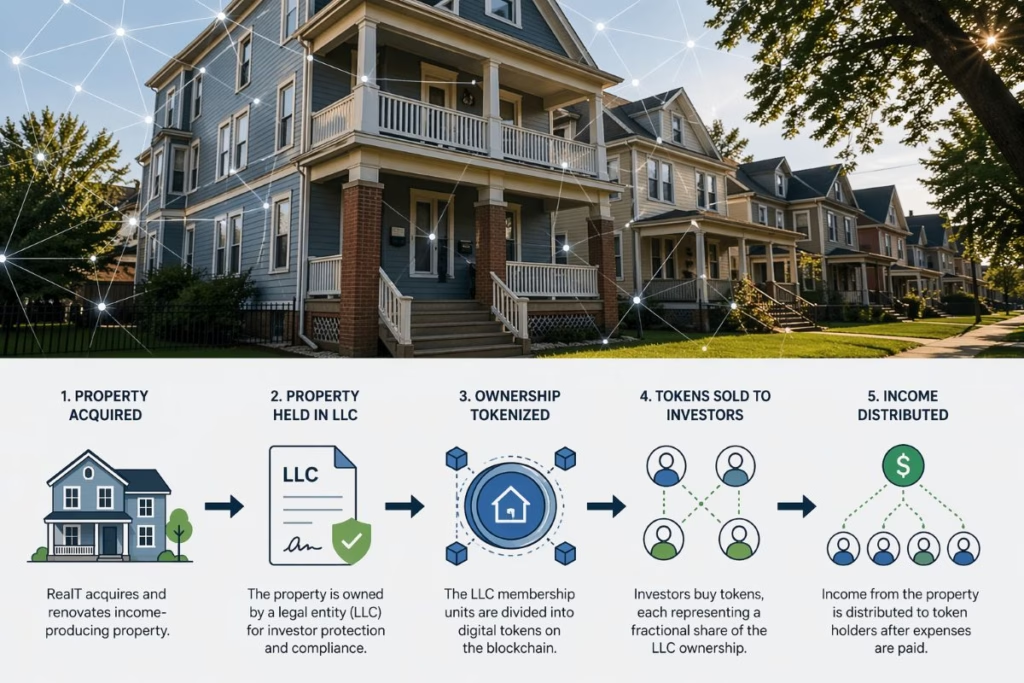
Step 1: The Property Is Acquired
RealT identifies a property, often in the US.
These are usually:
- single-family homes
- small multi-family buildings
Realt purchases a property and prepares it for rental.
Step 2: The Property Is Placed Into an LLC
This is the key step most people miss.
They then transfer the property into a legal entity.
That entity becomes the official owner on paper.
So when you invest, you are not buying the property.
You are buying into the company that owns it.
Step 3: Ownership Is Tokenized
RealT splits the LLC into shares, then converts them into blockchain-based tokens.
Each token represents a fraction of ownership.
This is where tokenization comes in.
It allows those shares to be:
- divided easily
- transferred digitally
- tracked on-chain
We covered this in more detail here.
Step 4: Investors Buy Tokens
You can buy as many tokens as you want, depending on availability.
This lowers the entry cost significantly.
Furthermore, instead of needing tens or hundreds of thousands…
You can start with a much smaller amount.
Step 5: Rent Income Is Distributed
When the property generates rent income, it flows through the structure.
RealT deducts costs first, then pays the remaining income to token holders.
Usually this happens:
- daily or weekly
- in stablecoins
So you receive income proportional to the number of tokens you hold.
Step 6: Tokens Can Be Traded (With Limits)
You can trade some RealT tokens on secondary markets.
But this is not like selling a stock.
Finding a buyer is not always straightforward.
You may not be able to sell instantly.
This is one of the trade-offs people often overlook.
What You Actually Own
This is where confusion happens.
You do not own:
- the property title
- the deed
You own:
- shares in an LLC
- represented by tokens
That distinction matters.
Because it affects:
- legal rights
- control
- how decisions are made
Why This Model Exists
This structure is not random.
It is designed to:
- fit within existing legal frameworks
- allow fractional ownership
- simplify distribution of income
Without this setup, tokenized real estate would be much harder to implement.
Where It Gets Interesting
This model sits somewhere between:
- direct property ownership
- REIT-style investing
It gives access to real estate income…
But without full control over the asset.
That trade-off is what makes it appealing to some investors and unsuitable for others.
In conclusion, how Realt works is not as complicated as it seems.
👉 Related: The Detroit Legal Case and Taxes
If you want to understand the legal side and where things can get complicated: