
Updated August 19, 2026
A token can move between wallets in seconds. Its owner might still wait months to find a buyer.
That tension defines tokenized asset secondary markets in 2026. Blockchain can make assets easier to record, transfer and settle. However, it cannot manufacture demand, remove securities law or guarantee a fair exit price.
Earlier descriptions of blockchain trading often promised global access, 24/7 markets and the removal of intermediaries. The real market looks different. Regulated exchanges, brokers, custodians, transfer agents and settlement providers remain deeply involved.
This is not necessarily a failure. In fact, regulated infrastructure may give tokenized assets their best chance of reaching meaningful scale.
The United States has approved exchange rules for certain tokenized securities. The European Union operates a DLT Pilot Regime. Meanwhile, the UK, Switzerland and Hong Kong have introduced their own routes for regulated secondary activity.
Yet, adoption remains uneven. A technically transferable token is not automatically a liquid investment.
TL;DR
- A secondary market lets investors trade an asset after its original issuance.
- Tokenization changes how ownership and transfers may be recorded. It does not remove the asset’s legal or regulatory obligations.
- A functioning market still needs buyers, sellers, price discovery, compliance, custody and a reliable settlement asset.
- Tokenized securities do not automatically trade 24/7 or settle instantly.
- The US, EU, UK, Switzerland and Hong Kong now have credible regulated models, although most activity remains institutional or restricted.
- Nasdaq’s approved model places eligible tokenized and conventional securities on the same order book rather than creating a separate crypto exchange.
- The cash side of a trade matters as much as the tokenized asset side.
- Thin demand, fragmented venues and transfer restrictions remain major barriers.
- Tokenized real estate can be particularly illiquid because the underlying property and legal structure remain difficult to value and sell.
- Investors should verify actual trading volume and exit rules before buying.
What Is a Secondary Market?
A primary market handles the original sale of an asset. For example, a company may issue a bond, or a property SPV may sell tokens to its first group of investors.
A secondary market allows those investors to sell later. The issuer may not receive money from these subsequent trades.
Traditional examples include stock exchanges, bond markets and private share platforms. Tokenized markets apply distributed ledger technology to some part of the ownership, trading or settlement process.
| Market stage | What happens | Simple example |
|---|---|---|
| Primary market | The asset is created and sold to its first investors | Investors buy tokens in a new property offering |
| Secondary market | Existing investors trade the asset with other eligible buyers | One token holder sells to another after issuance |
The distinction matters because a successful offering does not prove that investors can exit later. Issuance measures capital raised. Secondary activity measures whether ownership can change hands at a credible price.
If you need the basics first, our guide to what tokenization is explains how off-chain rights can connect with on-chain records.
What Makes a Secondary Market “Tokenized”?
There is no single model. A market may use blockchain for the asset record, settlement or both.
Some securities are issued directly as tokens. Others remain in a conventional register while a blockchain token acts as a digital representation. A third-party token can also provide indirect exposure to an asset held elsewhere.
The US Securities and Exchange Commission staff described these distinctions in its January 2026 statement on tokenized securities. It separated issuer-sponsored tokens from products created by unaffiliated third parties. Crucially, the rights may differ between those structures.
Therefore, investors should never assume that two tokens tracking the same company or asset provide identical legal ownership.
A credible tokenized secondary market usually needs six connected layers.
1. The legal asset
The token must represent an enforceable right. That right could be a share, bond, fund unit, security entitlement or contractual claim.
Code cannot repair weak legal documentation. If the issuer fails, investors need to know which court, register and insolvency rules determine ownership.
2. The ownership record
The blockchain may serve as the authoritative ownership register. Alternatively, it may operate alongside an off-chain master record.
When records differ, the legal documents should explain which one controls.
3. The trading venue
Buyers and sellers need somewhere to meet. That venue might be an exchange, an alternative trading system, a multilateral trading facility or an issuer-run marketplace.
A wallet-to-wallet transfer is not the same as an organised market with transparent prices and active bids.
4. The compliance layer
Securities laws do not disappear on-chain. Platforms may need to verify identity, location, investor classification and holding limits.
Smart contracts can enforce a whitelist. Nevertheless, the issuer and venue remain responsible for applying the correct rules.
5. Custody and wallet controls
Investors need a secure way to hold or control their tokens. Institutions may use regulated custodians, while retail investors might use approved self-custody wallets.
Recovery procedures also matter. Losing a key should not quietly destroy a legally recognised security.
6. The settlement asset
The buyer must pay with something. That cash leg may use commercial bank money, central-bank money, a qualifying stablecoin or a tokenized deposit.
Without a dependable payment system, the security can move on-chain while payment remains slow or uncertain.
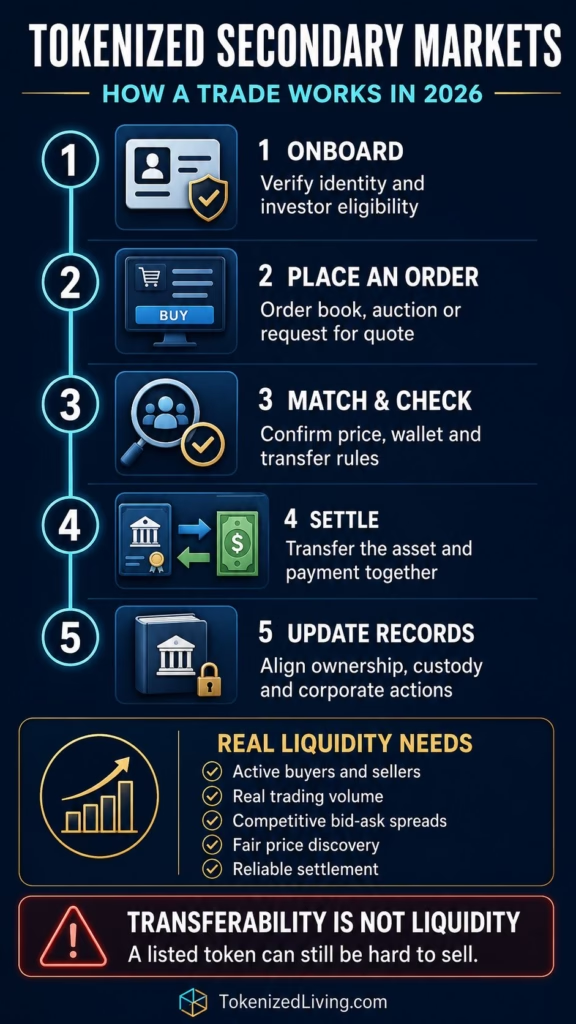
How a Tokenized Secondary Trade Works
Although the exact process varies, a regulated trade often follows these steps.
- The investor completes onboarding. The venue checks identity, jurisdiction and eligibility.
- The asset becomes eligible for trading. The issuer, transfer agent or venue confirms its legal and technical status.
- A buyer or seller submits an order. The order might enter an order book, auction or request-for-quote system.
- The venue matches the trade. Its rules determine price and execution priority.
- Compliance checks run. The system confirms that both wallets and investors can legally complete the transfer.
- The asset and cash legs settle. Ideally, delivery-versus-payment transfers them together.
- The ownership records update. The relevant register, blockchain and custody records must remain aligned.
Corporate actions continue after settlement. Dividends, interest, voting, redemptions and tax reporting still need reliable administration.
This lifecycle explains why “removing all intermediaries” is usually the wrong goal. The better target is fewer duplicated records and more efficient coordination.
The Main Trading Models
Tokenized asset secondary markets can use several market structures.
Central limit order books
Buy and sell orders compete by price and time priority. This model is familiar from public exchanges and works best when an asset attracts frequent orders.
However, an empty order book provides no liquidity. Technology cannot solve that problem alone.
Regulated ATSs and MTFs
An alternative trading system in the US or a multilateral trading facility in Europe can bring multiple participants together under regulated rules.
These venues may combine familiar market controls with blockchain settlement. Access can still be limited to approved participants.
Requests for quotes and auctions
Less liquid assets often trade through dealer quotes or periodic auctions. This approach may suit bonds, private shares and real-world assets better than a continuous order book.
Investors gain a price discovery process, although spreads can remain wide.
Issuer marketplaces and bulletin boards
Some platforms let existing holders advertise tokens to other approved users. The platform might facilitate the transfer without operating a full exchange.
These systems can help investors find buyers. Still, a listing page should not be described as a liquid secondary market when few trades occur.
Peer-to-peer transfers
Two eligible investors may agree on a price and transfer directly. Compliance controls can restrict the receiving wallet.
This provides transferability, but it may offer weak price discovery and limited investor protection.
Permissioned automated market makers
An automated market maker uses liquidity pools rather than a conventional order book. Permissioned versions can add identity and transfer controls.
Nevertheless, AMMs introduce pricing, smart-contract and liquidity-provider risks. They are not automatically suitable for thinly traded securities or properties with uncertain valuations.
Tokenized Markets Versus Traditional Markets
The difference is less dramatic than many promotional articles suggest.
| Feature | Traditional market | Tokenized market |
| Ownership record | Central databases and account records | DLT, conventional records or a hybrid |
| Trading access | Exchange, broker or private venue | Regulated venue, platform or approved wallet transfer |
| Market hours | Set by the venue | May be extended, but not automatically 24/7 |
| Settlement | Often T+1 or T+2, depending on market | Can support faster or atomic settlement |
| Compliance | Broker, venue and transfer controls | The same obligations, sometimes automated on-chain |
| Custody | Brokers, banks and central depositories | Custodians, approved wallets or hybrid systems |
| Liquidity | Depends on participants and market depth | Still depends on participants and market depth |
| Corporate actions | Established processing networks | Potentially programmable, but integration remains difficult |
Traditional systems are also improving. Most applicable US securities transactions have used a standard T+1 settlement cycle since May 2024.
Consequently, claims that conventional trades always take several days are outdated.
The Biggest Myth: Tokenization Creates Liquidity
Tokenization can make an asset easier to divide and transfer. Liquidity requires much more.
A liquid market needs:
- Enough eligible buyers and sellers.
- Regular trading activity.
- Competitive bid and ask prices.
- Reliable market makers or liquidity providers.
- Credible asset information and valuation.
- A trusted trading venue.
- Efficient custody and settlement.
- Clear rules for redemption and failure.
Consider a tokenized property. The smart contract may allow a transfer in seconds. However, the owner cannot sell at a fair price unless another approved investor wants that specific property exposure.
The token has improved transferability. It has not changed the building’s occupancy, maintenance costs, valuation or local property market.
Our beginner’s guide to RWA tokenization examines this difference between technical access and investment quality.
Regulated Secondary Markets in 2026
The strongest developments now combine DLT with existing market safeguards.
United States: tokenized securities meet existing exchanges
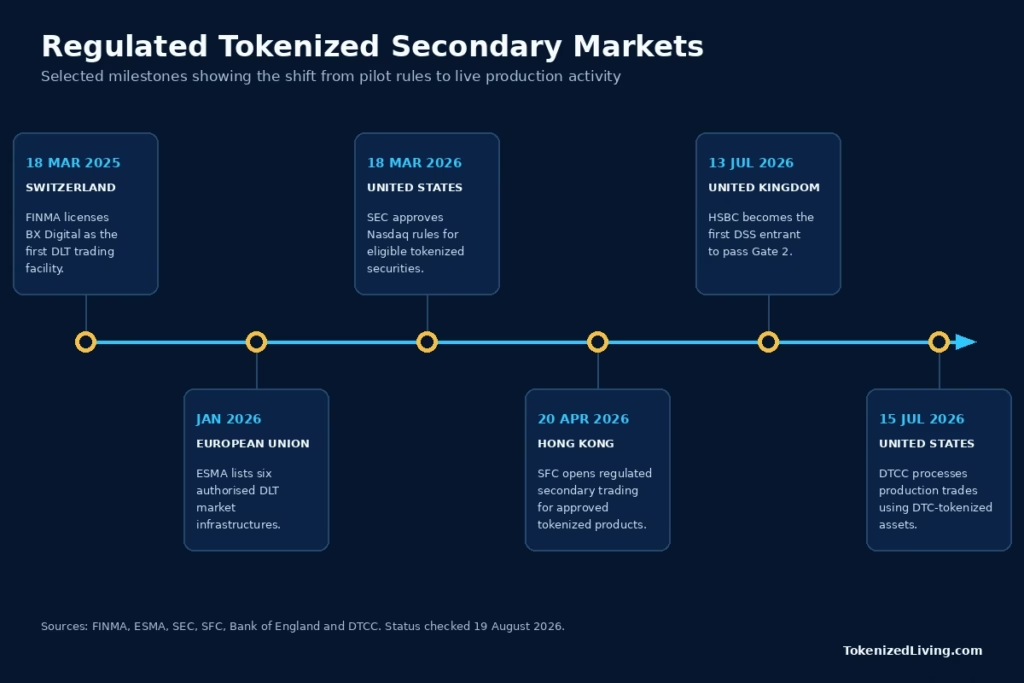
In March 2026, the SEC approved a Nasdaq rule change for securities in tokenized form during the DTC tokenization pilot.
The model is important because it does not create an unregulated parallel market. Eligible tokenized securities can trade alongside their traditional counterparts on the same Nasdaq order book. They must share the same CUSIP, trading symbol, rights and execution priority.
The approved scope covers eligible Russell 1000 securities and exchange-traded funds tracking major indices. Participation also depends on DTC pilot eligibility.
In July 2026, DTCC reported that more than 30 firms had participated in production transactions using DTC-tokenized assets. The tests included equity and Treasury delivery-versus-payment, securities lending, collateral and margin workflows.
DTCC plans to launch its Tokenization Service in October 2026. Therefore, the July transactions demonstrate production readiness, not a fully mature public secondary market.
The US direction looks evolutionary rather than revolutionary. Tokenization is moving into familiar market infrastructure with familiar investor rights.
European Union: the DLT Pilot Regime
The EU DLT Pilot Regime allows authorised infrastructures to support trading, settlement or both for eligible tokenized financial instruments.
As of ESMA’s January 2026 list, six DLT market infrastructures had received specific permission. However, earlier ESMA analysis found limited activity and several operational barriers.
The EU experience shows that permission to operate does not guarantee trading volume. Participants still need assets, investors, interoperable systems and a workable cash leg.
Our guide to the European tokenization market in 2026 covers those infrastructures and the ECB’s planned Pontes settlement connection.
United Kingdom: live testing inside the DSS
The UK Digital Securities Sandbox allows approved firms to test issuance, trading and settlement in a regulated live environment.
Passing the first gate does not permit live activity. In July 2026, HSBC became the first entrant listed by the Bank of England’s DSS dashboard as having passed Gate 2.
The Bank also allows firms to apply to use qualifying stablecoins for settlement. Each proposed stablecoin receives a case-by-case assessment.
Retail access is not automatic. Firms serving non-professional clients may need additional permissions and safeguards.
Switzerland: trading with integrated payment settlement
In March 2025, FINMA licensed BX Digital as Switzerland’s first DLT trading facility.
The venue targets supervised participants, usually banks. It uses Ethereum for securities settlement and connects to the Swiss Interbank Clearing system for payment. A smart contract coordinates delivery-versus-payment.
BX Digital does not provide custody. That separation shows why a blockchain venue still depends on a wider network of regulated services.
Hong Kong: controlled secondary trading for tokenized products
In April 2026, Hong Kong’s Securities and Futures Commission introduced a framework for secondary trading of tokenized SFC-authorised investment products on licensed virtual-asset trading platforms.
The SFC framework requires measures for fair pricing, orderly trading, liquidity provision and disclosure. Distributors must also remain regulated intermediaries.
This is controlled convergence between traditional products and licensed digital-asset infrastructure. It is not unrestricted global trading.
Our article on Hong Kong tokenized securities in 2026 explains the wider reforms.
Where Tokenized Secondary Markets Can Improve Trading
Faster and coordinated settlement
DLT can support delivery-versus-payment, where the asset and cash move together. This may reduce settlement exposure and reconciliation work.
Yet, faster settlement is not always free. Participants may need cash or securities earlier, which can create new funding pressures.
Shared transaction records
A common ledger can reduce duplicated records between brokers, custodians and issuers. It may also make ownership changes easier to trace.
However, each participant must trust the governance, data controls and legal status of that ledger.
Programmable compliance
Transfer restrictions can run automatically. For example, a smart contract may reject a wallet that has not completed required checks.
Automation can improve consistency. It cannot decide ambiguous legal questions without human governance.
More efficient corporate actions
Interest, dividends, voting and redemptions can connect with token-holder records. Issuers may reduce manual processing and reconciliation.
Errors can also scale quickly. A flawed contract or incorrect data input could affect every holder.
Smaller investment units
Tokenization can divide some assets into smaller denominations. This may reduce minimum investment sizes.
Nevertheless, fractional units only improve access when distribution rules permit retail participation.
Better collateral mobility
Institutions may move eligible tokenized assets between trading, lending and collateral systems more efficiently.
This is one reason much of the strongest adoption remains wholesale rather than retail.
The Risks Investors Should Not Ignore
Thin or artificial liquidity
A platform may advertise secondary trading while showing few genuine bids. Related parties or incentive programmes can also inflate activity.
Look for actual volume, spreads and completed trades—not merely the number of listed assets.
Fragmented markets
The same asset may appear on separate chains or venues. If those pools cannot connect, tokenization can divide liquidity instead of improving it.
Bridges introduce another layer of technology and counterparty risk.
Unclear legal rights
A token might represent the security itself, an entitlement held through a custodian or a synthetic claim created by a third party.
Those structures can behave differently during bankruptcy, redemption or corporate actions.
Transfer restrictions
Whitelists, lock-up periods and investor limits may prevent a sale. The code may block transfers even when two investors agree on a price.
Restrictions can protect compliance while reducing liquidity.
Cash-leg failure
The security may settle quickly while payment travels through another system. Stablecoins also introduce issuer, reserve and redemption risks.
Atomic settlement only works when both legs remain dependable.
Custody and key risk
Lost keys, hacked wallets and weak recovery processes can freeze assets. Institutional custody reduces some risks but adds fees and counterparty dependence.
Smart-contract and network risk
Code bugs, congestion, governance changes and network outages can interrupt trading or settlement. Public-chain finality may also differ from legal settlement finality.
Venue or platform failure
Investors may lose market access if a platform closes. The token can continue to exist while its main source of buyers disappears.
This risk deserves particular attention in small private markets.
What This Means for Tokenized Real Estate
Tokenized property is often marketed around liquidity. Investors should challenge that claim aggressively.
The token may represent shares in an SPV, a debt instrument or a fund unit. It rarely transfers direct land title with one blockchain transaction.
Furthermore, real estate remains difficult to price continuously. Rental performance, occupancy, repairs, local demand and financing all affect value.
A secondary marketplace may provide an exit route. It cannot guarantee an immediate sale or a fair price.
Before investing, check:
- How many secondary trades occurred during the last 30, 90 and 365 days?
- What is the gap between the highest bid and lowest asking price?
- Who can legally buy the token?
- Does a minimum holding period apply?
- Can the issuer or platform pause transfers?
- Does the venue operate an order book, auction or bulletin board?
- Who determines the reference property valuation?
- What happens if the marketplace closes?
- Can investors redeem directly with the issuer?
- Which legal document controls ownership?
Our guide to the benefits and risks of tokenized real estate examines these questions in greater detail. You can also compare platform-level risks in Tokenized Real Estate Platforms Compared.
Due Diligence Before Trading Any Tokenized Asset
Ask the following questions before relying on secondary-market access:
- What legal right does the token represent?
- Did the issuer create the token, or did an unaffiliated third party create it?
- Which regulator oversees the issuer and trading venue?
- Is the venue an exchange, ATS, MTF, bulletin board or peer-to-peer platform?
- Which investors can trade?
- What are the real trading volume and bid-ask spread?
- How does the cash leg settle?
- Is delivery-versus-payment available?
- Who provides custody and key recovery?
- Are the smart contracts audited?
- Can the asset move to another compliant venue?
- What happens during an issuer, custodian or platform failure?
Our guide to investing in tokenized assets provides a wider checklist covering valuation, fees and portfolio risk.
Outlook for 2026 and Beyond
The most credible path is becoming clearer.
First, regulated market infrastructure will probably lead adoption. Nasdaq, DTCC, the EU pilot, the UK sandbox and BX Digital all connect tokenization with established legal controls.
Second, wholesale use cases may scale before open retail trading. Collateral, securities lending, funds and bonds fit institutional workflows more easily than fragmented property tokens.
Third, interoperability will matter more than the choice of one “winning” blockchain. Assets need to move across custody, trading and payment systems without splitting liquidity.
Meanwhile, the cash leg will remain decisive. Central-bank money, commercial bank money, tokenized deposits and qualifying stablecoins offer different risk profiles.
Finally, markets will judge tokenization by repeat activity rather than pilot announcements. A successful future market needs active buyers, reliable prices and enforceable investor rights.
Final Verdict
Tokenized asset secondary markets are no longer theoretical. Regulated venues and settlement providers are now processing real transactions.
However, blockchain has not made every asset liquid, borderless or available around the clock. The strongest systems retain many familiar institutions while changing how those institutions coordinate.
That reality is less dramatic than the old promise of replacing traditional markets. It is also far more credible.
For investors, the rule is simple: never confuse the ability to transfer a token with the ability to sell it quickly at a fair price.
Frequently Asked Questions
Are all tokenized assets tradable on a secondary market?
No. Some tokens have holding periods, investor restrictions or no active venue. Others can transfer only between approved wallets.
Do tokenized markets operate 24/7?
Not automatically. A blockchain may operate continuously, but the venue, compliance process, banking system and asset rules can limit trading hours.
Does tokenization guarantee liquidity?
No. Liquidity requires active buyers, sellers and credible price discovery. Tokenization can improve transferability without creating demand.
What is delivery-versus-payment?
Delivery-versus-payment coordinates the transfer of an asset with the buyer’s payment. Ideally, neither leg completes unless the other one also completes.
Can retail investors use regulated tokenized markets?
Sometimes. Access depends on the product, jurisdiction and venue. Many current pilots focus on banks, institutions or professional investors.
Is blockchain settlement instant?
Not always. Network confirmation can be fast, but compliance checks, payment, custody records and legal finality may require additional steps.
Is an AMM suitable for tokenized securities?
It can be used in a permissioned structure, but it introduces pricing, compliance and smart-contract risks. Thinly traded securities may be particularly vulnerable to poor pricing.
Editorial note: This article replaces an earlier version that overstated 24/7 access, cost savings, security and the removal of intermediaries. Regulatory and market developments were checked against official sources available on August 19, 2026.
Disclaimer: This article is for educational and informational purposes only. It does not constitute financial, legal, tax or investment advice. Tokenized assets may involve loss of capital, limited liquidity, technology failures and changing regulation. Conduct independent research and consult qualified professionals before investing.