

Ondo Finance is dedicated to designing blockchain-based financial infrastructure directed toward optimization of market efficiency and transparency.
TL;DR
- Ondo Finance is focused on fixing how capital moves, not chasing hype
- It gives access to instruments such as US Treasuries using tokenized structures
- You are not owning the asset itself, and that detail matters
- The shift is happening inside the system, not in the token you see
- It is still early, but something real is forming
Why Ondo Finance Is Getting Attention
Most people still hear “tokenization” and think of speculation.
That reaction is fair. The early wave trained people to think that way.
Ondo does not really fit that category.
It is not trying to replace finance. It is trying to improve parts of it that clearly do not work well.
If you have ever moved money through traditional systems, you already know the friction. Things take time. Access is not equal. Capital gets stuck in places where it cannot do much.
So the idea here is simple.
What if those same assets could move more freely?
Not in theory, but in practice.
What Ondo Is Actually Doing
At first glance, it sounds straightforward.
Bring real financial products onto blockchain rails.
But once you look closer, it is less about the technology and more about how the structure is set up.
Ondo focuses on instruments that already exist. Treasuries, yield-based products, and things institutions are already comfortable with.
Instead of going through the usual system, investors access them differently.
And this is where people often misunderstand what is happening.
You are not buying the asset itself.
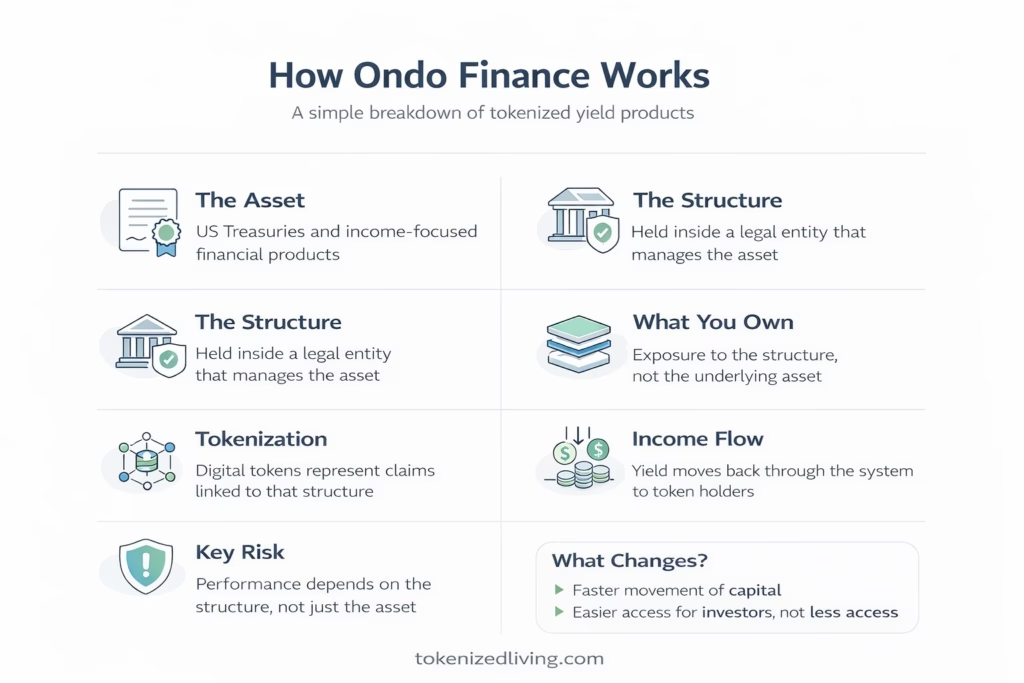
You are stepping into a setup that holds the asset. Your position sits inside that setup.
That might sound like a small detail, but it changes how you should think about ownership.
The Structure Behind It
This part is not complicated, but it often gets skipped.
A legal entity holds the asset. Tokens represent claims linked to that entity. Investors buy those tokens. Returns come back through that same path.
If you have looked into fractional real estate, it is a similar idea.
You are not holding the property. You are holding exposure to something that owns it.
Some people are fine with that. Others are not.
The important thing is knowing which side you are on.
Where Ondo Feels Different
There are a lot of tokenization projects out there.
Most of them focus on narratives.
Ondo focuses on things people already trust.
That changes the tone immediately.
It builds around stable instruments. It keeps the structure relatively simple. Then it connects those products to systems where they can actually be used.
Traditionally, these assets just sit there.
Here, they can move. They can be used as part of something bigger.
That is where it starts to feel more practical.
What Actually Improves
This is where it gets a bit messy, because not everything improves equally.
Some things clearly get better. Others depend on how the system is used.
Liquidity
It becomes easier to move assets from a technical point of view.
That helps.
But it does not magically create buyers.
If no one is on the other side, nothing really changes. That part is still very real.
Access
More people can get involved, depending on where they are and how the structure is set up.
It opens doors, but not for everyone at the same time.
So yes, access improves, just not evenly.
Settlement
This is one of the clearer wins.
Traditional systems can be slow. Sometimes slower than they should be.
Here, things move faster. Not always instantly, but enough to notice.
And over time, that kind of improvement adds up.
Visibility
You can follow what is happening more easily.
That is new for many investors.
Whether that builds confidence or raises more questions depends on how well you understand what is sitting underneath it.
The Risks Do Not Go Away
It is easy to focus on the upside.
But the trade-offs are still there.
You Are Not Holding the Asset
This is the part people tend to underestimate.
You are relying on a structure that holds the asset.
If that structure works as expected, everything feels smooth.
If it does not, that is where things can get complicated.
Someone Still Holds the Asset
The asset does not disappear into code.
It sits somewhere. Someone is responsible for it.
That introduces risk, just like in traditional systems.
Rules Are Still Changing
Different regions treat these setups in different ways.
That can create confusion, especially if you are looking at this from a global perspective.
Liquidity Is Not Guaranteed
Worth repeating.
Making something easier to trade does not mean people will trade it.
The market still decides that.
Market Insight
This does not feel like disruption in the usual sense.
It feels more like an upgrade.
Instead of tearing systems down, it improves how certain parts function.
That might not sound exciting, but it is probably why institutions are paying attention.
It solves real problems.
What To Watch
Ondo, on its own, is interesting.
But the bigger picture matters more.
You are starting to see similar ideas show up in different places.
Treasuries appearing in tokenized form. Wallets are experimenting with yield products. Institutions are testing how this works in controlled environments.
It is not happening all at once.
But it is happening.
And once these pieces start connecting properly, things could move faster than expected.
Traditional vs Tokenized
| Feature | Traditional Finance | Tokenized Setup |
|---|---|---|
| Access | Limited | Expanding slowly |
| Settlement | Slower | Faster |
| Visibility | Hard to follow | Easier to track |
| Ownership | Direct or fund-based | Indirect |
| Flexibility | Limited | More adaptable |
The Bigger Picture
What is really happening here is a connection between two systems that have not worked well together.
Traditional finance sits on one side.
Blockchain infrastructure sits on the other.
Now they are starting to overlap.
That is where things begin to make sense.
Not as an idea.
As something you can actually use.
FAQs
Is Ondo Finance safe?
It depends on what you compare it to.
The assets themselves may be stable. The structure introduces a different type of risk.
Do you own the asset?
No.
You hold a position tied to a structure that owns it.
How does Ondo make money?
Through fees and structured products built around those assets.
Is this the future?
Part of it, yes.
But it is not the full picture.
Final Thought
This space is moving away from pure speculation.
Slowly.
Not in a straight line.
But you can see the shift.
Ondo is one example of that.
And if this direction continues, the real change will not be what people invest in.
It will be how those investments actually function behind the scenes.
Finally, we refined and enhanced the article using ChatGPT.