

Tokenized property liquidity remains one of the biggest challenges in fractional real estate markets. Tokenization can divide a property into smaller, transferable digital units, but it cannot guarantee a buyer when an investor wants to sell.
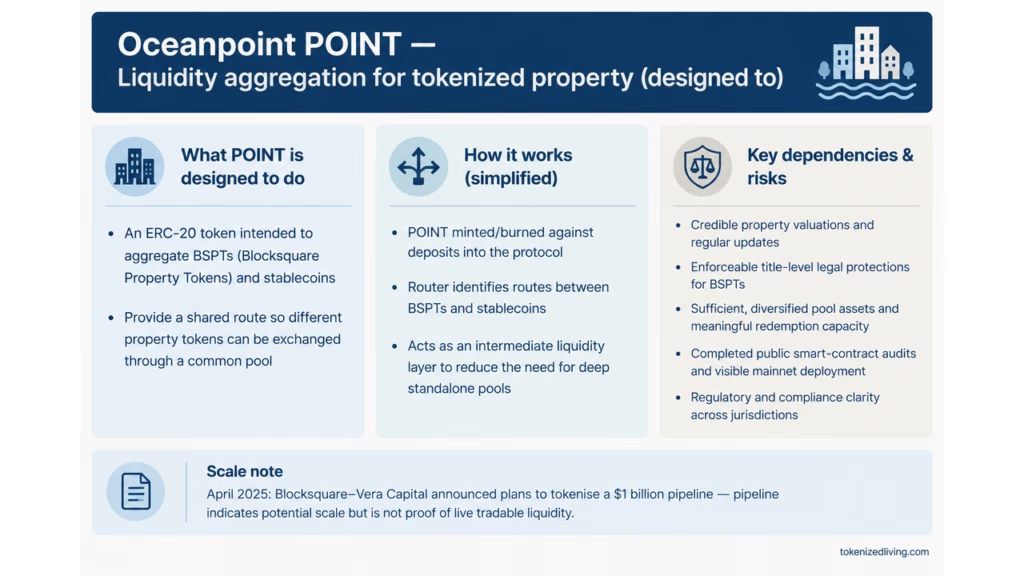
That distinction sits at the heart of Oceanpoint, a decentralised finance protocol developed by Blocksquare. Its proposed POINT token aims to aggregate liquidity across Blocksquare Property Tokens, or BSPTs, and stablecoins. Rather than relying on a separate market for each property token, Oceanpoint plans to introduce a shared route through which different assets can be exchanged.
The concept addresses one of the biggest structural problems facing tokenized real estate. Yet its success will depend on more than efficient smart contracts. Oceanpoint also needs credible property valuations, sufficient asset diversity, reliable redemption, robust legal rights and sustained demand.
Key Takeaways
- POINT is designed as an ERC-20 liquidity aggregation token for Blocksquare Property Tokens and stablecoins.
- Oceanpoint could reduce fragmented liquidity and slippage by giving property tokens access to a shared asset pool.
- Blocksquare describes POINT as “flatcoin-like”, tracking the net asset value of its backing rather than a fiat currency.
- Mainnet deployment, completed public audits, and title-level legal protections still require clearer public evidence.
- The reported $1 billion Vera Capital pipeline could add scale, but a property pipeline is not the same as live, tradable liquidity.
Why Tokenized Property Liquidity Is Difficult to Improve
Tokenization can make fractional ownership and digital transfers possible, but it does not remove the underlying characteristics of real estate. Properties remain expensive, jurisdiction-specific assets. Valuations change slowly, sales take time and legal ownership depends on off-chain records and agreements.
The market can become even more fragmented when each property has its own token. A token representing one commercial building may have few natural buyers, even if the building itself is valuable. An automated market maker could support trading, but every individual token would need enough capital in its liquidity pool. Thin pools can produce high slippage, where a relatively small trade causes a disproportionate price movement.
This creates a difficult loop. Investors may avoid a property token because they cannot exit easily, while liquidity providers may avoid it because trading activity is low. Issuing more tokens does not necessarily solve the problem. It can spread available liquidity across an even larger number of isolated markets.
Oceanpoint’s answer is to aggregate that liquidity rather than asking every property token to support a deep standalone market.
How POINT Is Supposed to Work
Blocksquare describes Oceanpoint as an open DeFi protocol for tokenized real estate liquidity. According to the company’s Oceanpoint whitepaper announcement, POINT is an ERC-20 token intended to connect BSPTs with stablecoin liquidity.
The proposed architecture includes an OceanpointToken contract, an OceanpointProtocol contract and an OceanpointRouter. Together, these components are intended to manage POINT issuance, protocol deposits and routes between supported assets.
In simple terms, POINT would act as an intermediate liquidity layer. Instead of requiring a direct and sufficiently funded trading pair between every BSPT and stablecoin, a user could move through POINT. The protocol’s router would identify and execute the relevant path.
Blocksquare says POINT would be minted and burned against deposits into the protocol. The token would represent value held within an asset pool containing tokenized property interests and stablecoins. Oceanpoint’s glossary describes it as “flatcoin-like” because it is intended to track the net asset value of that pool. It also states that POINT is not a fiat stablecoin.
That difference matters. A conventional fiat-backed stablecoin normally aims to maintain a fixed value against a currency such as the US dollar. POINT’s proposed value depends on the net asset value of its pool. Its stability would therefore rely on the quality, valuation and liquidity of the underlying assets, as well as the protocol’s minting and redemption mechanics.
Readers new to this model may find it helpful to start with what tokenization means and how real-world assets, or RWAs, connect off-chain assets to blockchain-based tokens.
Could Aggregation Reduce Slippage?
Theoretically, yes. A shared pool can use capital more efficiently than many small, disconnected pools. If investors can exchange different BSPTs through POINT, each property token may gain access to a broader source of liquidity than it could attract independently.
This could be especially useful for small fractional holdings. An investor might not need to find a buyer specifically seeking exposure to one building. The protocol could instead process the exchange through its aggregated pool and routing system.
However, this only works if the pool contains enough assets and supports meaningful redemption capacity. A liquidity layer cannot manufacture demand for property. It reorganises available liquidity and may make that liquidity easier to access.
Slippage could remain high if the pool is small, if investors rush to redeem at the same time or if a large portion of the backing comes from closely related assets. Liquidity would also be vulnerable if market participants lost confidence in property valuations or the legal claims attached to BSPTs.
POINT could therefore improve market plumbing without eliminating market risk.
The Vera Capital Pipeline Could Provide Scale
In April 2025, Blocksquare and Vera Capital announced plans to tokenise what the parties described as a $1 billion pipeline of US commercial real estate. The partnership received coverage from outlets including CryptoPotato and Bitcoin.com.
If suitable assets from that pipeline enter the Blocksquare ecosystem, they could expand the pool of BSPTs available to Oceanpoint. A larger pool could improve diversification, increase transaction activity and make POINT more useful.
But the headline figure needs context. A $1 billion pipeline is an ambition associated with properties that may be tokenized. It does not demonstrate that $1 billion of property tokens has already been issued, legally secured and made available for trading.
The critical measures will be the value of assets actually brought on-chain, the associated BSPT contract addresses, the legal rights attached to those tokens and the liquidity committed to active markets. Announced property value and usable secondary-market liquidity are not interchangeable.
The partnership may give Oceanpoint a route towards scale, but scale must become visible in deployed assets and functioning markets.
The Legal Layer Matters as Much as the Router
Oceanpoint combines on-chain trading mechanics with off-chain property rights. Smart contracts can record balances, process deposits and route swaps. They cannot, by themselves, establish an enforceable claim over a building.
Blocksquare has said that a Luxembourg legal entity was incorporated as part of a plan to secure BSPTs against real-world property titles. That could become an important part of the structure, but the practical protections depend on the underlying legal documents.
Investors need to know what a BSPT legally represents, who holds the relevant property rights and what happens if an issuer, property owner or platform fails. The answer may depend on trustee agreements, security registrations, custody arrangements and the laws of every jurisdiction involved.
Publicly available company materials do not yet provide independent confirmation of the title-level security described by Blocksquare. Nor do they establish how token holders would enforce their claims across all relevant jurisdictions.
This is not a secondary detail. POINT’s value would rely partly on BSPTs held within its asset pool. If those tokens provide uncertain or weak rights to the underlying properties, efficient liquidity routing cannot repair the legal gap.
Anyone evaluating the project should distinguish between control of a blockchain token and an enforceable interest in the asset behind it. That distinction is central to the wider benefits and risks of tokenized real estate.
Valuation Creates Another Challenge
POINT’s proposed net-asset-value model also makes valuation essential. Property markets do not produce continuous, transparent prices in the way that highly traded cryptoassets do.
Oceanpoint will need a clear process for valuing BSPTs, updating those values and responding to material changes in the properties. Market participants also need to understand who selects the valuation method and how disagreements or outdated assessments are handled.
If POINT can be minted or redeemed using valuations that no longer reflect achievable market prices, traders may exploit the difference. During stressed conditions, the quoted value of a property token could diverge from what the underlying asset would realise in a sale.
Diversification could reduce the effect of problems at any single property, but concentration would create its own risk. If one issuer or property group supplies a large share of the pool, operational or market problems affecting that contributor could spread through POINT.
Transparency over pool composition, valuation frequency and governance will therefore be essential.

Smart-Contract Security Remains a Test
Blocksquare’s developer documentation outlines the proposed components behind POINT, the protocol and its router. Company materials have also referred to security audits.
However, the available evidence does not establish that a completed third-party audit of the Oceanpoint v1 contracts has been published. It also does not clearly confirm live mainnet deployment of POINT, its definitive contract address or on-chain minting and redemption activity.
These are important milestones. A protocol can have a detailed whitepaper and credible architecture without yet proving that its production contracts operate securely under real market conditions.
A public audit would not remove smart-contract risk, but it would allow users to review the contracts assessed, the issues identified and whether critical findings were addressed. Verified contract addresses and observable transaction history would also make it possible to compare Oceanpoint’s proposed mechanics with its live operation.
Regulation Could Shape POINT’s Future
POINT sits at the intersection of several potentially regulated activities. It is intended to interact with property-linked tokens and stablecoins, while tracking the net asset value of an asset pool.
That design may raise different questions across jurisdictions, including whether POINT or BSPTs fall within securities, asset-backed token or stablecoin-related rules. The relevant treatment could also depend on how the assets are marketed, what rights token holders receive and where issuers and investors are based.
No regulator approvals for POINT, BSPTs or Oceanpoint pools are evident from the available public materials. That does not determine their legal status, but it means users should not assume that a technical launch equals regulatory approval.
A scalable property-liquidity protocol will need a compliance model capable of handling both blockchain transactions and jurisdiction-specific real estate rights.
So, Will POINT Solve Tokenized Property Liquidity?
POINT presents a coherent response to liquidity fragmentation. Pooling BSPTs and routing exchanges through a common token could be more capital-efficient than building an isolated market for every property. The model could also make smaller property-token positions easier to exchange.
But POINT cannot solve liquidity through architecture alone. It needs deep and diversified backing, dependable valuations, functioning redemptions and sustained market participation. It also needs enforceable legal links between BSPTs and properties, transparent governance, secure smart contracts and a workable regulatory approach.
The Vera Capital partnership could help Oceanpoint build the asset base required for its model. For now, however, the reported pipeline remains a statement of potential scale rather than proof of live liquidity.
Oceanpoint has identified the right problem and proposed an ambitious mechanism. Whether POINT solves that problem will become clearer only when users can inspect deployed contracts, public audits, asset-level legal protections and sustained on-chain trading. Until then, POINT is best understood as a promising liquidity design rather than a demonstrated solution.