
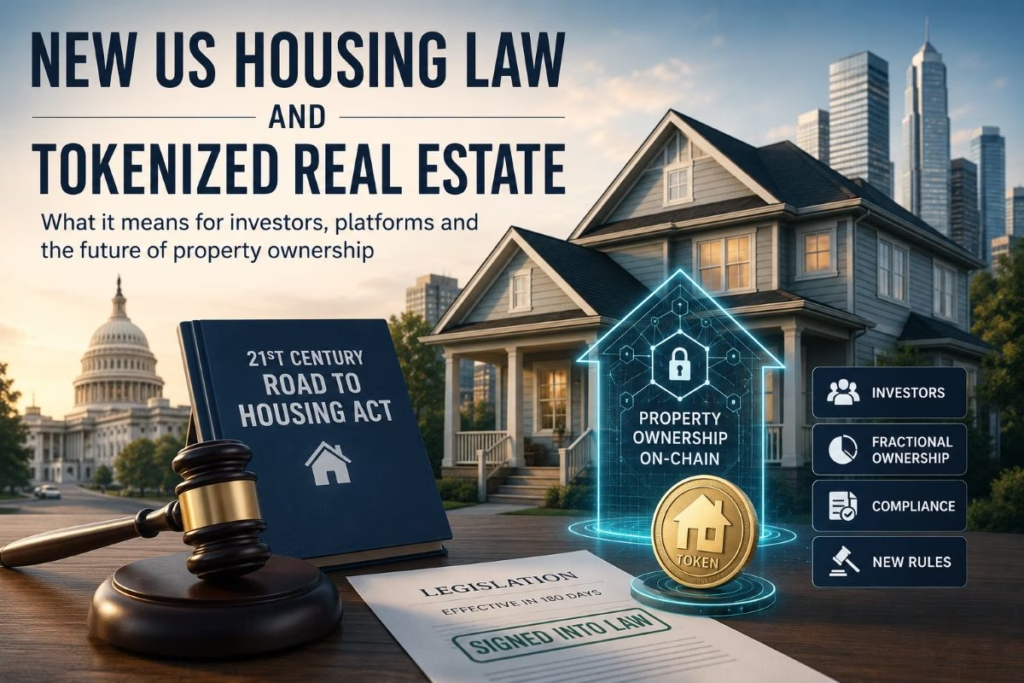
The United States has introduced one of its most significant housing reforms in decades—and part of it may directly affect tokenized real estate platforms.
The 21st Century ROAD to Housing Act became law on July 11, 2026. Its broader purpose is to increase housing supply, reduce construction barriers and make homeownership more accessible. However, the law also restricts large institutional investors from purchasing additional single-family homes.
Blockchain technology receives no special treatment. A property does not escape housing law simply because investors own digital tokens rather than conventional shares.
TL;DR
The new law:
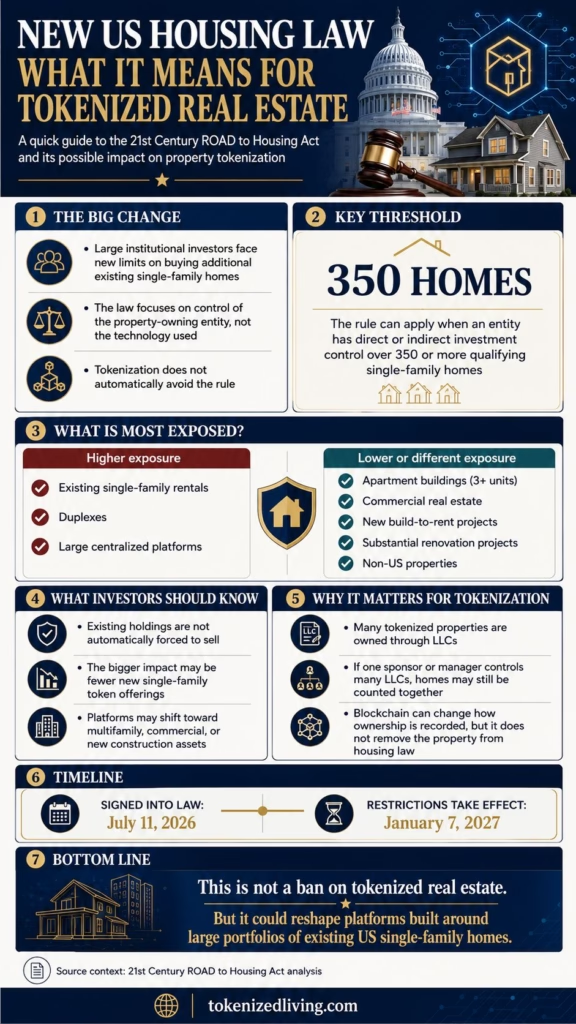
- Restricts covered investors that control at least 350 qualifying homes.
- Covers direct and indirect control through LLCs, managers and advisers.
- Does not force investors to sell qualifying homes acquired before enactment.
- Excludes some new construction, build-to-rent and major renovation projects.
- Could push tokenized platforms toward apartments, commercial property and non-US markets.
The restrictions take effect 180 days after enactment, which places the effective date on January 7, 2027. They are scheduled to remain in force for 15 years.
What Does the New Housing Law Actually Restrict?
The law creates a category called a large institutional investor.
A covered investor can include an investment fund, corporation, partnership, LLC, joint venture or another for-profit legal entity involved in owning, renting, managing or holding single-family homes.
The threshold is not based only on the number of properties appearing under one company name. Instead, the law applies when an entity—alone or working with other entities—has direct or indirect investment control over at least 350 single-family homes.
The count excludes homes acquired through qualifying excepted purchases after the law’s enactment. However, homes owned before enactment are not automatically excluded from the threshold simply because the law does not require their sale.
That definition matters enormously for tokenized property platforms.
An entity can have investment control when it:
- Makes material investment or management decisions.
- Controls the managing member of the property-owning LLC.
- Controls the investment manager, management company or adviser.
- Controls more than 25% of an equity class, unless it acts only as a passive investor.
- Otherwise controls the entity that owns the property.
Therefore, placing every property inside a separate LLC does not automatically avoid the restriction.
The token is not the deciding factor. Control of the property-owning entity is what matters.
Why Tokenization Does Not Create a Loophole
Most tokenized real estate platforms do not place the property title directly on a blockchain.
Instead, an LLC or corporation owns the physical property. Investors then purchase tokens representing membership interests, shares or economic rights connected to that legal entity.
RealT, for example, explains that each property is owned by a company and that the ownership interests in that company are represented by a unique set of RealTokens.
The new law looks through this type of structure. If the same platform, sponsor, adviser or management group controls hundreds of property-owning entities, regulators may count those homes together.
Tokenizing each LLC separately will not necessarily protect a platform from the 350-home threshold.
Which Tokenized Properties Are Most Exposed?
The law defines a single-family home as a structure containing two or fewer residential units. Manufactured homes are excluded from this particular definition.
| Tokenized property type | Likely treatment |
|---|---|
| Existing single-family rental | Potentially restricted |
| Duplex | Potentially restricted |
| Apartment building with 3+ units | Outside this section |
| Commercial property | Outside this section |
| Manufactured home | Excluded |
| New build-to-rent property | May qualify for an exception |
| Heavily renovated property | May qualify for an exception |
| Property outside the US | Not covered by this US law |
Several exceptions significantly reduce the law’s impact.
Large investors can continue making certain purchases connected to newly constructed homes and build-to-rent programs. A renovate-to-rent project may also qualify when the home fails key building-code requirements and improvements equal at least 15% of the purchase price.
The final version also removed an earlier proposal that would have forced institutional investors to dispose of some build-to-rent properties after seven years. The enacted law therefore treats new construction more favourably than the acquisition of existing homes.
What Does This Mean for RealT?
RealT’s historical model illustrates why property-level LLCs do not settle the question of investment control. However, its current situation requires separate treatment.
According to Outlier Media’s reporting, RealT announced plans for voluntary liquidation during a July 2, 2026 investor call. That announcement preceded the housing law’s enactment and followed mounting financial and legal problems.
It would therefore be misleading to describe those liquidation plans as a consequence of this law. The acquisition restrictions do not themselves require investors to sell homes purchased before enactment.
Any assessment of the law’s application would still require evidence about qualifying properties, controlling entities and relevant exceptions. Our updated RealT review explains the liquidation announcement and the uncertainties facing existing token holders.
What About Lofty?
Lofty’s public property totals do not establish whether it meets the law’s definition of a large institutional investor. A marketplace listing count cannot replace an assessment of qualifying homes and legal investment control.
The distinction matters because properties advertised through one marketplace may have different owners, sponsors and management arrangements. Any assessment must establish which entities exercise control and whether their holdings must be counted together.
A statement that Lofty has tokenized “more than 150 properties” also provides no upper limit. It cannot, by itself, establish that the relevant total remains below 350.
Investors should look for a documented explanation of how the rules apply to Lofty’s structure. Our Lofty review covers its ownership model, fees and investment risks.
What Changes for Tokenized Property Investors?
Existing token holders should not assume that their properties will be sold or that income distributions must stop. The law does not create an automatic liquidation requirement for previously acquired homes.
The more immediate effect could appear in the pipeline of new investment opportunities.
Large tokenization platforms may respond by offering:
- More multifamily apartment buildings.
- More commercial real estate.
- Newly constructed rental communities.
- Properties requiring substantial rehabilitation.
- More opportunities outside the United States.
- Fewer existing US single-family rentals.
Compliance costs may also increase. Covered investors must report the number and location of homes under their control, while the Treasury can enforce violations with penalties of up to $1 million per violation or three times the property’s purchase price, whichever is greater.
That penalty is large enough to make experimental legal interpretations extremely dangerous.
Could Platforms Split Their Portfolios?
A platform might attempt to divide its portfolio among several companies, sponsors or property managers.
That strategy is not bulletproof.
The law counts homes controlled by an entity alone or in concert with one or more other entities. Therefore, creating several entities on paper may fail when the same people continue making the important decisions.
Truly independent local sponsors may gain an advantage. Artificially fragmented platforms could instead attract regulatory scrutiny.
Tokenized Real Estate Is Not Being Banned
This law is not an attack on blockchain. It does not prohibit fractional ownership, property tokens or real estate securities.
Instead, it targets the concentration of control over existing single-family homes.
That distinction matters. A tokenized apartment building, commercial property or newly constructed rental community may continue operating outside the main restriction. Smaller platforms may also continue acquiring qualifying homes while they remain below the threshold.
The biggest losers may be platforms built around rapidly acquiring hundreds of existing rental houses under centralized management.
The biggest winners may be tokenization businesses focused on new housing supply, multifamily assets and genuinely decentralized property sponsorship.
The restrictions may influence which properties covered investors choose to acquire. However, an exception from these purchase restrictions does not establish that a project will attract demand or produce better returns.
Final Verdict
The acquisition restrictions are scheduled to take effect on January 7, 2027. Their application to a tokenized platform depends on qualifying homes, investment control and statutory exceptions.
Separate LLCs and digital tokens do not, by themselves, establish that a business falls outside the rules. Equally, the number of properties advertised on a marketplace does not establish that the operator is covered.
Investors should examine the legal structure behind each offering and any explanation of how the acquisition rules apply. Property quality, costs and the ability to sell remain important tokenized real estate risks.
This article provides general information and analysis. It does not constitute legal or investment advice.