
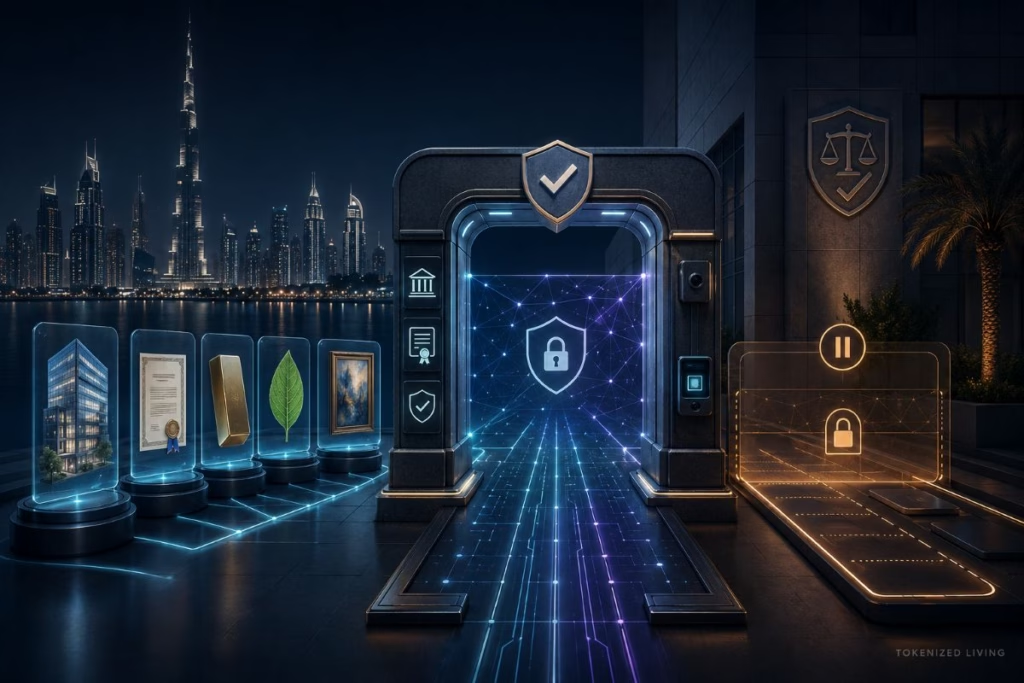
TOKO was once promoted as DLA Piper’s user-friendly platform for tokenizing real estate, art and other valuable assets.
However, TOKO no longer operates under that name.
Following a management buyout in 2024, the business relaunched as Scintilla. It now describes itself as a regulated tokenization, broker-dealer and virtual-asset exchange business based in Dubai.
That description requires an important qualification.
Scintilla holds an active licence from Dubai’s Virtual Assets Regulatory Authority. Nevertheless, the company’s own August 2026 disclosure says it remains in a pre-operational setup phase. No virtual assets were actively offered, quoted or brokered at that date. Moreover, its exchange services had not been activated.
Therefore, Scintilla currently represents a potentially credible regulated infrastructure project—not an established marketplace where investors can browse and trade tokenized assets.
This Scintilla review examines the TOKO rebrand, regulatory position, technology, proposed investment products and significant unanswered questions.
Last updated: August 30, 2026.
Scintilla Review 2026: The Short Version
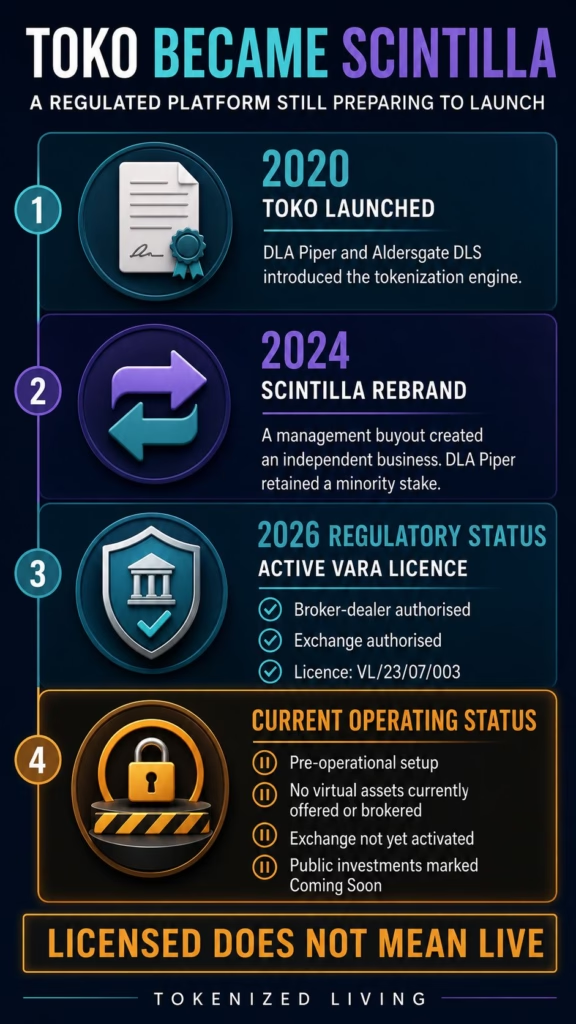
Scintilla grew out of TOKO, a tokenization engine launched by DLA Piper and Aldersgate DLS in 2020.
The company has stronger legal and regulatory foundations than many token-creation services. Furthermore, Dubai’s regulator lists it as holding an active broker-dealer and exchange licence.
However, regulatory authorisation does not mean every approved service is operating.
Scintilla’s public disclosure dated August 20, 2026 states that:
- It is operating exclusively under its broker-dealer licence
- Its exchange features will be introduced after future activation
- It remains in a pre-operational setup phase
- No virtual assets are currently offered, quoted or brokered
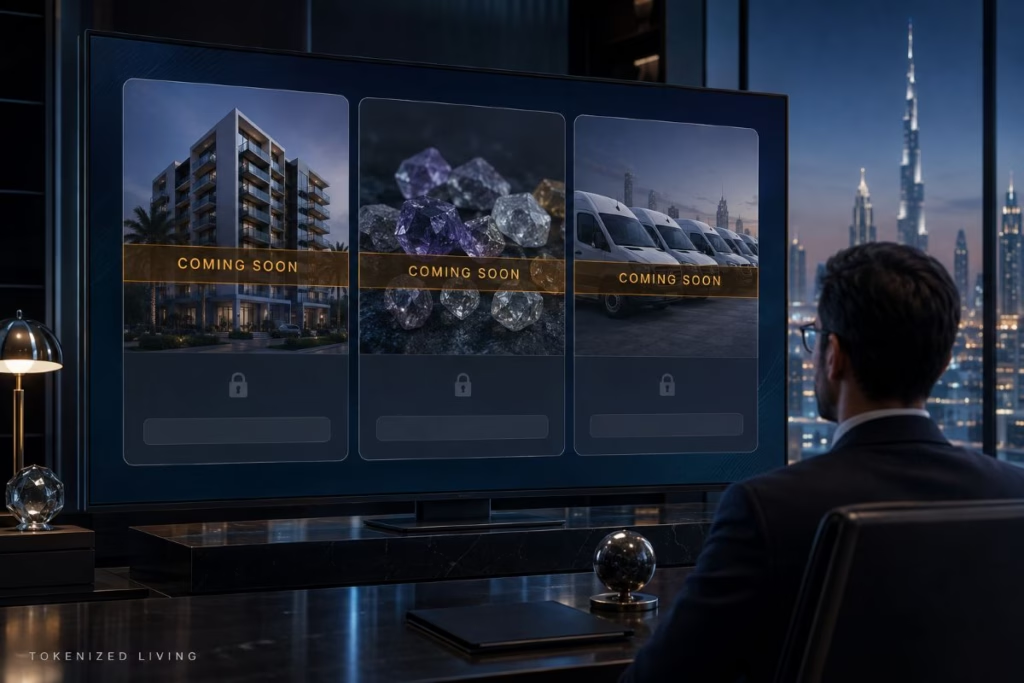
Its investment page lists residential property, precious stones and a commercial fleet. Yet all three opportunities are marked “Coming Soon.”
| Area | Assessment |
|---|---|
| Regulatory foundation | Strong |
| Current operating status | Pre-operational |
| Active investment catalogue | None publicly available |
| Exchange services | Licensed but not activated |
| Tokenization technology | Promising but largely company-reported |
| Public pricing | Limited |
| Security transparency | Incomplete |
| Website quality | Poor in several areas |
| Best suited to | Prospective institutional issuers conducting due diligence |
| Suitable for investors today | No active public opportunities confirmed |
Scintilla may develop into a serious regulated tokenization platform. However, it has not yet publicly demonstrated the scale, products or liquidity needed to justify stronger praise.
What Was TOKO?
DLA Piper and Aldersgate DLS launched TOKO in November 2020.
The original concept combined blockchain technology with legal structuring. This approach recognised that creating a digital token represents only one part of an asset-tokenization project.
A token must also connect with:
- Legally enforceable ownership rights
- Transfer restrictions
- Investor records
- Distribution rules
- Voting rights
- Redemption procedures
- Regulatory requirements
TOKO’s first demonstration involved a piece of fine art purchased by several DLA Piper partners in Hong Kong.
According to DLA Piper’s original TOKO announcement, the platform could also support funds and property.
TOKO provided tools for creating digital assets and smart contracts. In addition, its planned functions included distributions, voting, transfers, announcements and token redemption.
The original architecture combined private infrastructure with Hedera’s public network. Later versions expanded the platform’s blockchain options.
However, that history does not prove that every feature remains available today. Technology, ownership and regulatory requirements have changed considerably since 2020.
Why Did TOKO Become Scintilla?
TOKO’s leadership completed a management buyout in 2024.
The company then relaunched as Scintilla with a wider focus on tokenization, virtual-asset brokerage and secondary trading.
DLA Piper did not disappear completely. The law firm retained a minority shareholding and continued supporting the business after the transaction.
The DLA Piper announcement confirming the Scintilla relaunch described four intended service areas:
- Tokenization advice and opportunity assessment
- Proof-of-concept and product development
- Primary-market broker-dealer services
- Secondary-market exchange services
Therefore, Scintilla should not be described as simply a renamed DLA Piper product.
It is now a separate business with new ownership and leadership. DLA Piper remains involved as a minority shareholder rather than controlling the platform as an internal legal-technology project.
Is Scintilla Regulated?
Yes, but the licence needs careful explanation.
The current VARA public register lists Scintilla Network FZE as an active Virtual Asset Service Provider.
Its details include:
- Licence number: VL/23/07/003
- Licence status: Active
- Licensed activities: Broker-dealer services and exchange services
- Original licence date: September 11, 2023
- CMA registration: CMA-VASP-1100000-0003
VARA regulates virtual-asset activities across most of Dubai. However, its jurisdiction excludes the Dubai International Financial Centre.
A licence confirms that Scintilla has received authorisation for specified activities. It does not endorse the company, guarantee its investments or confirm that every approved service is operational.
That distinction matters because Scintilla’s current disclosure says it operates exclusively under its broker-dealer licence.
The company also says its exchange disclosures and features will be published after the exchange licence is activated. Therefore, readers should not interpret the licence as evidence of a functioning secondary market.
Some older Scintilla and DLA Piper webpages display different licence numbers. The current VARA register and Scintilla’s latest public disclosure both use VL/23/07/003. Those current sources should take precedence.
Is Scintilla Operating as an Investment Platform?
Not yet, based on its latest disclosure.
Scintilla’s main website uses language suggesting that investors can access assets, trade positions and receive rapid settlement.
However, its formal public disclosure presents a different picture.
As of August 20, 2026:
- Scintilla remained in a pre-operational setup phase
- No virtual assets were actively offered
- No assets were being quoted
- No assets were being brokered
- Exchange services had not been activated
The Scintilla360 investment page displays three proposed opportunities:
- Residential property in the United Arab Emirates
- Precious stones from East Africa
- A commercial fleet in the United Arab Emirates
Every opportunity is labelled “Coming Soon.”
The page also provides a pre-registration form. It does not publish detailed offering documents, minimum investments, projected returns, fee structures or launch dates.
Consequently, Scintilla should not currently be presented as a marketplace where investors can purchase tokenized real-world assets.
What Does Scintilla Plan to Offer?
Scintilla is developing an end-to-end structure connecting asset creation with regulated distribution and eventual trading.
Asset Evaluation and Structuring
The issuer first needs to define the asset, investor rights and economic model.
For example, a real estate project must determine whether investors own:
- Direct title to part of the property
- Shares in a special-purpose company
- A debt instrument secured against the property
- A contractual right to income
- A token with no direct ownership interest
This legal structure matters more than the token’s design.
Scintilla can help develop a proof of concept and assess how blockchain technology might fit the proposed product. However, issuers will still require appropriate legal, tax, valuation and regulatory advice.
Our guide explaining how to tokenize an asset covers these preparatory stages in more detail.
Smart-Contract Creation
Scintilla develops smart contracts that manage the digital asset.
Potential functions include:
- Creating and destroying tokens
- Restricting transfers
- Whitelisting approved wallets
- Recording ownership
- Processing distributions
- Recovering tokens under authorised conditions
- Applying lock-up periods
- Supporting redemptions
Automated rules can reduce manual administration. Nevertheless, smart contracts cannot repair a defective legal structure or poor investment.
Token Issuance and Distribution
Scintilla’s broker-dealer infrastructure is intended to support primary token distributions.
Before offering a virtual asset, the company says it will assess:
- The issuer
- Token economics
- Market liquidity
- Regulatory classification
- Smart-contract security
- Available audits
- Underlying risks
No assets were approved for active brokerage at the date of its latest disclosure.
Secondary Trading
Scintilla also holds authorisation for exchange services.
In the future, this could allow qualified participants to trade supported virtual assets through a regulated venue.
However, the exchange has not been activated. Furthermore, opening an exchange does not guarantee active trading.
Secondary liquidity depends on sufficient buyers, sellers and transaction volume. Transfer restrictions and investor-eligibility requirements can reduce that activity further.
Our examination of blockchain-powered secondary markets explains why transferability and liquidity are not the same thing.
OTC Trading
Scintilla also advertises over-the-counter conversions involving cryptocurrencies, stablecoins and tokenized assets.
OTC services generally target transactions too large for ordinary retail order books. Pricing may be agreed directly before execution.
However, customers should confirm which OTC services are operational before assuming availability.
Which Assets Can Scintilla Tokenize?
Scintilla says its technology can support more than 20 asset types.
Its website highlights:
- Real estate
- Bonds
- Shares
- Investment funds
- Stablecoins
- Commodities
- Carbon credits
- Intellectual property
- Healthcare-related assets
- Trade finance
- Legal-funding products
- Art and other luxury goods
- Project financing
- Commercial vehicles
- Precious stones
This list demonstrates technical flexibility. It does not represent a catalogue of completed or available investments.
Every asset class requires a different legal structure.
For example, tokenizing a bond involves different ownership rights and regulations from tokenizing a painting. Likewise, a carbon credit requires credible environmental verification that a blockchain cannot provide by itself.
Investors must evaluate each offering separately rather than relying on the Scintilla name.
How Does Scintilla’s Tokenization Engine Work?
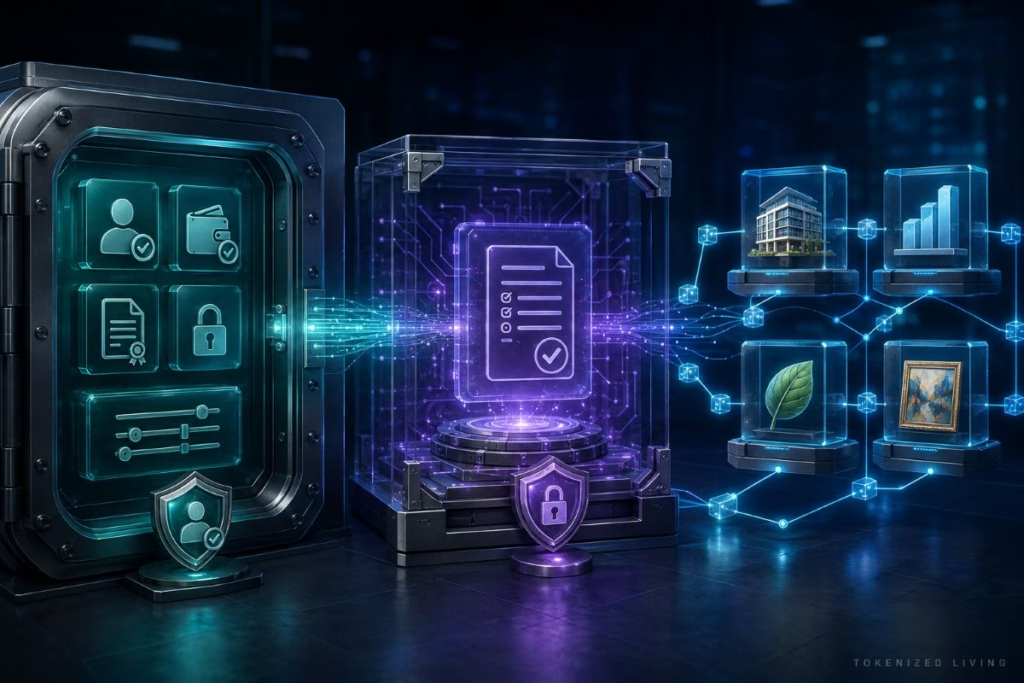
Scintilla describes its system as having a hybrid blockchain architecture.
Private infrastructure can store confidential data concerning investors, whitelisting and asset documentation. Meanwhile, public networks can record token ownership and approved transactions.
This arrangement aims to combine privacy with blockchain transparency.
The platform also advertises configurable asset templates. These templates can help standardise functions such as:
- Transfer restrictions
- Ownership records
- Investor eligibility
- Distribution calculations
- Voting rights
- Token recovery
- Redemption rules
However, a template should never replace asset-specific legal and financial analysis.
The tokenization process described on Scintilla’s website follows five broad stages:
- Proof-of-concept development and design
- Smart-contract creation
- Technology integration
- Testing and performance evaluation
- Full-scale deployment
That represents a reasonable technical workflow. Nevertheless, the company does not publish enough detail to assess typical project duration, completion rates or total costs.
Which Blockchains Does Scintilla Support?
Scintilla has identified four main public networks:
- Ethereum
- Polygon
- Algorand
- Hedera
The company says its hybrid structure can connect these networks with permissioned data storage.
Multi-chain support can help issuers select infrastructure suited to their transaction costs, security and compliance requirements.
However, no blockchain suits every project.
Issuers should confirm:
- Which network supports their required token standard
- How transfer restrictions operate
- Who controls administrative functions
- Whether smart contracts have received an independent audit
- How network upgrades will be handled
- Whether tokens can move between networks
- Which wallets and custodians support the asset
- How transaction fees will be paid
Our comparison of factors involved in choosing a blockchain for tokenization provides a wider framework.
Can Investors Buy Tokenized Real Estate Through Scintilla?
No active property investment appears publicly available at present.
Scintilla lists UAE residential property as a future opportunity. However, it has not published the property address, valuation, ownership entity, expected income or investor terms.
Before considering any future listing, investors should confirm:
- Which legal entity owns the property
- What the token legally represents
- Whether the investor receives rental income
- How expenses are calculated
- Who manages the property
- Whether debt ranks ahead of token holders
- How valuations will be conducted
- Whether tokens can be redeemed
- What happens when the property is sold
- Which investors may participate
- Whether a genuine secondary market exists
A property image and projected return would not provide enough information.
Scintilla’s involvement would also not remove property-level risks such as vacancy, maintenance costs, falling values or developer failure.
Who Will Be Able to Invest?
Scintilla says it intends to serve both institutional and retail customers.
Nevertheless, availability will depend on:
- The investor’s country
- Regulatory classification
- KYC and AML approval
- The individual asset
- Offering restrictions
- Investment minimums
- Wallet and custody requirements
- Sanctions screening
- Source-of-funds checks
A Dubai licence does not automatically allow Scintilla to market every product worldwide.
Specific offerings may also be restricted to professional, sophisticated or accredited investors.
When investments become available, readers should examine each offering document instead of assuming that platform registration guarantees eligibility.
Our guide to buying tokenized assets explains the typical onboarding and due-diligence process.
Scintilla Fees
Scintilla does not publish a standard numerical fee table.
Its fee and charge disclosure says quoted prices may include fixed or percentage-based spreads.
The spread can depend on:
- Market volatility
- Asset liquidity
- Execution risk
- Order size
- Operational costs
Scintilla says the total spread or commission will appear before a transaction is executed.
For OTC transactions and primary token distributions, prices may use direct order matching or volume-weighted average pricing. The parties may also agree on terms before confirming the transaction.
Asset issuers should request a detailed quotation covering:
- Initial assessment
- Legal structuring
- Proof-of-concept development
- Smart-contract creation
- Token deployment
- Compliance reviews
- Investor onboarding
- Custody
- Token distribution
- Exchange listing
- Ongoing administration
- Redemption or disposal
The lack of a public price range makes early comparison difficult.
How Does Scintilla Handle Custody?
Scintilla says it does not self-custody client virtual assets.
Its current disclosure identifies Hex Trust as its virtual-asset custody partner. It also identifies Zand Bank as a banking partner for client fiat reserves.
According to Scintilla:
- Client assets remain separate from company assets
- Virtual assets and fiat balances receive daily reconciliation
- Clients retain beneficial ownership
- Client funds use designated accounts
- Assets should remain outside claims from general creditors
These safeguards are valuable. However, they do not eliminate custody or counterparty risk.
Investors should still request information about:
- Insurance coverage
- Exclusions and compensation limits
- Wallet controls
- Private-key recovery
- Withdrawal procedures
- Custodian insolvency
- Cybersecurity incidents
- Dispute resolution
- Asset recovery after fraud
Scintilla also warns that its products are not covered by a central-bank deposit scheme, compensation scheme or UAE government investor-protection fund.
How Secure Is Scintilla?
Scintilla promotes several security and compliance controls.
These include:
- Wallet whitelisting
- Restricted transfers
- Token-recovery functions
- Daily asset reconciliation
- Regulated third-party custody
- KYC and AML checks
- Transaction monitoring
- Counterparty risk scoring
- Case management for suspicious activity
In 2025, Scintilla announced an integration with Flagright for transaction monitoring and AML case management.
However, the public website does not prominently provide:
- A library of smart-contract audit reports
- A current penetration-testing summary
- A bug-bounty programme
- Detailed security certifications
- A platform incident history
- Independent uptime statistics
That absence does not prove weak security. Still, serious issuers should request this information before signing a contract.
Does Scintilla Guarantee Liquidity?
No.
Scintilla’s marketing repeatedly links tokenization with liquidity and easier exits. Yet its own risk disclosure warns that some virtual assets may have limited or no liquidity.
That warning is more realistic.
A tokenized asset may remain difficult to sell because of:
- Limited investor demand
- Transfer restrictions
- Small offering size
- Infrequent valuations
- Accreditation requirements
- Geographic restrictions
- Long investment periods
- Poor underlying performance
- An inactive or shallow exchange
Furthermore, Scintilla’s exchange has not yet been activated.
Tokenization can improve settlement and transfer processes. It cannot manufacture market demand.
Problems With Scintilla’s Website
Scintilla’s website needs substantial work.
Several pages make the platform appear operational while the formal disclosure says it remains pre-operational.
Other problems include:
- Investment opportunities marked only as “Coming Soon”
- Broken counters showing values such as “0+ asset classes”
- Claims of 24-hour trading despite the inactive exchange
- Unsupported cost-reduction and investor-growth percentages
- Placeholder text on the investment and knowledge-base pages
- Inconsistent licence numbers on older page footers
- No clearly published platform volume
- No public assets-under-management figure
- No completed investment catalogue
- No standard numerical fee schedule
These are not minor cosmetic mistakes.
A company asking institutions and investors to trust it with regulated digital assets needs precise, consistent and current information. Scintilla’s formal disclosures are considerably better than parts of its marketing website.
Until the pages are corrected, users should prioritise the VARA register and Scintilla’s latest regulatory documents.
Scintilla Advantages
- Active VARA licence
- Broker-dealer authorisation
- Future exchange authorisation
- Origins within DLA Piper
- Legal-first approach to tokenization
- Multi-chain architecture
- Support for configurable transfer restrictions
- Institutional and retail ambitions
- Regulated third-party custody arrangements
- Published regulatory and risk disclosures
- Infrastructure covering issuance and potential secondary trading
- Support for different real-world asset classes
Scintilla Disadvantages
- Platform remains pre-operational
- No assets currently offered or brokered
- Exchange services have not been activated
- No verified secondary-market liquidity
- No completed public investment catalogue
- Pricing lacks numerical transparency
- Limited operating statistics
- Website contains placeholder material
- Marketing conflicts with current operational disclosures
- Older pages display inconsistent licence numbers
- Security audit evidence remains limited
- Investment minimums have not been published
- Global investor eligibility remains unclear
- Regulatory approval does not protect investors from losses
Who Should Consider Scintilla?
Scintilla may eventually suit:
- Institutions exploring Dubai-based tokenization
- Asset owners developing regulated digital products
- Real estate companies testing fractional structures
- Fund managers creating tokenized investment vehicles
- Businesses requiring configurable transfer restrictions
- Issuers seeking future primary distribution and exchange access
- Companies comparing multi-chain tokenization infrastructure
It does not currently suit:
- Investors seeking immediately available tokenized property
- Users expecting a functioning public exchange
- People requiring proven secondary liquidity
- Small issuers seeking transparent fixed pricing
- Investors unwilling to complete KYC checks
- Anyone relying on deposit or compensation protection
- Users expecting permissionless DeFi trading
- Investors who cannot tolerate losing their capital
Prospective issuers can contact Scintilla. However, they should request evidence concerning previous deployments, audits, pricing, licensing scope and implementation timelines.
Prospective investors should wait for actual offering documents.
Final Verdict: Is Scintilla Worth Considering?
Scintilla has credible foundations.
TOKO emerged from a global law firm rather than an anonymous blockchain team. The technology addresses real tokenization requirements, including investor permissions, ownership records, distributions and recovery mechanisms.
Moreover, Scintilla holds an active VARA licence covering broker-dealer and exchange activities.
However, its current position remains developmental.
The company’s own August 2026 disclosure says it is pre-operational. No virtual assets are actively offered, quoted or brokered. Its exchange has not been activated, while every public investment opportunity remains marked “Coming Soon.”
Therefore, Scintilla cannot yet be judged as a successful investment marketplace.
It is more accurate to describe it as a regulated tokenization business preparing for commercial operation.
Its next test will not involve obtaining another partnership or publishing another ambitious press release. Scintilla must launch real assets, disclose complete investment terms, activate permitted services and demonstrate genuine trading activity.
Until then, regulatory potential should not be confused with operating proof.
For issuers, Scintilla may deserve a place on a due-diligence shortlist. For investors, there is currently nothing substantial to evaluate beyond future plans.
Readers seeking more established institutional infrastructure can compare it with our Securitize review. Those interested in onchain lending and DeFi integration can also read our Centrifuge review.
Frequently Asked Questions
Is TOKO still operating?
TOKO relaunched as Scintilla following a management buyout in 2024. The TOKO brand should now be treated as the platform’s former name.
Is Scintilla owned by DLA Piper?
No. Scintilla operates as a separate business following the management buyout. DLA Piper retained a minority shareholding and continues supporting the company.
Is Scintilla regulated?
Yes. Scintilla Network FZE holds an active VARA licence for broker-dealer and exchange services. However, Scintilla says it currently operates exclusively under the broker-dealer part of its licence.
Is Scintilla’s exchange active?
No. Scintilla’s August 2026 disclosure says exchange features will be introduced following future activation.
Can I invest through Scintilla now?
No active public investment opportunities were confirmed at the time of this review. The assets shown on Scintilla360 are marked “Coming Soon.”
Can I buy tokenized real estate through Scintilla?
Scintilla plans to support tokenized residential and commercial property. However, no live public property offering currently appears on its website.
Which blockchains does Scintilla support?
Scintilla says its tokenization engine supports Ethereum, Polygon, Algorand and Hedera. Actual network availability may depend on the individual project.
Does Scintilla guarantee liquidity?
No. Even after its exchange becomes operational, liquidity will depend on buyer demand, trading volume and the asset’s transfer restrictions.
Does Scintilla publish its fees?
Scintilla publishes information about its pricing method but no standard numerical tariff. Transaction spreads and commissions should be disclosed before execution.
Who holds client assets?
Scintilla identifies Hex Trust as its virtual-asset custodian and Zand Bank as a banking partner for fiat reserves. Clients should verify the applicable arrangements for each product.
Is Scintilla safe?
Scintilla has regulatory, custody and compliance controls. Nevertheless, virtual assets remain exposed to market, liquidity, cybersecurity, custody and regulatory risks. No platform can eliminate those risks.
Is Scintilla suitable for retail investors?
Not currently. The platform has no confirmed active public offerings. Future retail availability will depend on each product, jurisdiction and investor-eligibility rules.
This article is for educational purposes only. It does not constitute investment, financial, tax or legal advice. Tokenized and virtual assets can result in the loss of some or all invested capital.