

Last updated: September 3, 2026
State Street has moved beyond simply exploring tokenization.
The global custodian launched its Digital Asset Platform in January 2026. It has also introduced a tokenized liquidity fund and a money market fund for stablecoin reserves.
Therefore, State Street’s strategy can no longer be described as choosing tokenization over cryptocurrency custody. The bank is building infrastructure that combines tokenization, custody, wallet management and digital cash.
However, investors should not mistake new infrastructure for unrestricted access. Some services remain subject to regulatory approval, while its flagship onchain fund targets qualified institutional investors.
This article examines what State Street has launched, what remains planned and why the distinction matters.
This article provides general information and does not constitute financial, legal or investment advice.
State Street’s Digital Asset Strategy: The Short Version
State Street is developing institutional infrastructure for tokenized securities, funds and digital cash.
Its strategy now includes:
- A Digital Asset Platform with wallet, custody and cash capabilities.
- Technology supplied through its collaboration with Taurus.
- A live tokenized private liquidity fund called SWEEP.
- A government money market fund designed for stablecoin issuers.
- Planned tokenized fund servicing from Luxembourg.
Nevertheless, these components sit at different stages of development.
| State Street initiative | Status in September 2026 | What it does |
|---|---|---|
| Digital Asset Platform | Launched January 2026 | Supports tokenized products, wallets, custody and digital cash |
| SWEEP tokenized liquidity fund | Launched May 2026 | Provides eligible investors with onchain short-term Treasury exposure |
| Stablecoin Reserves Money Market Fund | Launched June 2026 | Manages eligible reserve assets for stablecoin issuers |
| Tokenized fund servicing in Luxembourg | Planned by the end of 2026 | Would support issuance, administration, custody and transfer agency |
| Broader digital custody services | Dependent on product, asset and jurisdiction | Custodial technology exists, but availability and approvals can differ |
Why State Street’s Scale Matters
State Street is one of the world’s largest asset servicers and custodians.
As of June 30, 2026, the company reported $57.9 trillion in assets under custody and/or administration. It also reported $6.3 trillion in assets under management.
These figures come from State Street’s second-quarter 2026 results.
Assets under custody are not assets owned by State Street. Instead, the bank safeguards, administers or services them for clients.
That distinction is important. State Street’s influence comes from its role within financial infrastructure, not from owning tens of trillions of dollars.
Consequently, its tokenization push could connect blockchain systems with existing fund administration, reporting and custody operations.
How the State Street Digital Asset Platform Works
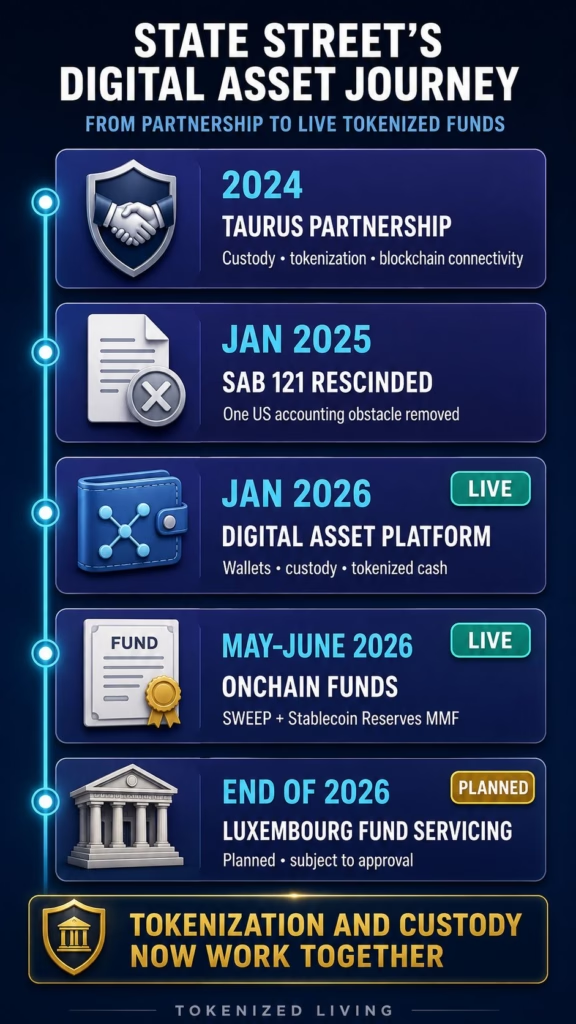
State Street launched its Digital Asset Platform on January 15, 2026.
The company describes the platform as infrastructure connecting traditional and digital finance. It supports product development across private networks and permissioned deployments using public blockchains.
Its main capabilities include:
- Digital wallet management.
- Custodial functions.
- Digital cash support.
- Blockchain connectivity.
- Operational and onchain compliance controls.
- Integration with State Street’s existing systems.
State Street intends to use this foundation for tokenized money market funds, exchange-traded funds and other assets. The platform may also support tokenized deposits and stablecoins.
However, the word “supports” needs careful treatment. A technical capability does not confirm that every product has launched in every market.
Likewise, it does not prove that clients can move every supported asset across unrestricted public wallets.
State Street’s Partnership With Taurus
The platform followed State Street’s 2024 agreement with Swiss digital asset infrastructure company Taurus.
Under the State Street and Taurus agreement, the bank planned to use three main products:
- Taurus-PROTECT for digital asset custody.
- Taurus-CAPITAL for issuing and managing tokenized assets.
- Taurus-EXPLORER for connecting with blockchain networks.
The collaboration covers tokenization, custody and node-management technology. It can therefore support more of an asset’s lifecycle than token issuance alone.
At the time, State Street clearly stated that its digital custody offering remained subject to regulatory approval.
Since then, the Digital Asset Platform has added custodial capabilities. Even so, State Street has not announced universal crypto custody across every market and asset type.
Therefore, investors should check the exact legal entity, jurisdiction and supported asset before assuming custody is available.
What Happened to the SAB 121 Obstacle?
State Street’s earlier position was partly shaped by the SEC’s Staff Accounting Bulletin 121.
SAB 121 directed listed companies safeguarding customers’ crypto assets to recognise a corresponding asset and liability on their balance sheets. Banks argued that this treatment created costly capital and operational consequences.
The SEC later issued Staff Accounting Bulletin 122. It rescinded the earlier guidance from January 30, 2025.
As a result, SAB 121 should no longer be presented as the current reason State Street avoids crypto custody.
Its removal reduced one accounting obstacle. Nevertheless, it did not create automatic approval for every bank, token, jurisdiction or custody model.
Banking regulation, securities law, anti-money-laundering controls and asset-specific requirements still apply.
SWEEP Brings State Street’s Cash Management Onchain
The clearest live example is the State Street Galaxy Onchain Liquidity Sweep Fund.
Known as SWEEP, the product launched in May 2026.
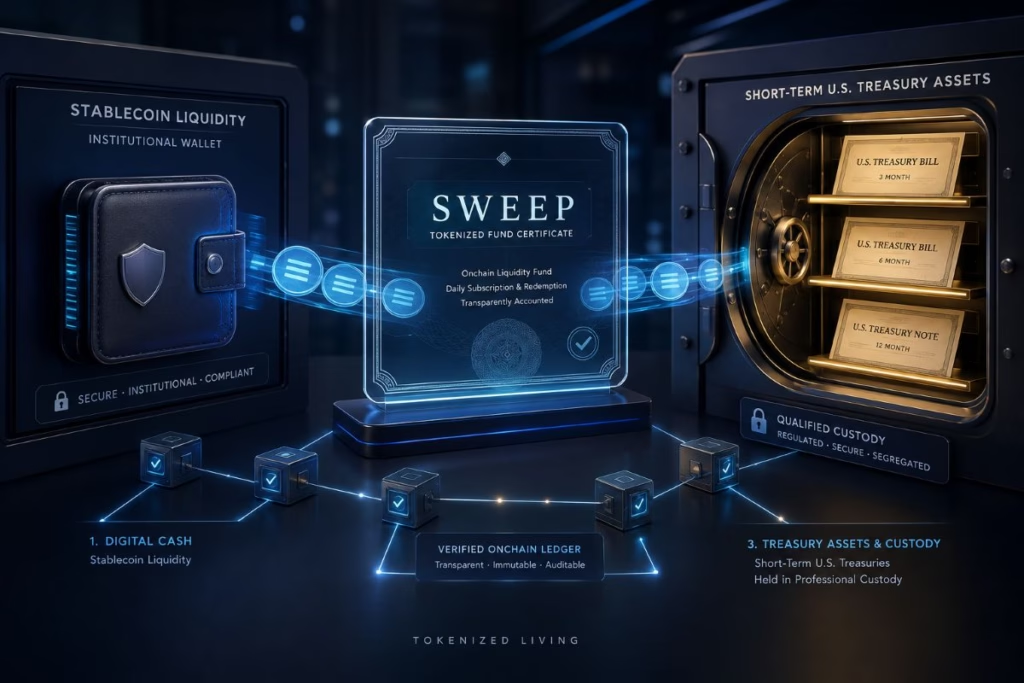
SWEEP is a tokenized private liquidity fund designed for onchain cash management. Its portfolio can include short-term US Treasury instruments, Treasury-backed repurchase agreements, dollar deposits and selected stablecoins.
The fund launched on Solana. Meanwhile, integrations with Stellar and Ethereum were announced as future additions.
Several firms handle separate parts of the structure.
| Participant | Role in SWEEP |
|---|---|
| State Street Investment Management | Investment manager |
| State Street Bank and Trust Company | Custodian for the fund’s securities |
| Galaxy | Tokenization and digital infrastructure |
| Anchorage Digital | Custodian for stablecoin holdings |
| NAV Consulting | Transfer agent |
| Chainlink | Onchain NAV data and cross-chain infrastructure |
| Solana | Initial blockchain network |
This division of responsibility shows why a tokenized fund is more than a smart contract.
Portfolio management, custody, investor records, compliance and blockchain infrastructure remain separate functions. Tokenization connects them but does not eliminate them.
Can Anyone Invest in SWEEP?
No. SWEEP is not a retail investment product.
State Street says the fund is available to Qualified Purchasers who satisfy its eligibility rules and minimum investment requirements.
Eligible participants can use PayPal USD for subscriptions and redemptions, subject to stablecoin availability within the portfolio. The fund targets continuous onchain cash management rather than ordinary retail trading.
Moreover, SWEEP is not itself a stablecoin. Its token represents an interest in a private investment fund.
That interest carries fund-specific rights, restrictions, fees and investment risks. Holding its token is not the same as holding cash in a protected bank account.
SWEEP resembles other institutional tokenized cash products, including BlackRock’s BUIDL fund. Both connect traditional short-term assets with blockchain-based issuance and settlement.
However, neither product makes government securities permissionless or universally accessible.
How Ondo Finance Fits Into the SWEEP Launch
State Street announced SWEEP in December 2025 alongside Galaxy Digital and Ondo Finance.
At that stage, Ondo Finance was expected to provide approximately $200 million through its OUSG tokenized Treasury fund. The proposed allocation would make SWEEP one of the reserve assets supporting OUSG.
The May 2026 launch announcement confirmed that SWEEP had entered the market. However, it did not restate that the full proposed $200 million investment had completed.
Therefore, the earlier commitment should not be treated as a confirmed final allocation without later evidence.
This relationship still illustrates an important trend. Tokenized funds can hold interests in other regulated funds, creating connected layers of issuers, custodians and blockchain infrastructure.
Such structures may improve operational flexibility. Conversely, they can introduce additional counterparties and dependencies that investors must understand.
State Street’s Stablecoin Reserves Money Market Fund
The company expanded its digital cash strategy again in June 2026.
State Street Investment Management launched the State Street Stablecoin Reserves Money Market Fund.
This registered government money market fund targets stablecoin issuers. It aims to hold reserve assets that align with requirements under the US GENIUS Act.
The product is not a new State Street stablecoin. Instead, it provides an investment vehicle for companies that need to manage assets backing their own stablecoins.
Therefore, the reserve fund and SWEEP serve different purposes.
| Product | Primary purpose | Intended users |
|---|---|---|
| SWEEP | Onchain liquidity and short-term Treasury exposure | Qualified Purchasers |
| Stablecoin Reserves Money Market Fund | Management of eligible stablecoin reserve assets | Stablecoin issuers and institutions |
Together, the products connect traditional money market management with blockchain-based financial activity.
Tokenized Fund Servicing From Luxembourg
State Street’s European plans focus on fund infrastructure rather than retail cryptocurrency trading.
In April 2026, the company announced plans to provide tokenized fund servicing from Luxembourg by the end of the year.
The proposed service would cover:
- Tokenized fund issuance.
- Fund administration.
- Custody.
- Transfer agency.
- Connections between traditional and digitally native fund structures.
State Street Investment Management expects to become an early user. Luxembourg was chosen because of its large fund industry and legal framework for digital securities.
However, this service was still planned at the time of writing. Delivery remains subject to regulatory approval and operational readiness.
It should not yet be described as a completed European launch.
Our wider analysis of the European tokenization market explains why regulated fund centres have become central to institutional adoption.
Does State Street Now Offer Cryptocurrency Custody?
The answer requires more precision than a simple yes or no.
State Street’s Digital Asset Platform includes custodial capabilities. Its Taurus relationship also provides technology designed for digital asset custody.
Furthermore, State Street Bank acts as custodian for the traditional securities inside SWEEP.
However, those facts do not confirm that State Street offers unrestricted custody for Bitcoin, Ether or every other crypto asset. Product availability can depend on the client, asset, jurisdiction and regulatory approval.
The custody of a fund’s Treasury securities also differs from safeguarding its stablecoins or blockchain tokens. SWEEP demonstrates this separation because Anchorage Digital holds the stablecoin assets.
Consequently, claims that State Street has either “rejected crypto custody” or “fully entered crypto custody” would both oversimplify its position.
What State Street’s Tokenization Strategy Can Achieve
State Street’s model could improve several institutional workflows.
Faster settlement and longer operating hours
Tokenized assets can move outside conventional market hours. In addition, digital cash may support quicker subscriptions, redemptions and collateral transfers.
However, 24/7 technical transfers do not guarantee continuous redemption liquidity. SWEEP’s stablecoin access depends on available stablecoins in the portfolio.
Better collateral mobility
Institutions may use eligible tokenized fund interests within trading, lending or collateral arrangements.
This can reduce idle cash and operational delays. Nevertheless, each venue must accept the asset and enforce its own risk controls.
Connected fund administration
State Street can combine blockchain records with custody, accounting and transfer-agency systems.
That combination matters because regulated funds require more than token issuance. They still need accurate ownership records, valuations, investor checks and correction procedures.
Broader institutional distribution
Digital infrastructure may eventually help asset managers reach more eligible investors across multiple networks.
Yet distribution restrictions remain. Wallet access does not override securities law or investor-qualification requirements.
The Risks and Limitations
State Street’s involvement adds institutional weight, but it does not remove the underlying risks.
Tokenization does not guarantee liquidity
A token may transfer quickly while the owner still struggles to find a buyer.
Our guide to tokenized asset secondary markets explains why technical transferability and market liquidity are different.
Several counterparties remain involved
SWEEP relies on State Street, Galaxy, Anchorage, NAV Consulting, Chainlink, stablecoin providers and blockchain infrastructure.
Therefore, investors face operational dependencies beyond the performance of the Treasury portfolio.
Smart contracts and blockchain networks create additional risks
Code errors, network outages, oracle failures and interoperability problems can disrupt access or reporting.
Traditional controls may reduce these risks. Still, they cannot remove them completely.
Regulatory treatment can differ
A tokenized fund interest remains a regulated financial product. Its blockchain format does not erase securities, custody, tax or anti-money-laundering rules.
Likewise, a tokenized bank deposit has a different legal structure from a stablecoin or tokenized fund share.
Retail access remains limited
State Street’s most important onchain product currently targets Qualified Purchasers.
Therefore, its progress demonstrates institutional adoption more clearly than financial democratisation.
Why State Street’s Digital Asset Platform Matters
State Street’s progress matters because the company already operates deep inside traditional fund infrastructure.
The Digital Asset Platform can connect tokenized products with existing custody, administration and compliance processes. Meanwhile, SWEEP shows that the strategy has produced a live blockchain-based fund.
This is stronger evidence than another pilot announcement.
Nevertheless, the transformation remains incomplete. European tokenized fund servicing is still planned, broader custody availability remains jurisdiction-specific and most products target institutions.
The real story is not that State Street chose tokenization over custody. Instead, it is building a controlled environment where both functions support institutional digital assets.
Final Verdict
State Street has progressed from partnership announcements to operating digital asset products.
Its Digital Asset Platform launched in January 2026. SWEEP then brought a private liquidity fund onto Solana, while the stablecoin reserve fund extended State Street’s role into digital cash infrastructure.
These developments make State Street one of the most credible traditional-finance participants in institutional tokenization.
However, the strategy should not be exaggerated. Retail investors cannot freely access SWEEP, tokenization does not guarantee liquidity and several services remain dependent on approvals or future delivery.
State Street’s advantage lies in combining blockchain technology with custody, fund administration and investment management. That approach may prove more important than issuing tokens alone.
Frequently Asked Questions
What is the State Street Digital Asset Platform?
It is institutional infrastructure supporting tokenized products, digital wallets, custodial functions and digital cash. State Street launched the platform in January 2026.
Is State Street focusing on tokenization instead of crypto custody?
No longer. Its platform includes both tokenization and custodial capabilities. However, the availability of specific custody services depends on the asset, client, jurisdiction and regulatory position.
What is the State Street SWEEP fund?
SWEEP is a tokenized private liquidity fund managed by State Street Investment Management and built with Galaxy’s digital infrastructure. It launched on Solana in May 2026.
Can retail investors buy SWEEP?
No. State Street limits the fund to Qualified Purchasers who meet its eligibility and minimum-investment requirements.
Is SWEEP a stablecoin?
No. SWEEP represents an interest in a private investment fund. The fund can use selected stablecoins for subscriptions, redemptions and liquidity management.
Has State Street launched tokenized fund servicing in Luxembourg?
Not yet. State Street plans to deliver the service by the end of 2026. The launch remains subject to regulatory approval and operational readiness.