

Updated: September 7, 2026
How large is the real estate tokenization market?
The honest answer depends on what you count.
One dashboard records hundreds of millions of dollars in tracked tokenized property. Meanwhile, one major forecast starts near $300 billion.
Deloitte expects the market to reach $4 trillion by 2035. Other commercial reports produce much smaller or larger numbers.
These figures cannot all describe the same market.
Some measure tokens that investors can hold in external wallets. Others include private funds, property loans and blockchain-based records inside controlled systems.
A few reports measure revenue earned by tokenization companies rather than the value of tokenized property.
Therefore, the headline number means little without its definition.
This article compares the strongest available figures and explains what they actually measure.
Market data checked on September 7, 2026.
TL;DR
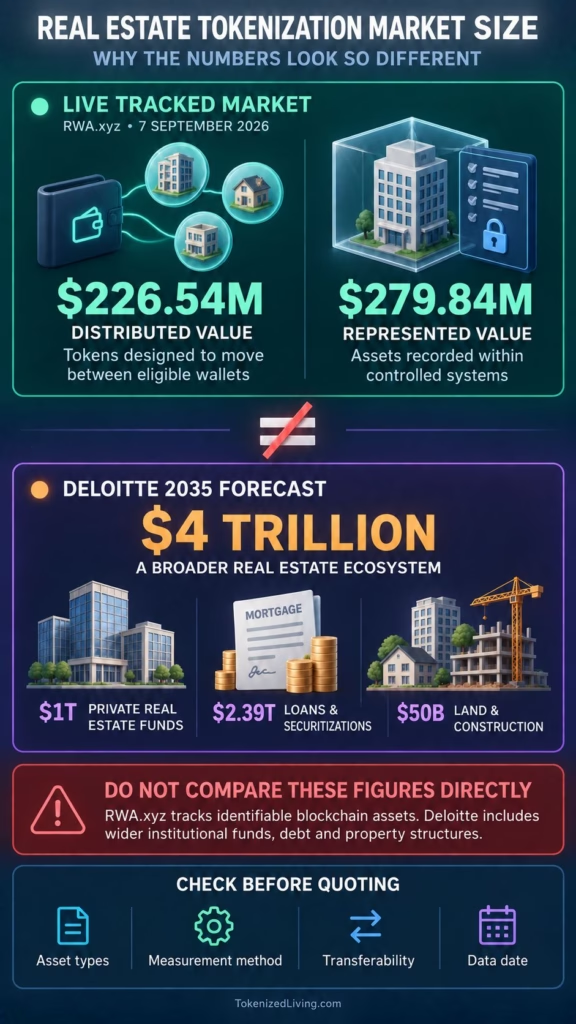
- RWA.xyz recorded $226.54 million in distributed tokenized real estate on September 7, 2026.
- It separately recorded $279.84 million in represented real estate value.
- Distributed assets can move between eligible wallets. Represented assets remain within controlled systems.
- These figures cover assets tracked by RWA.xyz, not every private transaction worldwide.
- Deloitte forecasts $4 trillion in tokenized real estate by 2035.
- However, Deloitte includes funds, loans, securitizations and development projects.
- Its forecast does not mean $4 trillion of individual buildings will trade freely on public blockchains.
- Tokenized debt and property funds may scale faster than single-building ownership tokens.
- Market-size claims remain useless unless the source defines the asset, token structure and measurement method.
Bottom line: The visible tokenized property market remains small. The trillion-dollar opportunity depends mainly on institutional funds, debt and financial infrastructure.
What Does “Real Estate Tokenization Market Size” Mean?
There is no single tokenized real estate market.
The term covers several completely different structures:
- Shares in a company that owns a building
- Units in a private real estate fund
- Loans secured against property
- Mortgage-backed or real estate-backed securities
- Rights to rental income or development profits
- Beneficial interests held through a trust
- Property records represented on a controlled blockchain
- Direct ownership interests recorded through a recognized land system
These structures do not give investors identical rights.
A property-backed loan remains debt. A fund token represents a fund interest rather than direct ownership of every building.
Likewise, a token connected to rental income may provide no claim on the property title.
Our complete guide to tokenized real estate explains these ownership structures in more detail.
Market researchers also use different financial measures.
Some calculate the market value of transferable tokens. Others count the underlying property value or the face value of property loans.
Another report may estimate software and service revenue earned by tokenization providers.
Comparing those figures directly creates nonsense.
How Large Is the Tracked Market in 2026?
The RWA.xyz real estate dashboard provides one of the clearest public snapshots.
On September 7, 2026, it displayed:
| Metric | Reported value | What it indicates |
|---|---|---|
| Distributed real estate value | $226.54 million | Assets designed to move between eligible external wallets |
| Represented real estate value | $279.84 million | Assets using blockchain within a controlled platform or system |
| Holders | 3,031 | Recorded holders across the dashboard’s covered distributed assets |
| Monthly active addresses | 143 | Wallets interacting during the measured monthly period |
These figures provide evidence of a live market. However, they also show how early that market remains.
For comparison, RWA.xyz recorded about $39.18 billion across all distributed real-world assets on the same date.
Therefore, tracked distributed real estate represented well below 1% of that broader total.
Treasuries and private credit currently have much larger visible onchain markets. Those assets offer standardized terms, familiar valuations and clearer redemption processes.
Property is harder.
Every building has a location, title, tenants, expenses and local legal framework. Consequently, tokenizing real estate requires more than creating a smart contract.
Our analysis of global tokenized real estate trends explains why regional adoption follows different legal and operational paths.
What the RWA.xyz Figures Do Not Prove
RWA.xyz does not claim to capture every tokenized property transaction worldwide.
Private funds may use closed systems and disclose limited information. Banks can also tokenize property-linked assets on private networks.
Meanwhile, some platforms publish the original property value rather than the current token value. Others report total transaction volume or capital raised.
The figures should therefore be treated as a tracked market snapshot.
They should not be presented as a complete global census.
Distributed Versus Represented Real Estate
This distinction explains much of the confusion.
Distributed Assets
A distributed tokenized asset can move outside its original platform. Investors may transfer it between eligible wallets or approved venues.
However, “distributed” does not mean unrestricted.
Securities rules, wallet allowlists and investor eligibility checks may still limit transfers. Secondary trading may also remain thin.
Represented Assets
A represented asset uses blockchain as a record or operational layer. Nevertheless, the token stays within an issuer-controlled platform or system.
This structure can still improve administration, reporting and settlement.
It offers less open onchain utility because investors cannot freely withdraw or transfer the asset.
Neither model is automatically better.
Institutional funds may prefer controlled systems because they simplify compliance. Retail investors may value external wallet access.
In both cases, the legal documents determine the holder’s rights.
Deloitte’s $4 Trillion Forecast Explained
Deloitte published the most useful property-specific forecast in April 2025.
Its tokenized real estate analysis predicts growth from less than $300 billion in 2024 to $4 trillion by 2035.
That represents an estimated compound annual growth rate of 27%.
The headline sounds enormous. Yet the underlying categories matter more.
Deloitte expects three areas to drive much of the expansion:
| Category | Deloitte’s 2035 estimate | What it represents |
|---|---|---|
| Tokenized private real estate funds | $1 trillion | Digital fund interests linked to property portfolios |
| Loans and securitizations | $2.39 trillion | Tokenized debt and securities backed by property-related cash flows |
| Undeveloped land and construction projects | $50 billion | Financing or ownership structures connected to development assets |
Loans and securitizations form the largest category.
Therefore, the forecast does not mainly describe investors buying $50 pieces of rental homes.
It describes financial institutions placing property funds, credit and securitized assets onto digital infrastructure.
That difference completely changes the story.
The forecast may still prove too optimistic. Regulation, interoperability, custody and settlement systems must all develop quickly.
Nevertheless, Deloitte provides a clear methodology and identifies the assets behind its estimate.
That makes the forecast more useful than an unsupported “market will explode” headline.
For the wider asset-class picture, our RWA market forecast comparison examines estimates from McKinsey, Citi, Ripple and BCG.
Why Does Deloitte Start Near $300 Billion?
Deloitte’s broad 2024 baseline looks far larger than RWA.xyz’s current public onchain figure.
This does not show that tokenized real estate collapsed.
Instead, the two sources use different scopes.
Deloitte considers a wider tokenized real estate ecosystem. That scope includes private funds, loans and securitizations which may use closed infrastructure.
RWA.xyz tracks identifiable assets using its distributed and represented framework. Its real estate dashboard covers a narrower visible market.
The comparison teaches an important lesson.
Always read the methodology before quoting the number.
Why Do Commercial Market Reports Produce Different Numbers?
Commercial research companies often publish forecasts ranging from a few billion dollars to several trillion.
Those differences rarely reflect genuine disagreement about one clearly defined market.
Instead, the reports may measure:
- Tokenization software revenue
- Platform and advisory service revenue
- Value of issued property tokens
- Value of underlying buildings
- Capital raised through tokenized offerings
- Property funds using blockchain records
- Loans and securitizations linked to real estate
- Forecast transaction volume
A market worth $4 billion in annual platform revenue could support hundreds of billions in underlying assets.
Both figures might be technically correct. Yet placing them in one comparison table would mislead readers.
Opaque reports also create another problem. Their public summaries often provide regional percentages without showing the underlying dataset.
The old version of this article claimed the US held 60% of the market. It assigned 25% to Europe and 10% to Asia.
No reliable methodology supported those percentages. Therefore, they have been removed.
Which Real Estate Structures Could Scale Fastest?
Property-Backed Debt
Debt has standardized terms such as principal, interest and maturity dates.
Investors can evaluate repayment obligations without managing the property directly. Institutions also understand loans and securitizations already.
For these reasons, tokenized property debt may scale faster than direct fractional ownership.
Private Real Estate Funds
Funds pool multiple properties inside one managed structure.
Tokenization can support subscriptions, capital calls, distributions and investor records. It may also help funds connect with approved digital marketplaces.
Our article on institutional adoption of tokenized real estate examines why fund units are gaining attention.
Development and Construction Finance
Property developers constantly need capital. Tokenization can create another route for distributing debt or equity interests.
However, development projects carry completion, planning, contractor and financing risks.
A token does not make an unfinished building safer.
Single-Property Investments
Retail platforms often divide one rental property into small investment interests.
This model is easy to understand. It also allows investors to select individual buildings.
Still, scaling remains difficult. Each property needs separate legal work, management, valuation and investor reporting.
One empty building can also damage returns dramatically.
Direct Onchain Property Titles
Putting legally recognized property ownership directly onchain attracts strong headlines.
In practice, land law remains local. Government registries, courts and conveyancing systems must recognize the digital record.
Most current investment tokens therefore represent company shares, debt, fund units or contractual rights instead.

What Is Driving Market Growth?
Several real developments support long-term growth.
First, asset managers want more efficient fund administration. Blockchain systems can simplify investor records and certain distribution processes.
Second, fractionalization can reduce investment minimums. Smaller units may widen access where regulations permit.
Third, digital settlement can shorten some transaction processes. It can also connect assets with tokenized cash or regulated stablecoins.
Moreover, institutions are testing tokenized collateral, funds and securities. Property-linked products can use the same infrastructure.
Finally, clearer legal frameworks are emerging in several markets. Yet progress remains fragmented rather than globally consistent.
These trends support growth. They do not prove Deloitte’s forecast will happen.
What Could Prevent the Market Reaching Trillions?
Weak Legal Connections
A blockchain token does not automatically create an enforceable property interest.
Investors need clear rights against the issuer, fund, trust or property-holding company.
Poor Liquidity
Real estate remains difficult to sell and value. Dividing it into tokens does not create willing buyers.
Our guide to tokenized secondary markets explains why technical transferability and liquidity differ.
Fragmented Regulation
Property law and securities law vary by country. Cross-border offerings can trigger several regulatory systems at once.
Incompatible Infrastructure
Different platforms use different blockchains, identity systems, custodians and token standards.
Assets cannot move efficiently when those systems cannot communicate.
Platform Failure
Investors may depend on one platform for documents, distributions, trading and wallet access.
If that company fails, recovering or transferring the investment can become difficult.
Weak Property Economics
Tokenization cannot repair poor occupancy, excessive debt or bad management.
The building still determines much of the investment’s value.
Our guide to the benefits and risks of tokenized real estate examines these investor-level dangers.
How to Judge a Market-Size Claim
Before repeating a tokenized real estate statistic, ask:
- What asset types does the figure include?
- Does it measure tokens, underlying assets, revenue or transaction volume?
- Are the assets transferable outside the issuing platform?
- Does the total include loans loans, funds and securitizations?
- Are stablecoins or other RWAs included?
- Does the report provide a methodology?
- Is the number current data or a future forecast?
- Which year does the forecast target?
- Does the source benefit commercially from a larger prediction?
- Can an independent reader verify the underlying data?
If the report does not answer these questions, its headline figure has little value.
What the Market Size Means for Investors
A growing market can improve product choice, regulation and infrastructure.
However, it says nothing about the quality of one investment.
An investor still needs to examine:
- The property and its valuation
- Debt secured against the asset
- The issuer and legal entity
- Tokenholder rights
- Management and platform fees
- Rental income or repayment terms
- Investor eligibility
- Custody and wallet arrangements
- Secondary-market activity
- Redemption and exit procedures
- Tax treatment
- Platform failure plans
Readers preparing to invest should follow our step-by-step tokenized asset buying guide.
A trillion-dollar forecast cannot make a weak property, unclear contract or illiquid token attractive.
Verdict: A Small Visible Market With a Large Institutional Forecast
The visible onchain real estate market remains small in September 2026.
RWA.xyz tracks hundreds of millions rather than hundreds of billions in distributed and represented property assets.
Deloitte’s $4 trillion forecast uses a much wider definition. Most projected value comes from institutional funds, loans and securitizations.
Therefore, both observations can be true.
Real estate tokenization could become an important financial market. Yet it is not currently a vast global exchange for fractional buildings.
The most credible growth path looks less dramatic than the old marketing suggested.
Property funds may adopt blockchain-based administration. Lenders may tokenize loans and securitized products.
Meanwhile, regulated marketplaces may improve access and settlement for approved investors.
Single-property tokens will continue developing. However, they may remain a smaller and less liquid part of the market.
The sector has real potential. It also has a measurement problem.
Anyone quoting a market-size figure should define the market first.
Frequently Asked Questions
How Large Is the Real Estate Tokenization Market in 2026?
RWA.xyz recorded $226.54 million in distributed value and $279.84 million in represented value on September 7, 2026. These figures cover assets tracked by its real estate dashboard rather than every private tokenization project.
Will Tokenized Real Estate Reach $4 Trillion?
Deloitte forecasts $4 trillion by 2035. However, this remains a scenario rather than a guarantee. The estimate includes funds, loans, securitizations and development-related structures.
Why Do Some Reports Say the Market Is Already Worth Hundreds of Billions?
They may count the underlying value of private funds, loans or properties using controlled blockchain systems. Other sources only count transferable tokens visible on public networks.
Does the Market-Size Figure Measure Property Tokens?
Sometimes. It can also measure real estate funds, property debt, securitizations, service revenue or blockchain-recorded assets. Always check the report’s methodology.
Which Tokenized Real Estate Category Could Grow Fastest?
Deloitte expects loans and securitizations to form the largest category by 2035. Private real estate funds also represent a substantial projected opportunity.
Does Tokenization Guarantee Property Liquidity?
No. A token may transfer quickly, but selling still requires an eligible buyer. Thin markets can produce long waits and poor prices.
Do Real Estate Tokens Provide Direct Property Ownership?
Not necessarily. Tokens may represent company shares, fund units, debt, beneficial interests or contractual rights. The legal documents determine ownership.
Should Investors Choose a Platform Because the Market Is Growing?
No. Market growth does not prove that a platform or property is safe. Investors must evaluate the asset, legal structure, fees and exit options separately.
Disclaimer: This article provides general educational information. It does not provide financial, legal, investment or tax advice. Market values and forecasts can change. Verify current information before making a decision.