

Updated 26th August 2026.
The tokenized real-world assets market could reach several trillion dollars by 2030.
At first, that sounds like a bold prediction. In fact, several major financial firms now support it.
However, they do not agree on the number. They are not always measuring the same market either.
McKinsey has estimated a base case of about $2 trillion by 2030. Citi now forecasts $5.5 trillion. Meanwhile, Ripple and Boston Consulting Group place the figure at $9.4 trillion.
Still, those forecasts cannot all be treated as one shared target.
For example, some exclude stablecoins. Others use broader definitions of tokenized assets. A few include assets recorded on blockchain systems but locked inside controlled platforms. The starting values also differ dramatically.
Therefore, the serious question is not simply whether real-world asset tokenization will reach trillions.
It is this:
What exactly is being counted, and what must happen for those forecasts to become reality?
As a result, this article compares the leading estimates, examines where genuine growth is occurring and separates measurable adoption from market hype.
Market data checked on August 26, 2026.
TL;DR: Can Tokenized RWAs Reach Trillions?
- A multitrillion-dollar market by 2030 is possible, but it is not guaranteed.
- McKinsey forecasts about $2 trillion in its base case. Citi projects $5.5 trillion, while Ripple and BCG estimate $9.4 trillion.
- The forecasts differ because they count different assets and use different definitions.
- RWA.xyz currently records about $38.3 billion of distributed tokenized assets and $353.1 billion of represented assets. It lists stablecoins separately.
- Tokenized Treasuries, money market funds, credit and public securities currently have clearer routes to scale than fractional property or collectibles.
- A crypto project described as an “RWA token” may not give holders any rights to real-world assets.
- Legal enforceability, trusted settlement money, market liquidity and compatible infrastructure will decide whether adoption reaches the predicted scale.
The bottom line: The trillion-dollar forecasts are plausible market scenarios, not proof that every RWA project—or any particular token—will succeed.
How Large Is the Tokenized RWA Market in 2026?
However, there is no single, universally accepted number.
As of August 26, 2026, RWA.xyz displayed approximately:
- $38.3 billion in distributed asset value
- $353.1 billion in represented asset value
- 2.9 million distributed-asset holders
RWA.xyz also reported roughly $302.7 billion in stablecoin value as a separate category.
Therefore, these figures need context.
RWA.xyz classifies an asset as distributed when investors can move it outside the issuing platform and transfer it between eligible wallets. Whitelists and compliance controls may still apply.
In contrast, represented assets use blockchain for recordkeeping or operational efficiency but cannot move freely outside the issuer’s platform.
That difference matters.
For example, a transferable tokenized Treasury fund and a mortgage recorded on a closed blockchain system both involve tokenization. However, they do not offer the same access, liquidity or on-chain utility.
Meanwhile, Citi’s 2026 report uses a different framework and places the present tokenized financial-asset market at about $17 billion. That does not necessarily conflict with RWA.xyz. Instead, it shows how much the answer changes when analysts alter the definition.
For anyone new to the subject, our beginner’s guide to RWA tokenization explains how physical and financial assets connect with blockchain-based tokens.
Major Tokenized Real-World Asset Forecasts Compared
Of course, the market has no shortage of enormous predictions. Yet the assumptions behind them matter more than the headlines.
| Research organization | Target year | Main forecast | Important scope detail |
|---|---|---|---|
| McKinsey | 2030 | About $2 trillion base case | Excludes cryptocurrencies and stablecoins; range of roughly $1 trillion to $4 trillion |
| Citi | 2030 | $5.5 trillion base case | Bear case of $2.7 trillion and bull case of $8.2 trillion; led by public securities and liquid collateral |
| Ripple and BCG | 2030 and 2033 | $9.4 trillion by 2030; $18.9 trillion by 2033 | Uses a broader tokenized-asset market and starts from an estimated $0.6 trillion |
| Deloitte | 2035 | $4 trillion | Covers tokenized commercial real estate, including funds, loans, securitizations and development projects |
Overall, these estimates point in the same direction: substantial growth.
Nevertheless, they do not describe one identical pool of assets.
McKinsey: Approximately $2 Trillion by 2030
McKinsey’s analysis offers the most conservative major forecast in this comparison.
Specifically, its base case places tokenized market capitalization at roughly $2 trillion by 2030. The pessimistic scenario sits near $1 trillion, while the optimistic case reaches approximately $4 trillion.
Importantly, McKinsey excludes cryptocurrencies and stablecoins. It expects early growth to come mainly from:
- mutual funds
- bonds and exchange-traded notes
- loans and securitization
- alternative investment funds
McKinsey also warns that adoption will arrive in waves. Assets with a clear financial benefit and manageable regulatory structure should move first. More complex markets may take longer.
Citi: $5.5 Trillion in the Base Case
Citi’s June 2026 Tokenization 2030 report is more bullish.
It forecasts:
- $2.7 trillion in a bear case
- $5.5 trillion in its base case
- $8.2 trillion in a bull case
Citi expects public-market securities and liquid collateral to lead adoption. U.S. equities and Treasuries could play a larger role than private assets because their legal structures, pricing and existing markets are easier to scale.
The report also identifies tokenized cash as essential infrastructure. Securities cannot settle efficiently on-chain without a trusted digital payment leg. Therefore, regulated stablecoins and tokenized bank deposits may support growth even when analysts count them separately from the assets being traded.
Ripple and BCG: $18.9 Trillion by 2033
Ripple and Boston Consulting Group produced the highest mainstream forecast in this comparison.
Their 2025 report projects the market rising from $0.6 trillion to:
- $9.4 trillion by 2030
- $18.9 trillion by 2033
Next, the forecast assumes three broad stages.
First, institutions tokenize familiar products such as bonds and money market funds. Next, adoption moves into private credit and real estate. Finally, tokenization becomes part of ordinary financial infrastructure.
That path is possible. Still, Ripple operates in the digital-asset industry and benefits from wider tokenization adoption. Readers should treat the report as a serious industry forecast, not a neutral guarantee.
Deloitte: $4 Trillion in Tokenized Real Estate by 2035
Deloitte predicts that tokenized commercial real estate could grow from less than $0.3 trillion in 2024 to $4 trillion by 2035.
However, that does not mean investors will trade $4 trillion of individual houses as freely as cryptocurrencies.
Deloitte’s definition includes:
- tokenized private real estate funds
- real estate loans and securitizations
- undeveloped land and construction projects
Notably, loans and securitizations represent the largest part of its projection. Therefore, the forecast is more institutional than the phrase “fractional property ownership” suggests.
Our guide to institutional adoption of tokenized real estate explains why regulated funds, debt and market infrastructure are gaining more traction than tiny pieces of individual buildings.
Our real estate tokenization market-size analysis examines Deloitte’s forecast in detail and explains why its scope differs from public blockchain dashboards.
Why Do the Market Forecasts Differ So Much?
Clearly, a range from $2 trillion to $9.4 trillion is not a minor disagreement.
Several measurement problems create that gap.
Different Reports Count Different Assets
“Tokenized assets” can include government bonds, fund shares, corporate credit, property interests, commodities, equities and other securities.
Some analysts also include tokenized deposits or stablecoins. Others exclude them to prevent double counting.
As a result, two firms can study the same trend and produce very different totals.
Recorded Value Is Not the Same as Tradable Value
For instance, a financial institution may use blockchain as its official ownership record while keeping the asset inside a controlled system.
That arrangement could improve reconciliation and settlement. Yet investors may not be able to withdraw the token, trade it on an external market or use it elsewhere.
Counting that asset is reasonable when measuring blockchain adoption. It is less useful when measuring openly transferable investment products.
Market Capitalization and Underlying Asset Value Can Diverge
Likewise, some forecasts measure the value of issued tokens. Others examine the underlying assets connected with blockchain infrastructure.
Those figures are not interchangeable.
For example, a platform might record a large loan portfolio on-chain while only a small portion circulates among external investors. Quoting the entire loan book as a liquid tokenized market would exaggerate what users can actually buy or sell.
Forecasts Depend on Aggressive Adoption Assumptions
Above all, moving from billions to trillions requires exceptional growth.
Analysts must estimate how quickly regulations, custody, investor demand, settlement systems and secondary markets will develop. Small changes to those assumptions can add or remove trillions from a long-range prediction.
Therefore, forecast ranges deserve more attention than the biggest number in the press release.
Which Tokenized Assets Are Most Likely to Drive Growth?
Initially, the tokenization story focused heavily on fractional real estate, art and luxury goods.
Those markets still matter. Nevertheless, today’s strongest momentum sits closer to traditional finance.
Tokenized Treasuries and Money Market Funds
Treasury-backed products solve a clear problem. They allow eligible on-chain investors and institutions to hold yield-bearing assets without moving entirely back into traditional accounts.
Pricing is transparent. The underlying market is deep. Moreover, investors already understand the asset.
BlackRock’s BUIDL fund provides the clearest example. By August 2026, it had grown to approximately $2.7 billion in assets and expanded across several blockchain networks. Our BlackRock BUIDL guide explains what its tokens represent and why ordinary retail investors cannot simply buy them like cryptocurrency.
Public Securities and Collateral
Citi expects public equities and Treasuries to lead the next stage. Existing market infrastructure companies are moving in the same direction.
In 2026, the Depository Trust & Clearing Corporation published research on using tokenized collateral to reduce funding costs and free capital. Later, about 40 firms joined DTCC’s live production transactions using tokenized DTC-custodied assets ahead of the planned October 2026 launch of its Tokenization Service.
This use case is less glamorous than selling $50 pieces of a luxury apartment.
It may also be far more important.
Large financial institutions care about moving collateral quickly, settling transactions safely and reducing money trapped in slow processes. If tokenization provides measurable savings, adoption has a commercial reason to continue.
Credit and Securitization
Loans are another major opportunity.
Blockchain can support issuance, servicing data, payment records and the packaging of loans into investment products. However, it cannot remove borrower default risk.
Private credit also creates difficult questions around valuation, transparency and enforcement. Investors still depend on originators, servicers, legal agreements and recovery processes.
Therefore, credit may become a large tokenized market without becoming a simple or low-risk investment.
Tokenized Commodities
Gold-backed tokens have already shown that a physical asset can gain useful digital distribution.
Products such as PAXG and XAUT let investors hold fractional exposure linked to vaulted gold. Even so, blockchain data cannot independently prove that the metal exists. Custody, audits, redemption terms and issuer reliability remain essential.
Our guide to PAXG, XAUT and gold-backed tokens examines those differences.
Tokenized Real Estate
Real estate has enormous theoretical potential because the underlying market is vast and notoriously difficult to divide or trade.
Yet property is also one of the hardest assets to scale.
Every building sits inside a local legal system. Titles, taxes, tenants, maintenance, valuations and lending rules remain off-chain. In many offerings, the token represents an interest in a company or contract rather than the property deed.
Consequently, institutional real estate funds and property-backed debt may scale faster than retail marketplaces selling fractions of individual homes.
Readers considering this area should start with our complete guide to tokenized real estate and review the benefits and risks of tokenized property.
An “RWA Token” May Not Represent a Real-World Asset
Unfortunately, this distinction gets mangled across crypto media.
A genuinely tokenized asset gives its holder defined rights or exposure linked to an underlying asset. That could be a fund share, debt claim, company interest, redemption right or ownership record.
By contrast, many cryptocurrencies labelled “RWA tokens” are governance or utility tokens for tokenization protocols.
Buying one may give you:
- voting rights inside a protocol
- fee discounts
- staking incentives
- access to platform services
- exposure to demand for the project’s cryptocurrency
It may give you no legal claim on any property, Treasury bill, loan or commodity.
Therefore, the price performance of an RWA-themed cryptocurrency does not measure the growth or returns of tokenized real-world assets.
The old version of this article compared the Sharpe ratios of several crypto tokens. That section confused two separate investments and has been removed.
What Must Happen Before the Market Reaches Trillions?
Ultimately, large forecasts will remain presentation slides unless the supporting infrastructure works at scale.
Five developments matter most.
1. Tokens Need Enforceable Legal Rights
A blockchain can show who controls a token. It cannot automatically make that token an enforceable claim on an off-chain asset.
Issuers still need valid contracts, regulated entities, reliable custody and clear procedures for defaults or insolvency.
Without those protections, tokenization adds a digital record without fixing the investment.

2. Markets Need Trusted Settlement Money
Buying and selling tokenized securities requires a dependable payment asset.
Stablecoins can provide fast settlement, but they carry issuer and reserve risks. Tokenized commercial-bank deposits remain tied to individual banks. Central-bank money offers stronger settlement finality but is not widely available on tokenized platforms.
The Bank for International Settlements argues that tokenized finance must connect with trusted money, credible redemption and settlement liquidity. In plain English, moving securities onto blockchain is not enough. The cash side must work too.
3. Separate Networks Must Work Together
Assets now sit across public blockchains, private ledgers and traditional databases.
If those systems cannot communicate, liquidity fragments. Institutions may need separate wallets, compliance processes and settlement arrangements for every network.
Interoperability does not mean every asset must move freely everywhere. However, firms need reliable ways to exchange data and value without rebuilding the entire process for each platform.
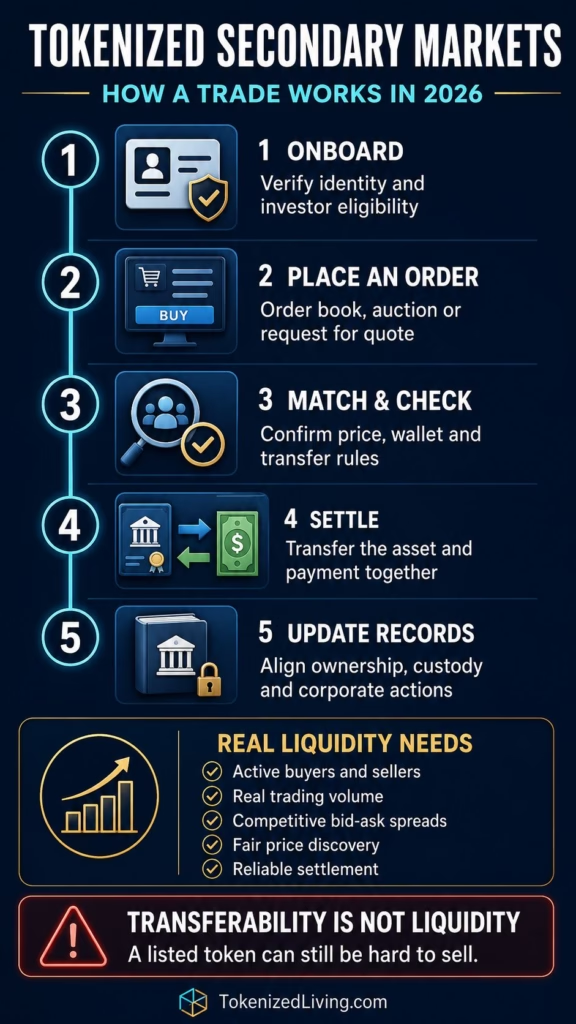
4. Secondary Markets Need Real Buyers
Creating a token is easy. Creating a liquid market is not.
A secondary-market button does not guarantee an exit. Liquidity depends on active buyers, fair pricing, transfer eligibility and enough market depth to absorb sales.
This problem becomes more severe with unique assets such as individual properties, artworks or private loans.
5. Tokenization Must Beat Existing Systems
Financial institutions will not replace established infrastructure because blockchain sounds modern.
The new system must reduce costs, accelerate settlement, improve collateral use, reach new investors or create useful products. Otherwise, firms have little reason to accept the operational and regulatory burden of migration.
That is why tokenized collateral and funds currently look more convincing than many consumer-facing experiments. Their potential savings are easier to measure.
What Could Stop Tokenized RWAs Reaching Trillions?
Furthermore, the market faces more than technical growing pains.
The Financial Stability Board has identified potential vulnerabilities involving liquidity, leverage, asset quality, interconnectedness and operational fragility.
Several obstacles could slow adoption:
- conflicting regulations across countries
- weak links between tokens and legal ownership
- unreliable custody or asset verification
- thin secondary-market trading
- dependence on a small number of issuers and technology providers
- smart-contract, oracle and cybersecurity failures
- fragmented blockchains and incompatible standards
- limited investor demand outside short-term yield products
Moreover, tokenization can move transactions faster without removing financial risk.
A bad loan can default on a blockchain. An overvalued building can still lose money. A dishonest issuer can misrepresent reserves. Faster settlement may even spread problems more quickly when systems become deeply connected.
Technology changes the rails. It does not repeal economics or law.
What the Trillion-Dollar Forecasts Mean for Investors
Even so, the growth of the wider market does not guarantee returns from an individual token.
Investors should ignore the size of the forecast until they can answer more basic questions:
- What does the token legally represent?
- Who owns or holds the underlying asset?
- Which regulator and jurisdiction apply?
- How is the asset valued and audited?
- Can the token be redeemed or sold?
- Who provides custody and administration?
- What fees reduce the investment return?
- What happens if the issuer, platform or borrower fails?
Market growth may produce better products, stronger infrastructure and more choice. It will also attract weak projects that use “RWA” as a marketing label.
Therefore, investors should judge the legal claim and underlying asset before the blockchain brand.
Our guide on how to buy tokenized assets covers the practical checks to complete before funding an account or connecting a wallet.
Final Verdict: Trillions Are Possible, but the Path Is Narrow
Tokenized real-world assets have moved beyond the experimental stage.
The market now includes regulated funds, government-debt products, credit, commodities, equities and real estate structures. Moreover, some banks, asset managers and market-infrastructure providers are running live systems rather than publishing only theoretical pilots.
That progress supports the case for a multitrillion-dollar market.
However, the largest forecasts depend on rapid adoption, clearer regulation, trusted settlement money and compatible infrastructure. They also rely on definitions that extend well beyond freely tradable tokens held in ordinary crypto wallets.
McKinsey’s $2 trillion base case may prove too cautious. Ripple and BCG’s $9.4 trillion estimate may prove too optimistic. Citi’s $5.5 trillion forecast sits between them.
Nobody knows which number will be right.
The more reliable conclusion is simpler.
Tokenization will probably grow fastest where it solves an expensive financial problem. Treasuries, funds, collateral and securities settlement already show that logic. Real estate and other illiquid assets may follow, but legal complexity and weak secondary markets will slow them down.
The sector does not need every asset to move on-chain to become enormous.
It does need the assets that move on-chain to carry enforceable rights, credible backing and genuine economic use.
Without those foundations, “trillions” is only a headline.
Frequently Asked Questions
Will tokenized real-world assets reach trillions by 2030?
They could. McKinsey, Citi, and Ripple with BCG all forecast a multitrillion-dollar market by 2030. However, their estimates range from roughly $2 trillion to $9.4 trillion because they use different definitions and assumptions. These are scenarios rather than guarantees.
How large is the tokenized RWA market now?
RWA.xyz displayed about $38.3 billion in distributed tokenized assets and $353.1 billion in represented assets on August 26, 2026. Distributed assets can move between eligible external wallets. Represented assets remain inside controlled platforms and mainly use blockchain for recordkeeping or operational processes.
Why do RWA market forecasts vary so widely?
Some forecasts include stablecoins, deposits, closed-platform assets or wider financial instruments. Others exclude them. Reports also measure different things, including token market capitalization, assets under management and the value of underlying assets recorded on-chain.
Which tokenized assets are growing fastest?
Tokenized Treasuries, money market funds, credit products and commodities have shown clear traction. Public equities and collateral may drive the next phase because they already have established legal structures, pricing and institutional demand.
Does an RWA token give me ownership of a real asset?
Not necessarily. A token may represent a fund share, debt claim, company interest, redemption right or contractual exposure. Some cryptocurrencies called RWA tokens are only governance or utility tokens and provide no claim on an underlying real-world asset.
Are stablecoins real-world assets?
Stablecoins represent or reference fiat currency and often support RWA settlement. However, market reports frequently track them separately to avoid double counting. Always check whether a forecast includes or excludes them.
Will tokenization make illiquid assets easy to sell?
No. Tokenization can simplify transfers, but it cannot create buyer demand. Property, private credit, art and other unique assets may remain difficult to sell even when a platform offers a secondary marketplace.
Editorial note: This article provides general educational information and does not constitute financial, legal or tax advice. Market values change frequently, and long-term forecasts can differ significantly from actual results.