

Updated September 10, 2026
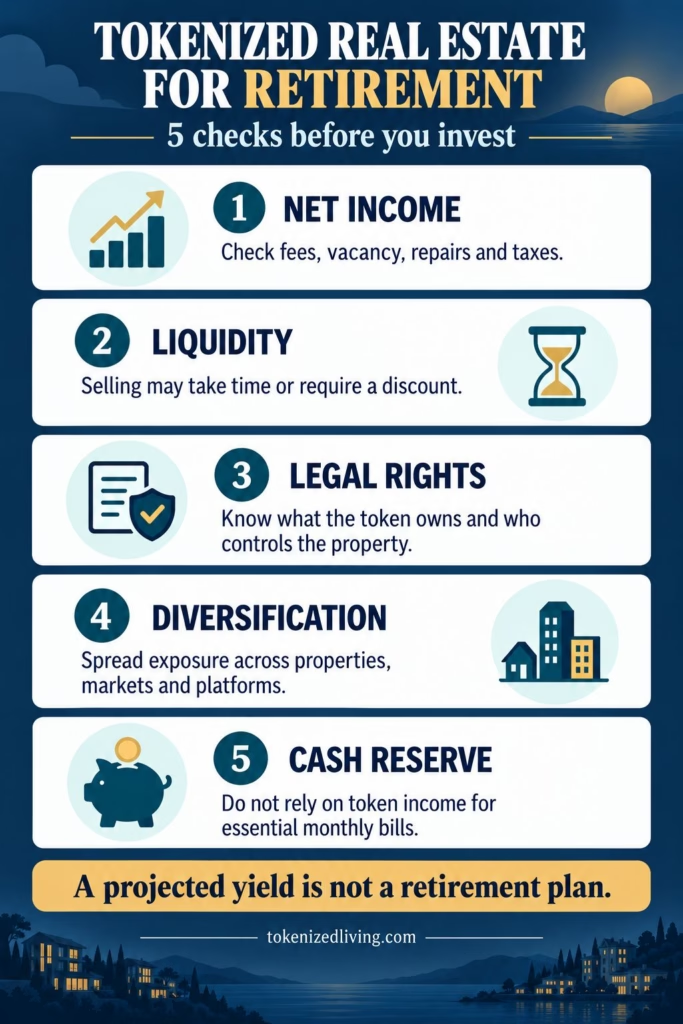
A tokenized real estate retirement portfolio needs a plan for missed payments, unexpected costs and delayed exits. Small investment amounts and frequent distributions can help, but they don’t make property income dependable.
Tokenization allows investors to hold digital interests linked to property. Depending on the offering, those interests may represent company shares, debt or registered fractional ownership. The contract determines the rights behind the token.
For retirement planning, the central question is practical: could you still cover your expenses if this investment stopped paying and you could not sell it?
This guide explains how to assess that risk, compare alternatives and decide whether tokenized property deserves a place in your wider portfolio.
TL;DR
- Treat tokenized property as an investment that can lose capital and become difficult to sell.
- Separate essential spending from income that depends on property performance and platform operations.
- Compare net distributions, total costs and exit terms rather than advertised yields alone.
- Check the underlying issuer, legal rights and arrangements if the platform fails.
- Assess retirement-account eligibility separately from the decision to invest for retirement.
- A zero allocation can be a sensible outcome. There is no requirement to include tokenized property.
What Does Tokenized Real Estate Add to Retirement Investing?
The main attraction is access to individual property investments without buying an entire building. Smaller units can make it easier to spread a fixed budget across selected assets. A manager may also handle tenants and maintenance.
However, access and suitability are separate questions. A convenient way to buy an investment tells you little about its quality.
The underlying model also matters. A loan financing construction has different repayment risks from shares in a company holding an occupied apartment building. Neither should automatically be described as a reliable source of rent.
Our complete guide to tokenized real estate explains the main structures and how tokens connect to investment rights.
For retirement purposes, evaluate the property exposure first. Then examine whether the digital platform improves administration enough to justify its costs and additional risks.
Saving for Retirement and Living on Investments Are Different
Someone with employment income may be able to leave an investment untouched during a difficult period. A retiree drawing money for living costs has less room to wait.
That difference should shape both investment selection and the amount committed. The SEC’s asset allocation guidance explains why time horizon and risk tolerance affect portfolio choices.
| Retirement stage | Main planning question | Tokenized property consideration |
|---|---|---|
| Building savings | Can I tolerate losses and a long holding period? | Reinvestment may suit the goal, but increases exposure to the selected assets. |
| Approaching retirement | Will I need this capital when work income ends? | A planned property sale may take longer than expected. |
| Drawing retirement income | How will I replace missed distributions? | Spending needs continue even when the investment stops paying. |
A long horizon does not make a weak investment safe. Equally, reaching retirement does not mean every asset must become cash. The relevant issue is how each holding supports the overall plan.
Start With the Retirement Spending Gap
Before considering a property token, estimate the gap between spending and income you can reasonably rely on.
Include housing, food, healthcare, insurance and irregular expenses. Then consider pensions, benefits or other income, including their conditions and inflation protection.
For example, suppose essential spending is $2,000 a month and dependable income covers $1,600. The remaining $400 must come from savings or other investments.
If projected token distributions are the only way to meet that gap, the plan depends heavily on uninterrupted payments. A more resilient approach identifies another source before investing.
The appropriate reserve depends on your circumstances. Rather than assuming one buffer suits everyone, test how long available cash and other liquid holdings could cover a shortfall.
Rental Yield Is Not the Same as Spendable Income
A property can collect rent while distributing little to investors. Management fees, insurance, repairs, taxes and debt payments can absorb the cash.
Reserves may also need replenishing. Therefore, a higher distribution today can leave less protection against tomorrow’s repair bill.
Before counting an investment toward retirement income, establish:
- What funds the payment: operating income, borrowing, asset sales or returned capital?
- Which expenses the advertised yield already includes.
- Whether payments depend on a forecast, a contract or actual cash collected.
- How much remains after personal taxes and currency conversion.
Compare annual statements with the amount that reaches your bank. Daily accounting or monthly distributions describe timing; they do not prove profitability.
Our guide to passive income through tokenization examines the cash flows behind different investment models.
A Simple Income Interruption Test
Consider a hypothetical $30,000 investment expected to distribute 8% annually after property and platform costs, before personal taxes. That equals $2,400 a year, or $200 a month on average.
| Illustrative outcome | Annual distributions | Shortfall against the projection |
|---|---|---|
| Payments match expectations | $2,400 | $0 |
| Six months of payments are missed and not recovered that year | $1,200 | $1,200 |
| No distributions for twelve months | $0 | $2,400 |
These are stress scenarios, not forecasts or suggested returns. They assume the missed payments do not arrive later within the same year.
The planning task is to identify how you would fund the shortfall. Selling the investment may be impossible precisely when its income disappoints.
Liquidity Matters When You Need to Withdraw
An investment is useful for spending only when you can access money from it. A token balance and an estimated property value cannot pay a household bill.
Secondary markets can provide an exit opportunity, but they still need eligible buyers. Lock-in periods, trading windows and minimum prices may further limit your options.
Consequently, plan for a longer holding period than the platform’s most optimistic selling example. Check the actual bid and charges before treating an investment as readily available capital.
Our explanation of tokenized asset secondary markets distinguishes transferring a token from finding a buyer.
What a Discounted Exit Can Cost
Using the same hypothetical $30,000 starting investment, assume a buyer offers 20% less than you paid. The sale price is $24,000.
A 3% selling charge deducts another $720, leaving $23,280. That is $6,720 below the original investment, before considering any income received, purchase costs or taxes.
The example does not predict a particular platform’s performance. It shows why a retirement plan should include the possible cost of raising money early.
Why the Order of Returns Matters
Losses can be especially damaging when withdrawals force you to sell investments during a downturn. You then have less capital available for a later recovery. This is commonly called sequence-of-returns risk.
Consider a separate, simplified portfolio starting with $100,000. Assume a $10,000 withdrawal at each year-end, after that year’s investment return.
| Return order | Balance after year one and withdrawal | Balance after year two and withdrawal |
|---|---|---|
| Down 20%, then up 25% | $70,000 | $77,500 |
| Up 25%, then down 20% | $115,000 | $82,000 |
Both paths contain the same two returns. Without withdrawals, both would finish at $100,000. With withdrawals, the early loss leaves the first portfolio $4,500 behind.
This arithmetic illustration excludes fees and taxes and assumes withdrawals can be completed. Illiquid property investments introduce an additional problem: the required sale may not happen at all.

Diversify the Risks Behind the Tokens
Ten tokens do not necessarily represent ten independent investments. They might share one development, borrower, manager or local rental market.
Map the underlying exposures before adding another holding. Also count property you already own and real estate exposure inside other funds.
Consider concentration across:
- Individual properties and developments.
- Issuers, borrowers and property managers.
- Cities, tenant types and economic sectors.
- Platforms, custodians and payment systems.
- Currencies and legal jurisdictions.
Using another platform may spread some operational risk while adding new administration and custody demands. Similarly, buying abroad adds another market, but also introduces unfamiliar contracts and currency exposure.
Diversification can reduce concentration. It cannot guarantee protection from a broad property downturn.
Compare Tokenized Property With Other Real Estate Options
| Investment route | Access to capital | Main retirement trade-off |
|---|---|---|
| Publicly traded REITs or REIT ETFs | Exchange trading during market hours, at prevailing prices | Easier trading, but prices and distributions can fall. |
| Direct rental property | Usually requires a property sale or refinancing | More control, alongside management work and large individual commitments. |
| Non-traded REITs and private property funds | Restrictions depend on the product | Professional management can come with limited redemption and valuation transparency. |
| Tokenized property investments | Depends on the offering and available buyers | Smaller units and asset selection, alongside legal, platform and liquidity risks. |
The distinction between listed and non-traded REITs is essential. The SEC’s REIT guide warns that non-traded REITs may be difficult to sell and value.
Avoid assigning a universal retirement score to any category. Compare the actual investment, its costs and the job it needs to perform in your plan.
Platform Examples and Their Retirement Implications
Platform features are useful examples of investment design. They do not establish that a platform is suitable for retirement savings.
Lofty and Individual Property Selection
Lofty’s model gives investors membership interests in property-owning LLCs and access to individual listings. Frequent income distributions may help with administration, but the underlying cash flow still depends on the property.
For retirement planning, examine expenses, any borrowing and buyer demand before relying on an exit. Our Lofty review covers ownership, income and trading risks.
Reental and Project Payment Schedules
Reental includes different legal structures and property strategies. Some projects make periodic payments, while others target a return at completion.
A final payment after a development project ends serves a different purpose from ongoing retirement income. The Reental review explains the contractual and payment distinctions.
Binaryx and Overseas Project Risk
Binaryx offers rental and construction opportunities connected to overseas property arrangements. Construction exposure adds completion risk, while rental performance depends on local operations and demand.
Eligibility matters too: its published rules exclude US citizens. Read our Binaryx review before treating a listing as an available investment option.
For other models and current access conditions, use our tokenized real estate platform comparison.
RealT and Interrupted Income
RealT provides a distressed-platform case study. Reported liquidation plans and court oversight of its Detroit portfolio undermine its earlier presentation as a straightforward retirement-income option.
Our RealT Detroit update explains the reported developments and unresolved recovery questions.
The retirement lesson is practical: legal interests can continue to exist while income and access to capital deteriorate. A portfolio needs a response to both problems.
Investing for Retirement Is Different From Using a Retirement Account
Buying property tokens through a personal account does not automatically give them retirement-account tax treatment.
For US readers, some self-directed IRAs allow alternative assets. However, the custodian’s acceptance of an investment does not mean it has assessed its quality or verified the promoter’s claims.
The SEC, FINRA and NASAA’s self-directed IRA warning highlights limited liquidity, higher fees and complex tax rules. Restricted assets can also complicate required distributions.
Before using retirement-account money, confirm the proposed investment and ownership arrangement with the custodian and a qualified tax adviser. Ask about reporting, valuations, withdrawals and applicable transaction restrictions.
Readers outside the US should assess their own pension and tax rules. A platform’s international availability does not establish local tax eligibility.
Plan for Inflation, Currency and Access Problems
Protect Purchasing Power
Retirement spending can rise even when distributions remain unchanged. Do not assume rents will increase at the same pace as your living costs.
For illustration, $200 received in ten years has purchasing power of about $149 today if inflation averages 3%. That calculation assumes constant inflation and uses $200 divided by 1.03 to the power of ten.
Compare projected income with future expenses, rather than judging success from a rising account balance alone.
Match Income With Spending Currency
Income paid in dollars may buy less in your home currency after an exchange-rate move. Conversion charges can further reduce the amount received.
If payments use a stablecoin, evaluate the payment token and conversion route separately. A dollar peg does not remove the risks of the property, issuer or wallet.
Prepare for Incapacity and Inheritance
Keep ownership agreements, issuer details and platform contacts in an organised record. Establish how an authorised representative could manage the investment if you could no longer do so.
For self-custody, arrange secure recovery instructions. Avoid placing secret recovery phrases in ordinary emails or shared documents.
Legal authority and technical access are separate requirements. Your estate plan should address both without exposing the account while you are alive.
A Practical Retirement Suitability Check
Before investing, answer these questions in writing:
- What legal claim am I buying, and who owes me money or holds the property?
- Could I cover essential expenses without these distributions for a year?
- Can I tolerate a longer holding period and a permanent loss of capital?
- What would I receive after fees, taxes and currency conversion?
- How much exposure do I already have to this property market and these operators?
- Who continues operations if the platform fails, and how can I prove my rights?
There is no universal percentage that makes tokenized property appropriate. The allocation should follow your loss capacity, liquidity needs and understanding of the investment.
If the investment’s failure would jeopardise essential spending, reduce the proposed commitment or leave it out. A retirement portfolio does not need every available asset type.
Frequently Asked Questions
Is Tokenized Real Estate Suitable for Retirement?
It may suit some investors as a limited part of a wider plan. Suitability depends on the offering, legal rights, finances and ability to tolerate losses or delayed access. It is not a necessary retirement holding.
Can Property Tokens Provide Monthly Retirement Income?
Some investments make monthly distributions. However, payments may fall or stop because of vacancies, costs, project delays or operational problems. Assess the payment source and your backup plan.
How Much Should I Invest?
There is no evidence-based allocation that fits everyone. Start with the amount you could leave invested longer than expected and afford to lose without compromising essential needs.
Does Tokenization Make Real Estate Liquid?
It can simplify transfers, but selling still depends on legal restrictions and buyers. A marketplace does not provide an unconditional right to withdraw your capital.
Are Tokenized Properties Better Than REITs?
Neither category is automatically better. Publicly traded REITs offer a different trading and ownership model from individual property tokens. Compare diversification, costs, access and the specific risks involved.
Conclusion
A tokenized real estate retirement portfolio should begin with spending needs and the ability to withstand setbacks. Property selection, legal rights and net cash flow deserve more weight than payment frequency or token technology.
If an offering fits those requirements, it may merit further research. If it depends on uninterrupted income or an easy resale to work, the retirement plan needs strengthening before committing any money.
This article provides general education, not personalised investment, legal or tax advice.
Tokenized Real Estate vs REITs vs Direct Property (Retirement Comparison)
Tokenized Real Estate
REITs
Direct Property
Notes: This is an educational comparison. Liquidity, FX, and one-off transaction costs vary widely by country and platform.